
Brand investment: make the case to finance and track its value

Brand investment earns finance’s support when it is tied to business growth and measured over a timeframe that reflects how brand effects build. The case for convincing finance to invest in long-term brand building should connect brand activity to indicators such as awareness, branded search, customer acquisition and sales, alongside short-term campaign results. BCG research found that only one in 10 CMOs can assign a long-term financial value to brand equity, highlighting why a clear measurement plan matters.
It’s reasonable for finance leaders to ask how brand spending can contribute to revenue and when its impact may appear. A credible case does not ask them to choose between brand and performance marketing. It shows how each supports growth and how progress will be measured.
This article explains how to build an investment case around your organisation’s growth stage, choose useful measures and express brand impact in financial terms. It covers balancing near-term outcomes with longer-term indicators, setting measurement expectations and bringing finance into the discussion with evidence they can assess.
Table of Contents
How do I invest in brand at each stage of growth?
Connect brand investment to the growth challenge, then measure both current demand and signals of future sales. The right balance depends on your market, growth stage and evidence about what influences customers.
Measuring Brand Equity and Value
Brand equity is the value created by what customers know, feel and expect from a brand. It matters because finance needs to see how marketing builds an asset, not just generates immediate clicks. BCG research found that only one in 10 CMOs can assign long-term financial value to brand equity. Track awareness, consideration, preference and distinctiveness alongside commercial measures. Brand valuation can then connect these signals to future cash flows, pricing power or customer demand, with assumptions made explicit.
Tracking Brand Impact Over Time
Brand impact measurement tracks changes in customer perceptions and behaviour across a sustained period. A six-week campaign reaching 1,000 relevant people may build awareness and recall without producing measurable sales within that window. Use a consistent baseline and compare later results, rather than treating a short-term sales report as the full verdict. A MASB-sponsored project used an 18-month tracking study of over one hundred twenty brands, illustrating how longer observation can reveal patterns that campaign-level reporting misses.
Connecting Brand to Sales and Revenue
Connect brand measures to sales by testing how shifts in awareness, consideration and branded search relate to later demand. BCG describes First-Fast Response as four times more predictive of future sales than awareness alone. Track attributed branded searches alongside sales and conversion trends, while accounting for other activity and market changes. BCG research found that 67% of CMOs, compared with 40% of CFOs, were highly confident their marketing mix model reliably predicts future sales. That gap makes shared assumptions and model calibration important.
Balancing Brand Building and Performance Marketing
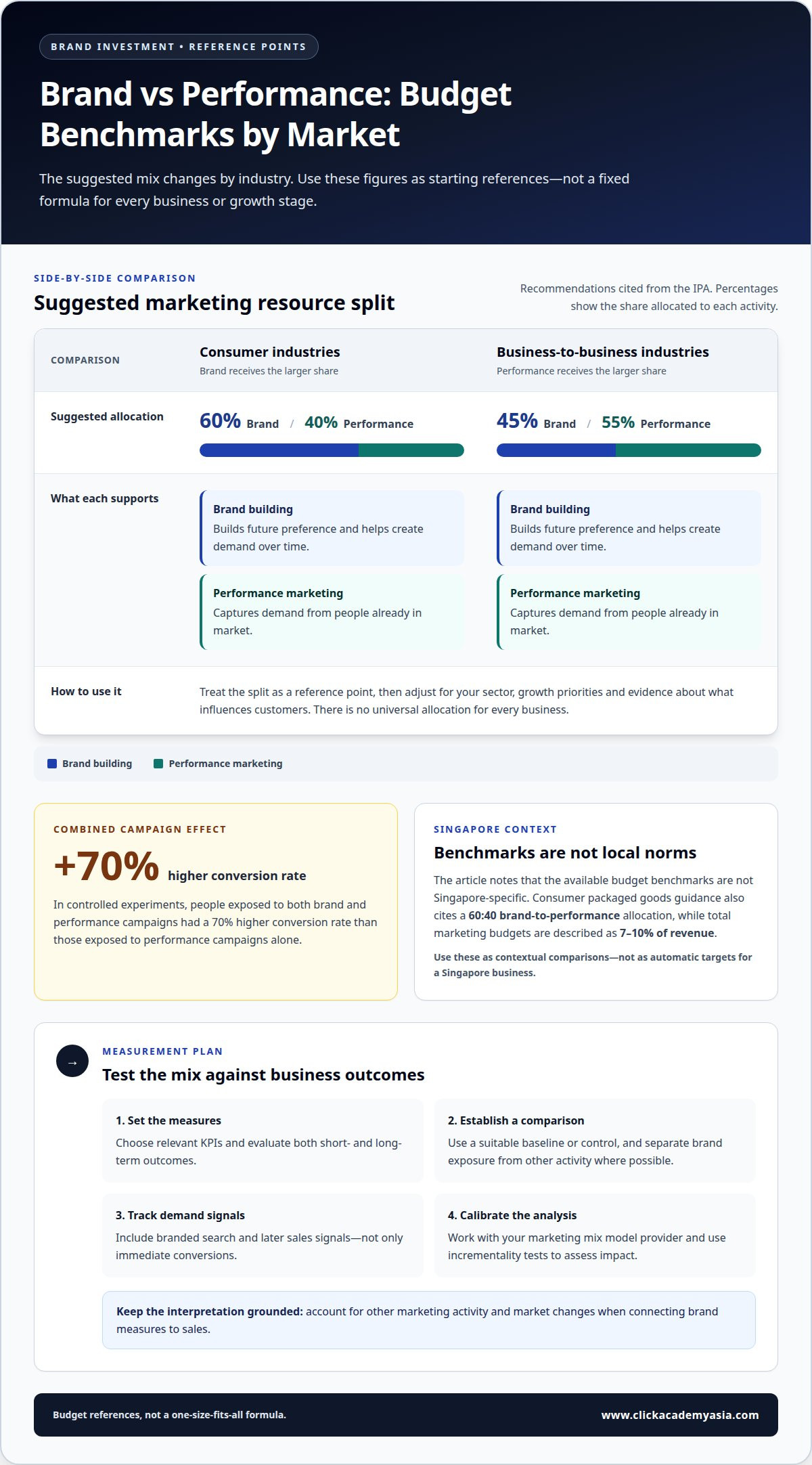
Brand building creates future preference; performance marketing captures demand already in market. There is no universal split for every sector or growth stage. The IPA recommends 60% of marketing resources for brand and 40% for performance in consumer industries, versus 45% and 55% respectively in business-to-business industries. These are reference points, not automatic targets. Controlled experiments found people exposed to both brand and performance campaigns had a 70% higher conversion rate than those exposed to performance campaigns alone.
For Singapore businesses, budget practice should reflect sector, growth priorities and the time needed to influence buyers. The available benchmarks are not Singapore-specific: consumer packaged goods guidance suggests a 60:40 brand-to-performance allocation, while total marketing budgets are described as 7-10% of revenue. Treat these as contextual comparisons, not local norms. Set a target share, then adjust it as evidence and business needs change.
To test impact, work with your marketing mix model provider to measure short- and long-term outcomes, select relevant KPIs and calibrate results with incrementality tests. Compare outcomes with a suitable control or baseline, and separate brand exposure from other campaign activity where possible. Include branded search and later sales signals, not just immediate conversions. One estimate links a 1% increase in brand awareness with a 0.4% increase in short-term sales and a 0.6% increase in long-term sales.
Brand investment and customer acquisition cost
A strong brand can make acquisition more efficient by helping potential customers recognise and trust a business before they enquire. One cited study found that 81% of B2B buyers would not consider providers whose brand was unfamiliar at the start of the process. This makes awareness and credibility relevant to acquisition, even when a brand campaign doesn’t produce an immediate conversion. Track the relationship between brand activity, qualified enquiries and acquisition cost over time.
Build a clear comparison for finance and other stakeholders. Establish a baseline for customer acquisition cost, then monitor it alongside branded search, lead quality and conversion rates as brand activity runs. Strong brands experience up to 26% lower customer acquisition costs than weak brands, according to the figures cited in the market research. This is a benchmark, not a forecast for an individual company. A scenario analysis also estimated a 10% reduction following budget reallocation. Model your own assumptions transparently, and show which changes would support or challenge the case. To ensure your team is equipped to evaluate these trends accurately, learning how to interpret performance data through ClickAcademy Asia Marketing Analytics & Insights courses can help bridge the gap between creative strategy and financial validation.
Public relations: Track coverage, message recall and relevant referral activity, rather than counting mentions alone.
Events: Record attendee engagement and subsequent enquiries to see whether experiences move target buyers closer to consideration.
Customer reviews: Monitor review themes and volume alongside conversion patterns, since customer evidence can help unfamiliar prospects assess risk.
Customer interviews add context to the data. Ask recent buyers how they first heard about the business, what made it credible and which alternatives they considered. Compare their answers with lost-deal feedback and search behaviour. If buyers repeatedly mention a review, event or distinctive message, that evidence can guide marketing investment. It can also help separate brand effects from a temporary offer or a change in sales follow-up. For deeper tracking across digital touchpoints, implementing structured measurement frameworks taught in ClickAcademy Asia Google Analytics (GA4) Training ensures you capture the full customer journey.
Acquisition is only part of the value. It costs 5× more to acquire a new customer than to retain one, according to a cited market figure. Connect brand measures with repeat business, customer retention and referrals, then examine whether loyalty strengthens as recognition and trust grow. This gives finance a fuller view than first-purchase cost alone. A useful report pairs acquisition trends with retention patterns and explains the period each measure covers.
One starting recommendation is to protect 15-30% of marketing budget for brand-building campaigns, then adjust against evidence and business priorities. Present that share as a testable allocation, not a universal rule. If you are ready to refine your financial models and want expert guidance on aligning your strategy with stakeholder expectations, contact ClickAcademy Asia to discuss brand investment and discover tailored pathways for your marketing team.
Customer loyalty and lifetime value
Brand investment can create business value by strengthening customer relationships that support repeat purchases and sustainable growth. To assess its contribution, connect brand measures to your business model’s value drivers, such as renewals, purchase frequency or pricing strength.
Brand Investment and Customer Lifetime Value
Customer lifetime value estimates the value of a customer relationship over its duration, while brand investment can influence loyalty and repeat behaviour. This connection matters because acquisition alone misses the value created after the first sale. A cited study found that a 5% increase in customer retention can boost profits by 25-95%. Track retention with repeat purchase or renewal patterns to see whether stronger loyalty accompanies brand investment.
Consider how your audience chooses and stays with a brand. Brand-loyal customers pay 38% more, while even price-sensitive loyal customers pay 14% more. These figures point to possible pricing power, not a guaranteed outcome for every company. Compare realised prices, repeat rates and customer segments to assess whether brand strength supports higher lifetime value in your market.
Brand ROI and Compounding Value
Brand ROI evaluates the contribution of brand investment across multiple customer and business outcomes, rather than one campaign’s immediate return. This matters because loyalty, preference and repeat business can accumulate over time. Consumers who connect emotionally with a brand can have customer lifetime value up to 306% higher than consumers who do not. Use that finding as a reason to track emotional connection alongside commercial indicators, not as a forecast.
Link investment to specific value drivers. A subscription business might examine renewals; a retailer might analyse repeat purchases and realised prices. Compare changes with the timing and reach of brand activity. This helps finance assess how brand value may build through customer behaviour, while distinguishing observed outcomes from assumptions in the ROI model.
Revenue Growth and Profitability Evidence
Evidence for long-term brand impact comes from sustained comparisons between brand strength and commercial performance. In a 14-year McKinsey study, top-ranked brands outperformed the world market by 74% in returning shareholders. This supports examining revenue, profitability and shareholder outcomes together, rather than relying on campaign clicks alone. It does not prove that brand investment caused every difference, so present the comparison alongside your organisation’s own results.
Shareholder measures offer another lens: Brand Finance’s study found that, between 2016 and 2025, the top 100 global brands achieved 21% higher shareholder yield, 22% higher return on equity and 20% higher operating margins on average than mega-cap peers in the MSCI World Index. For your business case, connect these indicators to relevant value drivers and explain the comparison period.
Limits of Short-Term Attribution
Short-term attribution assigns outcomes to measurable touchpoints within a limited reporting window. It can understate brand impact when awareness or trust influences later consideration, repeat purchases or referrals. A buyer may encounter brand activity before searching, clicking or purchasing through another channel. Treating the final click as the entire journey can miss earlier influence and give too much credit to the last recorded interaction.
Use short-term attribution to assess immediate campaign performance, not as the only test of long-term brand ROI. Pair it with customer retention, lifetime value and longer-term revenue trends. State which outcomes are directly observed and which are inferred. This gives finance a more balanced view of brand performance while making the limits of each measurement method clear.
Building an evidence-based business case for brand investment
A finance-ready case connects brand activity to a business priority, customer behaviour and financial outcome. When convincing finance to invest in long-term brand building, show how these connections will be tested instead of presenting an assumed return as fact.
Start with the decision at hand, such as entering a new market, supporting a premium position or increasing repeat purchases. Define the audience and the behaviour the investment aims to influence. For example, a market-entry proposal could test whether clearer brand messaging improves consideration among target buyers, then track changes in qualified enquiries and sales opportunities.
Separate evidence the business can observe from outcomes it needs to estimate. Record campaign activity, investment, audience, baseline and measurement window. Build conservative and stronger scenarios using your organisation’s data, and identify the assumptions behind each. This lets finance assess potential outcomes without confusing forecasts with results.
Choose measures that reflect the customer journey and commercial objective:
Recognition: Track whether the intended audience notices and recalls the brand message.
Consideration: Assess whether target buyers include the brand when evaluating options.
Commercial progress: Compare qualified enquiries, opportunities and revenue trends against the baseline.
Explain how each measure informs a decision. If recognition improves but qualified opportunities do not, review whether the message reaches the right audience and addresses a relevant need. If opportunities rise, examine sales progression and other factors that may have contributed. This makes the business case useful for budget decisions, rather than simply a report on campaign activity.
Leadership should agree in advance how the team will evaluate incremental impact. Where practical, set up a suitable comparison, such as a control group or matched audience, and account for changes in pricing, product availability and sales activity. A consistent method helps distinguish brand contribution from broader market movement. Explain the comparison’s limitations so stakeholders can interpret results responsibly.
A disciplined approach to convincing finance to invest in long-term brand building also sets decision points before spending begins. Specify what evidence would support continuing, adjusting or ending the activity, and who will review it. Keep the business case concise: objective, investment rationale, measures, assumptions and review criteria. This structure helps finance assess the proposal and gives marketing a practical framework for learning and improving future campaigns.
Communicating brand impact to financial stakeholders
Finance needs a clear link between brand activity, customer behaviour and business outcomes. For teams convincing finance to invest in long-term brand building, open with evidence investors recognise: 82% believe brand strength and name recognition are becoming more important to investment decisions.
Make the commercial pathway explicit. Show how an effort aims to increase mental availability, how that may influence consideration, and which revenue measures could move next. B2B brands with greater mental availability are 30% more likely to be shortlisted by buyers. Treat shortlisting as an intermediate signal, then compare it with qualified opportunities and competitive win rates.
Use a concise stakeholder scorecard that separates leading indicators from financial outcomes:
Brand signals: Measure awareness, recognition, trust and consideration among the target audience.
Buyer actions: Track branded search, shortlist rates, qualified enquiries and sales progression.
Business results: Report revenue, margins, retention and win rates against agreed periods.
Put each measure beside its business meaning. A rise in consideration can indicate stronger future demand, while a change in win rate may reflect several factors. Companies with strong brands saw an average 31% higher win rate in competitive deals. Present this as a market comparison, then show your own baseline and trend without claiming brand activity alone caused the result.
When convincing finance to invest in long-term brand building, make reporting useful to financial stakeholders. For each campaign, state its objective, audience, investment, measurement window and next review point. Separate observed results from estimates, and explain factors such as pricing changes or sales activity that could also affect revenue. This helps finance decide whether to maintain, adjust or scale the effort.
Invite finance into measurement design before launch. According to BCG research, 100% of surveyed CMOs and CFOs agree brands require ongoing nurturing to maintain strength. Agree on indicators, assumptions and review cadence together. Shared criteria prevent a short-term revenue report from becoming the only test of long-term brand value.
Keep the executive summary focused on the business objective, evidence so far, uncertainty and decision required. Consumers pay 11% more for trusted brands, showing how trust can influence pricing as well as preference. Pair that wider context with your own pricing and customer data, rather than treating a market figure as a forecast.
To strengthen the measurement skills behind stakeholder reporting, explore [Internal Link: ClickAcademy Asia Google Analytics (GA4) Training] and build a clearer view of campaign outcomes.
ClickAcademy Asia
ClickAcademy Asia helps professionals build the marketing skills needed to develop a clearer brand investment case. Its training is relevant when your team needs to connect strategic planning, campaign execution and measurement more effectively.
WSQ Digital Marketing Strategy & Planning helps teams align marketing priorities with business goals. WSQ Content Marketing Strategy helps marketers plan content around audience needs and brand objectives. For teams focused on digital channels, WSQ Search Engine Optimization (SEO) and WSQ Search Engine Marketing (SEM) develop capabilities in discoverability and paid search.
These programmes are a practical next step when your team needs stronger foundations to plan, deliver or evaluate marketing activity. Contact ClickAcademy Asia to discuss which training best fits your team’s learning needs.
Turn the business case into stronger team capability
A practical approach to convincing finance to invest in long-term brand building starts with the people who plan, execute and evaluate marketing. Help your team connect strategy with action and understand how marketing decisions support business priorities. That foundation keeps investment discussions focused on learning and progress, rather than only on the results of a single campaign.
ClickAcademy Asia offers WSQ Digital Marketing Strategy & Planning, WSQ Content Marketing Strategy and WSQ Search Engine Optimization (SEO). These programmes can help teams develop strategic planning, content development or search marketing capabilities. The right learning focus depends on the skills your team needs to put its brand priorities into practice.
Take the next step by identifying the capability gap your team wants to address. [Internal Link: Contact ClickAcademy Asia to discuss brand investment] and explore relevant learning options. With focused skills and a clear direction, your team can make its next marketing decisions with greater confidence.
Frequently Asked Questions
How can brand investment be linked to financial metrics such as revenue, margin, pricing power, and customer lifetime value?
Connect each brand objective to a financial measure through customer behaviour your business can observe. For example, if clearer positioning helps buyers understand a premium offer, track realised selling prices and gross margin alongside customer feedback. For recurring revenue, compare renewal patterns across customer groups with different levels of brand engagement. Keep comparisons consistent and account for changes in product, pricing or sales activity that could also explain the results.
How can finance teams calculate the ROI and payback period of brand-building investment?
Finance teams can estimate ROI by comparing the incremental financial contribution associated with an activity against its investment over an agreed measurement period. Define which revenue or margin changes count, subtract relevant costs and document how the analysis accounts for other influences. Payback occurs when cumulative attributable contribution offsets the investment. Use observed results where possible, clearly label modelled outcomes and show how assumptions affect the estimate.
Which leading indicators can measure brand-building effectiveness before sales results appear?
Track whether the target audience notices, remembers and understands the brand before expecting sales to change. Useful indicators include aided and unaided awareness, message recall, consideration, brand preference, share of branded search and direct traffic. For a campaign promoting a new service, for example, measure whether people recognise the offer and consider it. Compare results against a consistent baseline and the audience exposed to the activity.
How should a business build a finance-ready business case for long-term brand investment?
Start with a business priority, such as entering a market or supporting a premium position, then specify the customer behaviour the investment aims to influence. Present the planned activity, budget, measures, assumptions and review points in a single decision document. Include a baseline and scenarios showing how different outcomes affect the financial case. Ask finance to agree on definitions and evaluation criteria before launch, so later reviews assess the same outcomes.
What brand-building budget and measurement practices are common among Singapore businesses?
The available benchmarks are not Singapore-specific: consumer-industry guidance suggests a 60:40 brand-to-performance split, and CPG marketing budgets are described as 7-10% of revenue. Treat these as context, not local norms. For measurement, track branded search, lead quality, conversions and later sales against a baseline, using marketing mix models calibrated with incrementality tests.



Comments