
Agency negotiations: Set scope, fees and proposal terms

Strong agency negotiations begin by matching the proposal to your marketing goals, budget and in-house capabilities. Assess the work, deliverables, timelines and payment terms together, rather than as isolated line items. If the proposal exceeds your budget, discuss which parts of the scope can change before asking for a lower fee.
A proposal may look attractive on price while leaving key expectations unclear. You need to know what the agency will deliver, what your team must contribute and how the work supports your advertising plan. This guide explains how to assess proposals, align expectations, negotiate scope and terms, and balance agency fees with advertising budgets.
You’ll also learn how to compare retainer and project-based arrangements, clarify ownership and exclusions, and keep discussions focused on value. A structured approach helps you make an informed decision and build an agreement that gives both sides a workable basis for the relationship.
Table of Contents
Aligning expectations and agency capabilities
Start with a shared brief covering business goals, advertising budget, intended outcomes and the agency’s proposed work. When both parties are discussing the same requirements, capability gaps and trade-offs are easier to identify.
Industry Differences in Agency Negotiations
Industry differences matter because each sector brings distinct goals, constraints and success measures to discussions between an agency and a client. A lead-generation campaign, for example, needs different deliverables and performance measures from a brand-awareness campaign.
The agency’s relevant experience should match the proposed work, not just the client’s industry label. Ask how the team’s skills and planned activities connect to your brief and intended outcome. Use benchmarks to identify questions and align expectations, not as automatic rules for setting a fee.
Clarify capabilities before weighing a proposal. Identify your main requirements, the agency’s proposed approach and any work your team will handle. For example, if your team supplies campaign assets, state that responsibility clearly and specify what the agency still needs to produce. This helps distinguish a genuine capability gap from different assumptions.
Decide what you want to achieve before the meeting, and invite the agency to explain its priorities and constraints. Ask which work is likely to have the greatest effect, what information the agency needs and what could change if resources shift. Both parties bring strengths; a productive relationship makes them visible rather than assuming one side has all the answers.
In Singapore, put the scope, deliverables, timelines, payment terms and intellectual property ownership in the written agreement. Applicable rules can depend on the services and relationship, so ask legal advisers to assess the obligations relevant to your arrangement instead of relying on a generic template.
Steps in Agreement Negotiations
Agreement negotiations turn a proposal into clear, workable commitments. Start by agreeing on the brief and intended outcome, then review each deliverable, owner, deadline and payment term so both parties understand what they are accepting.
Discuss open questions, exclusions and dependencies before accepting the final wording. If a cost or requirement needs more thought, ask for time rather than agreeing prematurely. Record agreed changes, including ownership, in the contract so the signed document reflects the commercial discussion.
Common Risks and Disputes
Common disputes arise from mismatched expectations, unclear deliverables, missed dependencies or disagreements over ownership. If a proposal promises an outcome without defining the agency’s work and the client’s contribution, both parties may believe the other is responsible.
Agency relationships involving intermediaries can also carry risks: an intermediary may have different incentives, withhold information or misrepresent a principal’s priorities. Name decision-makers, document approvals and align incentives with the intended outcome. These steps make misunderstandings easier to spot before they disrupt the work or weaken the relationship.
Negotiating scope instead of requesting discounts
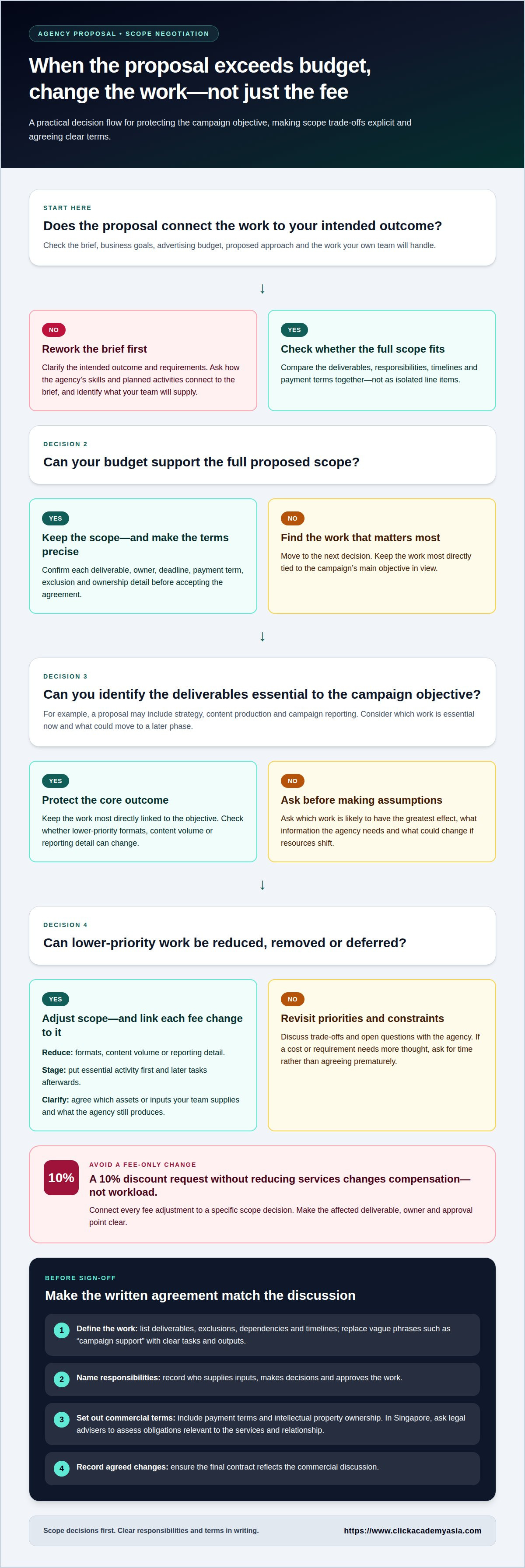
A fee reflects the work, expertise and resources included in a proposal. If your budget cannot support the full scope, adjust the work before negotiating the price. This keeps the discussion focused on priorities instead of asking the agency to deliver the same services for less.
To reach an agreement, both sides should explain their priorities, ask open-ended questions and explore trade-offs. For example, identify which deliverables support the campaign’s main objective, then discuss whether lower-priority work can be deferred or removed.
A request for a 10% discount without reducing the services changes the agency’s compensation, not the workload. Instead, connect every fee adjustment to a specific scope decision. If a proposal includes strategy, content production and campaign reporting, decide whether all three are essential now or whether one can move to a later phase.
Protect the core outcome: Keep the work most directly tied to the campaign objective.
Adjust deliverables: Reduce formats, content volume or reporting detail if those items are not priorities.
Change the sequence: Stage the work so essential activity comes first and later tasks follow when ready.
Clarify responsibilities: Agree which assets or inputs the client team will provide, and what the agency will still produce.
Make each trade-off explicit. If your team can supply approved product information, for instance, the proposal may need less research work. But do not assume that one task replaces another: specify the deliverable, owner and approval point affected by each change.
Benchmarks can prompt useful questions, such as whether the proposed reporting meets the campaign’s needs. They should guide discussion, not dictate an arbitrary fee. Ask how each workstream supports the objective, what depends on client input and what would change if the scope were reduced.
Record the revised scope in the proposal or agreement. Specify included deliverables, exclusions, timelines, payment terms and ownership of work. Phrases such as “campaign support” can mean different things, so replace them with clear descriptions of tasks and outputs. This gives both teams a practical reference when priorities shift.
Teams that need to strengthen their planning before reviewing campaign proposals can develop clearer priorities through WSQ Digital Marketing Strategy & Planning. Better-defined objectives make it easier to distinguish essential work from optional extras and negotiate scope constructively.
Keep negotiations focused on creating value, not forceful, top-down cost reductions. Avoid seeking discounts without reducing the included services or products. Lawyers can help with contract wording and legal outcomes, while commercial leads should stay involved in business decisions.
Retainer and project-based terms
Choose a payment structure that fits the work’s rhythm and scope. A retainer supports ongoing activity, while a project fee is based on agreed outputs and completion criteria.
Retainer Terms
A retainer is an ongoing arrangement for recurring agency work over an agreed period. It can suit continuous campaign management, content planning or regular optimisation when priorities may shift as performance data comes in.
Define the activities covered, expected availability, reporting, payment schedule and pricing for additional work. For example, specify whether the retainer includes campaign adjustments and routine reporting or only planned monthly deliverables. Clear boundaries help both teams forecast workload and prevent new requests from being treated as automatically included.
Project-Based Terms
A project-based agreement defines the work, deliverables and completion point. It can suit a one-off website campaign, a content production brief or a marketing audit with agreed outputs.
Describe each deliverable in practical terms, then set milestones, review rounds, dependencies and acceptance criteria. For a content project, name the formats and identify who supplies source material and approvals. State how changes to the brief affect timing and payment. These details help distinguish a new request from a correction to an agreed output.
Reviewing and Changing Agreements
Review an agreement by checking its commercial terms and operating clauses against the work required. In Singapore, the signed agreement is the practical reference for amendments and exit processes, so read its clauses on changes, renewal, notice, payment, handover and ownership.
To change an arrangement, document the revised scope, fee structure, dates and responsibilities, then have both parties approve the amendment in writing. To end the relationship, follow the agreement’s termination and notice process, and clarify outstanding payments, access, assets and work handover. Keep the signed agreement and amendments together.
Compare payment structures against the pattern of work, not just the headline fee. A retainer can provide continuity for recurring tasks; project pricing can make a finite assignment easier to define. A mixed arrangement may separate ongoing campaign management from a one-off creative project, provided the contract distinguishes each workstream.
Payment terms should state when invoices are due and which deliverables or period they cover. For hourly billing, agree how time is recorded and whether a cap applies; without one, costs may be harder to predict. For fixed project fees, specify milestone payments and what happens if client approvals or required inputs arrive late.
Review performance and workload at agreed intervals. If a retainer repeatedly absorbs new requests, identify whether priorities have changed or the original scope was too broad. If a project expands, record the additional output and its effect on delivery dates before work proceeds. Written change control gives agency and client leads a shared basis for decisions.
Finally, align incentives with the intended outcome. Performance-based terms can connect payment to results, but the agreement should define the measure, reporting source and each party’s responsibilities. Predetermined deliverables, assigned talent or value-based pricing each create different expectations, so state the basis clearly rather than leaving the fee model open to interpretation.
Balancing ad spend with agency or freelancer fees
Your campaign budget has two distinct parts: money spent placing ads and fees for managing or producing the work. Assess them together, but keep them separate in your budget. This makes it easier to see how much remains for media after accounting for strategy, management, creative production and reporting.
For a Google Ads proposal, map the full investment before discussing a fee. Use a simple worksheet: total campaign investment = media spend + agency or freelancer fee + agreed production costs. Then assess whether the proposed media allocation can support the campaign objective. If the fee takes too much of the available budget, discuss workload, channels or deliverables instead of treating media spend and professional work as interchangeable.
Compare proposals by value and responsibilities, not just fee. An agency may assign a team and cover planning, optimisation and reporting; a freelancer may focus on fewer tasks. Neither label tells you what is included. Ask who sets up campaigns, monitors performance, prepares creative assets and reports results. A written division of tasks shows whether a lower quote leaves more work with your team.
Use return on marketing investment (ROMI) to frame the commercial discussion. Agree on the outcomes that matter, the data to use and how the agency’s work contributes. For a lead-generation campaign, separate media spend from ad-management costs, then compare total investment with the value of qualified leads and resulting sales. This does not guarantee a particular return; it gives both parties a shared way to assess performance.
Before negotiations, the agency should prepare as a team so no one unintentionally gives away terms. If your budget is private or still being allocated, the agency should state its financial expectations and explain the proposed work. Ask open-ended questions such as, “Which activities are essential to reach this objective?” and “What would change if we adjusted the campaign plan?” These questions invite practical options rather than pressure.
Discuss exclusions early. Identify whether creative production, landing-page work, analytics setup or additional reporting is outside the quoted fee. For example, a campaign may need new assets before ads can run; clarify who supplies them and how the work affects the total investment. Apply the same discipline to freelancer arrangements by defining the task and agreeing on a limit for hourly billing.
Decide how you will review performance and adjust budget allocation. Set a reporting cadence, name the metrics and agree who can approve budget shifts. Treat benchmarks as prompts for discussion, not arbitrary fee rules. Separating media, fees and exclusions helps teams in Singapore negotiate a realistic plan and make informed trade-offs as campaign evidence develops.
What are common types of agency negotiations?
Agency discussions cover more than a single fee. They may involve a client and agency, two agencies forming a partnership, or an agency engaging an independent contractor. Each arrangement needs terms that match the parties’ roles and intended outcomes.
Client-agency commercial negotiations shape the working relationship. The parties may discuss campaign objectives, deliverables, timelines, payment terms and intellectual property ownership. For example, a client commissioning a content campaign needs to know which assets the agency will create and who owns the finished work. Specific terms help prevent conflicting assumptions once delivery begins.
Scope and service negotiations focus on what work is included and how priorities fit available resources. A client might ask an agency to phase a campaign rather than remove a key activity without adjusting the workload. Focus the discussion on trade-offs: which tasks can move, which remain essential and how each change affects delivery responsibilities.
Agency-to-agency partnerships can support referrals, white-label collaborations or joint work for shared clients. The agreement should specify who manages the client relationship, which agency delivers each service and how revenue is shared. A referral arrangement differs from a white-label project, where one agency may deliver work under another agency’s client-facing brand. Define roles upfront to reduce confusion about accountability.
Contractor negotiations arise when an agency engages an independent specialist. The agreement can specify payment, deadlines and ownership of deliverables. If a contractor produces campaign assets, define the output, review process and handover expectations. Clear terms help the agency coordinate the contractor’s work with its commitments to the client.
Clause and renewal discussions address how the relationship will operate over time. Parties may negotiate exclusivity, incentive models, confidentiality or the process for changing work. A renewal discussion, for instance, can revisit whether the original responsibilities still fit the client’s priorities. Commercial leads should stay involved in scope and business terms, while legal advisers can help with contract wording.
Across these negotiation types, identify the parties, their responsibilities and the intended outcome first. Then record decisions in the agreement, including client handling, payment, ownership and any conditions for collaboration. This gives each participant a practical reference when questions arise during delivery.
Marketing teams building stronger content plans can apply clearer objectives to agency collaborations through WSQ Content Marketing Strategy training. Use those planning skills to frame partnership discussions around the audience, content outcomes and each party’s contribution.
ClickAcademy Asia
ClickAcademy Asia helps professionals build the marketing knowledge to assess proposals, set clearer objectives and discuss agency deliverables with confidence. If your team needs stronger foundations in campaign planning, content strategy, SEO or paid search, relevant options include WSQ Digital Marketing Strategy & Planning, WSQ Content Marketing Strategy, WSQ Search Engine Optimization (SEO) and WSQ Search Engine Marketing (SEM).
Turn to structured training when gaps in strategic or channel expertise make it harder to assess an agency’s approach or align internal stakeholders. Contact ClickAcademy Asia to discuss which learning option fits your team’s needs.
Strengthen your judgement for the next agency partnership
Your next proposal is an opportunity to build shared understanding across marketing, finance and leadership. Equip your team to assess recommendations against business objectives and carry those decisions into campaign planning with greater confidence.
ClickAcademy Asia offers WSQ Digital Marketing Strategy & Planning, WSQ Content Marketing Strategy and WSQ Search Engine Optimization (SEO). These WSQ-funded training tracks can strengthen your team’s ability to evaluate agency recommendations and contribute confidently to agency negotiations.
Choose learning that reflects the capability your team wants to build, whether that means sharper planning, stronger content decisions or deeper search knowledge. Contact ClickAcademy Asia to discuss WSQ-funded training for your team and take a practical step towards more informed marketing decisions.
Frequently Asked Questions
How does this apply to receiving and negotiating proposals?
Use the proposal as a working document, not simply a price comparison. Check how its recommended activities connect to your business objective, then identify assumptions about approvals, data access and internal resources. For example, a proposal based on your team supplying product information should state what happens if that information arrives late. Send questions and requested changes together so the agency can respond to the full brief.
What does agency negotiation mean?
Agency negotiation is the discussion between an agency and a client to agree on the terms of their commercial relationship. It can cover service expectations, responsibilities, fees, timing and contract wording. For example, agency negotiations may establish who approves campaign changes or how the parties handle new requests. The aim is a workable agreement, not simply the lowest fee or the broadest service list.
What terms should be included in an agency contract?
Include terms that explain how the work will be delivered and managed: services, deliverables, responsibilities, timelines, payment arrangements, ownership of work, exclusions and the process for changing or ending the agreement. For a campaign, also define who approves creative, provides platform access and receives performance reports. Clear operational terms help both teams manage handovers and resolve disagreements using the same written reference.
How are agency commissions and fees negotiated in Singapore?
Clarify the pricing basis before negotiating fees: value, assigned talent, performance or specified deliverables. Ask what the fee covers, which costs are excluded and how any commission is calculated and reported. For performance-linked arrangements, define the measurement method, attribution window and responsibilities that affect results. Compare the proposed structure with the required work and outcomes, then record the agreed basis and payment terms in the contract.



Comments