
Agile marketing for enterprise teams: workflows and tools

Enterprise marketing becomes agile when customer signals can shape campaign decisions while there is still time to act. Agile marketing for enterprise teams uses data, short work cycles and regular feedback to adapt campaigns as customer needs and market conditions change.
That does not mean abandoning strategy or treating every task as urgent. It means breaking work into manageable pieces, bringing the right people together and learning from each piece. Agile content marketing makes this approach tangible: teams produce content, assess its performance and use what they learn to improve the next piece.
This article explains what agile means in a large marketing organisation, how it can strengthen customer responsiveness and cross-functional teamwork, and where Scrum, Kanban and workflow tools fit. The focus is practical: choosing a way of working that supports your team’s structure, priorities and content goals without adding process for its own sake.
Table of Contents
Benefits for customer responsiveness and teamwork
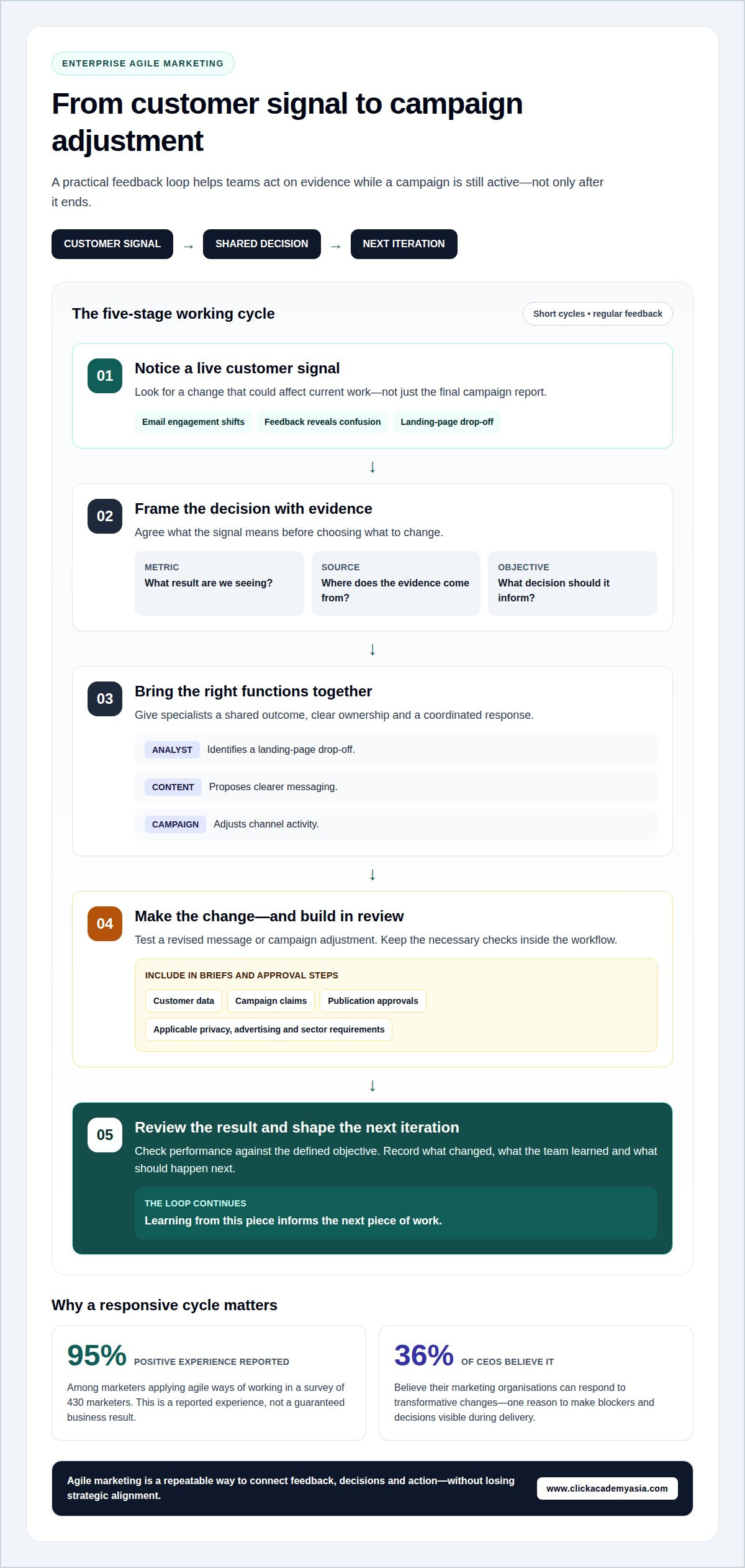
Agile marketing connects customer feedback to decisions while campaigns are still active. Teams work in short cycles, review evidence and adjust upcoming work instead of waiting for a campaign to end. For enterprise teams, this creates a practical link between strategy, execution and ongoing learning. The aim is not simply to move faster, but to focus effort on work that responds to customer needs and business priorities.
In Singapore, relevant practices include setting clear review points for customer data, campaign claims and publication approvals. Agile workflows should account for applicable privacy, advertising and sector requirements. Build those checks into briefs and approval steps so iteration does not bypass review or accountability.
The customer benefit comes from shortening the gap between a signal and a response. If email engagement shifts or customer feedback reveals confusion, the team can investigate, agree on a change and test a revised message. A continuous feedback loop makes adjustment part of normal work, rather than a post-campaign lesson that arrives too late to influence current activity.
The 2026 State of Agile Marketing Report surveyed 430 marketers, and 95% of marketers applying agile ways of working reported a very positive experience. That finding signals a positive experience among respondents, not a guaranteed business result. The opportunity for enterprise leaders is to make decision-making more responsive: only 36% of CEOs believe their marketing organisations can respond to transformative changes. Agile practices help teams surface blockers and act on evidence within the work cycle.
For customers: use feedback to refine content, channel choices or campaign messages while activity is live.
For teams: agree priorities and ownership at planning, then share progress and blockers during delivery.
For performance: review results against a defined objective and use the learning to shape the next iteration.
These practices also strengthen teamwork by making decisions visible. A shared priority gives creative, analytics and marketing colleagues a common outcome to pursue; regular reviews clarify what changed and why. AgileSherpas research found that 10% think their organisations are good at feeding customer insights back into operations. A team can address that gap by assigning an owner to each insight, recording the decision and checking whether the resulting action improved the customer experience.
Agile marketing works best as a repeatable operating practice, not a promise of instant growth. Start with a defined customer or campaign problem, connect feedback to the work and review the outcome before deciding what to do next. This discipline helps enterprise teams respond more effectively without losing strategic alignment.
Cross-functional collaboration
Enterprise agility depends on specialists working together toward a shared business outcome. Clear responsibilities, useful data and agreed approval steps turn collaboration into coordinated action.
Data-driven team decisions
Data-driven decisions help teams use shared evidence to set priorities, test ideas and improve work across functions. This matters because analysts, creatives and campaign leads may interpret the same result differently unless they agree on the decision it should inform.
For example, an analyst might identify a landing-page drop-off, while a content specialist proposes clearer messaging and a campaign manager adjusts channel activity. AgileSherpas research found that 46% of respondents said their organisations make data-based decisions. Teams can strengthen this practice by agreeing on the metric, its source and the decision it should inform before a review.
Cross-functional agile teams can also connect marketing activity to wider business outcomes. Forrester reports that these teams increase revenue growth by 25% and customer satisfaction by 30%. Treat these as reported findings, not automatic results: team structure, customer needs and execution all shape performance. Define one shared objective, then assign each function a contribution and review point.
Collaboration platforms and communication
Collaboration platforms bring project updates, working files and decisions into shared digital spaces. They are most useful when ownership and next steps are visible, especially when creative, analytics, product and development colleagues contribute asynchronously.
Use a project workspace to record the brief, task owner, approval status and decision history. Keep discussion channels focused on specific campaigns, and document final approvals beside the relevant asset. For example, a designer can flag a review blocker on the project board while the approver records the required change in the same workstream. This keeps feedback together and helps distributed teams maintain context.
Creative collaboration improves when teams distinguish useful review from late-stage preference changes. Define the audience, message, format and approval owner in the brief, then invite feedback against those criteria. A reviewer might assess brand fit, while a legal or compliance stakeholder reviews relevant claims. Set a clear way to resolve conflicting comments so revisions improve the work rather than reopen settled decisions.
Communication also needs a deliberate rhythm. A regular touchpoint with sales and customer experience colleagues can surface recurring objections, product questions or customer language. Feed those insights into creative briefs and campaign decisions, then share what changed with contributors. This closes the loop between customer-facing teams and marketing without turning every discussion into another approval meeting.
For teams building shared content processes, exploring ClickAcademy Asia content marketing strategy programs can strengthen planning and collaboration skills.
Kanban boards for marketing workflows
A Kanban board makes campaign work visible as tasks move through workflow stages. Teams can spot stalled work, competing priorities and hand-off delays before they disrupt delivery.
Tracking work on Kanban boards
A Kanban board is a visual workflow: each card represents a task, and each column represents a stage. A campaign board might move a landing page from “Brief” to “Draft”, “Review”, “Approved” and “Published”. Contributors can see ownership and progress without relying on separate status updates.
To make the board useful, define what “ready” and “done” mean at each stage. Add the task owner, due date, priority and required approvals. Limit work in progress so specialists can focus instead of starting new tasks whenever a request arrives. If several cards remain in “Review”, investigate whether feedback, capacity or unclear criteria are holding them up.
Kanban and Scrum workflows
Kanban organises work as a continuous flow, while Scrum groups selected work into time-bound sprints. Marketing teams can choose based on how predictable their work is: Kanban suits a changing queue of requests, while Scrum gives a campaign or launch a defined planning and review cycle.
A Scrum board can show sprint tasks under “To Do”, “In Progress” and “Done”, helping the team track its agreed work. Scrum development sprints generally last two weeks, a cadence marketing teams can adapt if it suits their planning. Unlike a continuously updated Kanban board, sprint work is selected during planning and reviewed at the cycle’s end.
Both methods support cross-functional collaboration, but neither replaces clear ownership. For a product launch, a content writer, designer, analyst and campaign lead might share one board. The writer moves copy to review, the designer flags a dependency, and the analyst prepares measurement. Visible hand-offs help colleagues address blockers while keeping the shared campaign outcome in view.
Use Kanban for ongoing requests, such as SEO updates, social content or email revisions.
Use Scrum when a coordinated campaign needs a selected scope and regular review.
Combine thoughtfully by managing ongoing work in Kanban and planning a distinct campaign in Scrum.
Tools such as Trello can help teams visualise task progress, while Slack can support work-related communication. Choose a tool that makes the workflow easy to understand, then establish one source of truth for task status. During reviews, discuss what moved, what is blocked and what the team learned. This routine keeps the board connected to campaign decisions instead of turning it into a static task list.
Selecting a tool based on agile maturity and team size
Choose tools that support how your marketing team works now, then scale them as needs evolve. Team structure, decision rights and reporting needs matter as much as features.
Software costs depend on configuration, number of users and integrations, as well as the scope and duration of any training or consulting. Compare these factors with the work the tool needs to support, rather than choosing on price alone.
For large organisations, agile marketing can improve visibility, coordination and responsiveness, but it may expose bottlenecks or meet resistance in hierarchical structures. To implement it, choose a focused marketing challenge, define ownership and measures, pilot a workflow, train participants, then review and adapt before expanding.
Team structures and scaling challenges
Marketing team structures evolve from a small group sharing tasks to specialist functions coordinating across campaigns. A foundation phase can cover organisations of 5-15 people, while a growth phase can cover 15-50 people.
As teams scale, role-based hand-offs can create bottlenecks when functions work at different speeds. An agile marketing team should have at least 3 members and no more than 9. Track campaign outcomes alongside workflow measures, such as work in progress, cycle time and unresolved blockers. Pair those indicators with team feedback to assess both delivery and team health.
Autonomous team models
The Spotify autonomous team model describes squads with room to organise their work while aligning with broader goals. Its appeal is faster local decision-making; its challenge is preserving coordination, shared standards and visibility across teams.
For comparison, ING Bank organised its transformation into 350 squads, each with nine people, and grouped them into 13 tribes. These figures illustrate one organisation’s structure, not a universal template. Enterprise leaders can define decision boundaries, shared priorities and escalation routes before adopting autonomous teams. That clarity lets team members act locally without fragmenting customer experience or campaign direction.
When choosing tools, start with the friction your marketing team needs to resolve. A team building basic agile practices may need a shared board, task owners and simple reporting. A more mature team may benefit from integrations connecting campaign delivery, analytics and approvals. In either case, keep the workflow understandable and avoid features that add administration without improving decisions.
Assess tools against practical criteria: can team members see priorities, identify blockers, share campaign status and learn from outcomes? Use meetings to resolve dependencies and improve processes, not to read information aloud when it is already visible in the system. Expand access and reporting as teams grow, while keeping ownership clear. A measured rollout helps leaders test whether a tool supports agility before adopting it across the organisation.
Agile content marketing
Agile content marketing produces, tests and improves content in short cycles. Rather than planning every detail of a long campaign upfront, teams release useful work, examine audience response and apply what they learn to the next piece. For an enterprise, this connects content decisions to customer needs while keeping activity aligned with business goals. The principles are straightforward: prioritise value, make progress visible and use evidence to guide improvement.
The case for shorter cycles is clear. Marketing ideas take over 8 months on average to reach execution, while agile teams can compress idea-to-market timing to less than 2 weeks. These figures describe different processes, not a guaranteed outcome for every organisation. The practical takeaway is to identify where approval queues, unclear briefs or hand-offs delay valuable content, then target one constraint at a time.
Start with a focused sprint addressing a specific audience need. For example, a financial services team could create a concise guide answering a recurring customer question, then track relevant engagement and follow-up enquiries. Set the audience, purpose, owner and success measure before production begins. Keep the first release small enough to review promptly, but complete enough to provide genuine value.
After publication, assess performance against the original objective. If readers leave before reaching the call to action, review the introduction, page structure and audience match before producing more content. If a particular section attracts meaningful engagement, develop a related follow-up. Adobe’s marketing team increased content effectiveness by 15% after adopting agile sprints, illustrating how structured iteration can improve content work.
Prioritise: select content according to customer needs and business relevance.
Produce: assign owners and approvals for a tightly scoped sprint.
Measure: choose indicators that show whether the content serves its intended audience.
Learn: record what worked, what underperformed and what the next iteration should change.
Short cycles also help teams manage changing priorities without discarding the broader strategy. A campaign can retain its core message while headlines, formats or supporting assets adapt to audience response. Teams may roll out batches of content within 48-72 hours, giving them a way to respond to emerging needs. Protect productivity by limiting each sprint’s scope and avoiding revisions that lack customer or performance evidence.
Make progress visible on a shared content calendar or workflow board, and review outcomes at the end of each sprint. A monthly editorial plan can set strategic themes, while shorter delivery cycles determine which assets are ready next. Teams can build practical skills for this approach through [Internal Link: ClickAcademy Asia Content Marketing Strategy].
ClickAcademy Asia: WSQ Digital Marketing Strategy & Planning
ClickAcademy Asia helps professionals build the strategic skills to plan and coordinate digital marketing. Its WSQ Digital Marketing Strategy & Planning course is relevant when your team needs a stronger foundation for aligning marketing goals, campaign priorities and performance measures.
For teams focused on content workflows, WSQ Content Marketing Strategy supports more structured planning and execution. Choose according to your priorities: strategy and planning for broader direction, or content marketing for planning and managing content activity.
Equip your team with practical digital marketing skills that support more informed planning and collaboration. Visit ClickAcademy Asia to learn more.
Build the capabilities that keep agility moving
A workflow becomes part of how an organisation operates when people can make sound decisions within it. Start by identifying the skills your team needs to plan, create and evaluate work together. For agile marketing for enterprise teams, that means building strategic judgement and the confidence to apply it across real campaigns.
ClickAcademy Asia offers WSQ Digital Marketing Strategy & Planning, WSQ Content Marketing Strategy and WSQ Search Engine Optimization (SEO). These courses support professionals strengthening marketing plans, content processes or organic search capability. Choose the area that best matches your team’s current priorities, then apply the learning to work already in progress.
Ready to equip your team with relevant digital marketing skills? Contact ClickAcademy Asia to discuss training and take a considered next step towards stronger, more adaptable marketing practice.
Frequently Asked Questions
What is Agile?
Agile is a way to make decisions and organise work when requirements can change. It describes values and principles, not one mandatory process or software platform. Agile is the underlying approach; Scrum and Kanban are ways teams can put parts of that approach into practice. This distinction lets leaders choose suitable practices instead of adopting a framework wholesale.
What is agile marketing and how does it work in enterprise teams?
Agile marketing applies adaptive ways of working to marketing decisions and delivery. In an enterprise, connect strategic priorities to a portfolio of campaigns, then make sure teams understand which objectives take precedence when requests compete. For example, a central marketing leader can set audience and brand guardrails while a market team adapts its channel mix to local customer behaviour. This preserves strategic direction without requiring every execution choice to sit centrally.
How should enterprise teams structure agile marketing roles, squads, and workflows?
Choose a structure that balances customer-facing ownership with specialist development. A matrix can pair initiative owners, who are accountable for outcomes, with functional groups that maintain expertise in analytics, creative or search. Communities of practice can share standards and lessons across initiatives without routing every decision through a central department. Make capacity allocation visible so specialists are not quietly committed to competing priorities.
Which agile marketing frameworks work best for enterprise teams: Scrum, Kanban, or hybrid?
Choose a method based on the shape of demand, not its popularity. For work with frequent interruptions, use a method that makes incoming requests and capacity conflicts visible. For a coordinated launch with defined deliverables, a time-boxed planning cycle can help teams synchronise dependencies. A hybrid can suit organisations with both patterns, provided leaders define how work moves between them and avoid duplicate status reporting.
What tools do enterprise agile marketing teams use for planning, collaboration, and reporting?
Look for capabilities that help teams manage enterprise complexity: role-based access, reusable campaign templates, consistent tagging and portfolio-level reporting. Integrations matter when campaign activity spans content systems, customer platforms and analytics environments. Shared naming conventions, for example, can help leaders compare campaign performance across business units. Before rollout, agree on data ownership and access rules; otherwise, even a capable platform may produce inconsistent or hard-to-interpret reports.
How do enterprise teams measure agile marketing performance and ROI?
Connect marketing activity to incremental business value, rather than counting outputs alone. A campaign may generate content assets and website visits, but its ROI depends on attributable value relative to the resources invested. Agree on the attribution approach before launch, including how assisted conversions will be treated. For longer buying cycles, compare cohorts or use a suitable holdout where practical to distinguish campaign contribution from activity that might have happened anyway.
What are common risks and challenges when scaling agile marketing across an enterprise?
A less visible risk is a mismatch between team incentives and shared outcomes. If each function is rewarded only for its own output, teams may optimise local targets at the expense of the customer journey. Shared outcome measures can reduce that tension, but leaders also need to resolve resource conflicts across portfolios. As the programme expands, review whether decision-making authority and specialist capacity are keeping pace with active initiatives.
How can enterprise marketing teams align agile practices with legal, compliance, brand, and approval requirements?
Use risk-based review paths rather than sending every asset through identical scrutiny. Routine updates using approved claims and templates may follow a lighter internal route, while new claims, sensitive audiences or unfamiliar channels can receive closer specialist review. Keep approved versions easy to identify, and retain records of material changes and decisions. In Singapore, map these controls to your organisation’s applicable legal, regulatory and sector obligations.



Comments