
Marketing Analytics in a Cookieless Future: Data and Methods

Cookie loss doesn’t mean advertising or measurement has to stop. Cookieless advertising uses approaches such as contextual targeting, consent-based first-party data and alternative measurement methods instead of relying on third-party cookies to follow people across websites. For marketing analytics in a cookieless future, the challenge is linking campaign activity to business outcomes when familiar tracking signals are missing.
If your reports no longer tell a clear story, you’re not alone: measurement is changing. The answer isn’t to find one perfect replacement for cookies, but to understand how different data sources and methods work together.
This article explains why marketing is moving away from third-party cookies, how first-party data and privacy-focused advertising work, and what changes in analytics and attribution. You’ll also see where measurement gaps can emerge and how to build a more resilient approach for your Singapore campaigns.
Table of Contents
First-party data collection
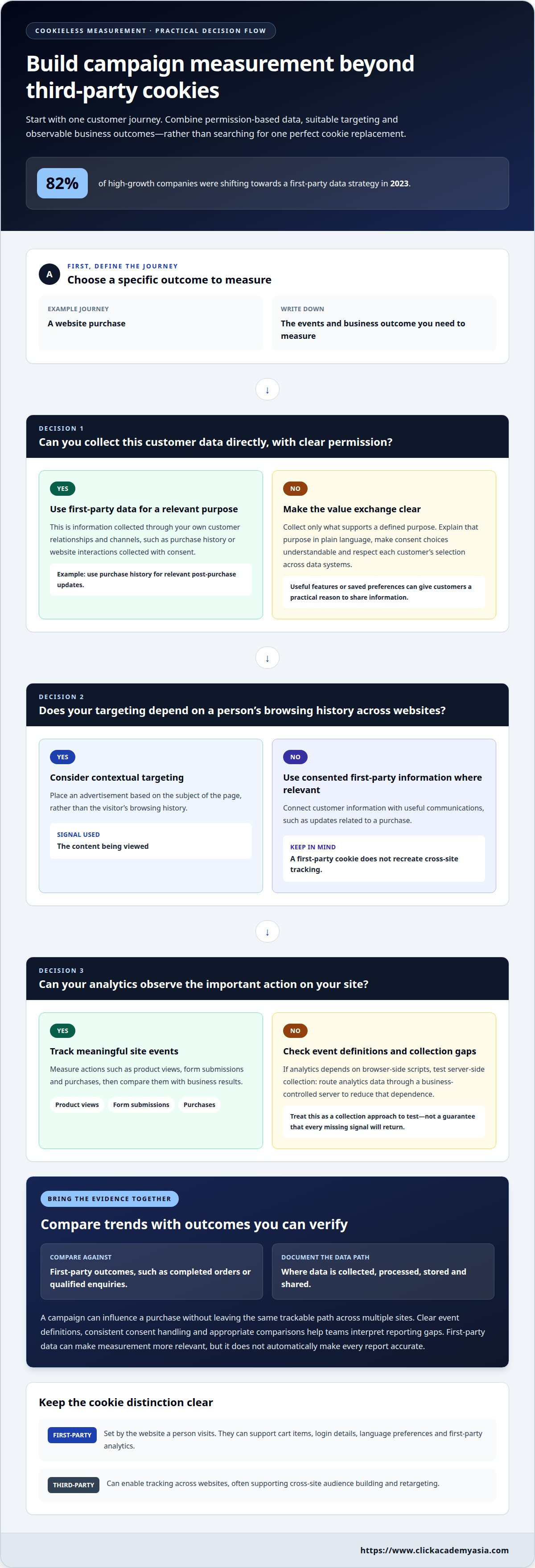
Prepare by mapping customer data, strengthening consent-based collection and testing how analytics reports change when third-party signals disappear. Start with a specific journey, such as a website purchase, and identify the events and business outcomes your team needs to measure.
First-party data is information a business collects directly through its own customer relationships and channels. Examples include email addresses, phone numbers, postal addresses, purchase history and website interactions collected with consent. A retailer, for instance, can use a customer’s purchase history to tailor relevant product updates.
First-party cookies are set by the website a person visits. They can support functions such as remembering cart items, login details or language preferences, and provide first-party analytics. Third-party cookies, by contrast, enable tracking across websites, often supporting cross-site audience building and retargeting. The distinction matters: retaining a first-party cookie does not recreate cross-site tracking.
In 2023, 82% of high-growth companies were shifting towards a first-party data strategy. That shift works best when the value exchange is clear. A useful account feature, saved preferences or relevant purchase information gives customers a practical reason to share data. Collect only what supports a defined purpose, then explain that purpose in plain language.
Privacy concerns make the collection experience part of the strategy. A consent choice should be understandable, and the business should respect the customer’s selection across its data systems. For Singapore campaigns, make consent practices and data handling part of the analytics design, rather than treating them as a separate communications task.
Without third-party cookies, marketers can combine several approaches instead of relying on a single replacement:
Use first-party data: connect consented customer information with relevant communications, such as post-purchase updates.
Choose contextual targeting: place an advertisement based on the page’s subject, rather than a visitor’s browsing history.
Measure site actions: track events such as product views, form submissions and purchases, then compare them with business results.
Test server-side collection: route analytics data through a business-controlled server to reduce dependence on browser-side scripts.
These strategies affect attribution. A campaign may influence a purchase without leaving the same trackable path across multiple sites. Compare campaign trends with first-party outcomes, such as completed orders or qualified enquiries, and document where data is collected, processed, stored and shared. This map helps teams interpret gaps and troubleshoot reporting.
First-party data can make measurement more relevant, but it does not automatically make every report accurate. Clear event definitions, consistent consent handling and appropriate comparisons help analysts distinguish genuine changes from missing signals. Start with one customer journey, agree on its key events and review the results before expanding the approach.
Why Are Marketing Strategies Increasingly Moving Away From Third-Party Cookies?
Privacy expectations, browser controls and consent choices have changed how marketers can observe activity across websites and apps. The shift affects audience targeting, retargeting and the evidence teams use to assess campaigns.
Privacy Rules and Browser Restrictions
Privacy rules and browser restrictions limit how organisations collect and use identifiers for cross-site advertising. The European Union’s GDPR and California’s CCPA and CPRA illustrate stronger expectations around personal data use. Marketers can’t assume every visitor is trackable or available for retargeting.
Browser policies have also changed over time. Apple introduced Intelligent Tracking Protection in Safari in 2017, while Google announced in July 2024 that Chrome would retain third-party cookies and introduce a user-choice experience. For planning, separate cookie availability from permission: a browser setting doesn’t replace a clear consent choice where one is required.
Alternative Identifiers and Tracking Methods
Alternative identifiers and tracking methods use signals other than third-party cookies to connect advertising with activity. Options include consent-based identifiers, first-party information, contextual targeting and data from publishers or advertising platforms. Unified ID 2.0, for example, uses encrypted, consent-based identifiers to support targeting and frequency capping across publishers.
Each method has different coverage and privacy implications. Device IDs or geographic signals may help analyse campaign delivery, while contextual targeting reaches people through the subject matter they’re viewing. Assess whether a signal is consented, relevant to the measurement goal and useful across your actual media mix.
Probabilistic Tracking and Machine Learning
Probabilistic tracking estimates whether separate interactions may belong to the same user, rather than relying on a persistent cookie identifier. Machine-learning models can analyse patterns across available signals, such as timing, campaign exposure and aggregated outcomes. This can help when deterministic links disappear, but an estimate should not be treated as a confirmed individual journey.
Fingerprinting creates identifiers from attributes such as an IP address, user agent and browser configuration. Its compliance under GDPR remains uncertain, so it is not a simple cookie replacement. Distinguish observed events from modelled estimates in reports, then use aggregated results to guide decisions rather than claiming exact person-level attribution.
Server-Side Tracking and Conversion APIs
Server-side tracking sends selected analytics information through a business’s server instead of relying solely on browser scripts. Conversion APIs similarly allow a platform to receive conversion events directly from a server. These methods can reduce dependence on client-side collection, but they don’t create consent or make every event eligible for measurement.
Before implementation, define which events matter, such as completed purchases or submitted enquiries, and apply consent choices consistently. Document where data is collected, processed, stored and shared. This helps teams assess gaps and troubleshoot reporting when browser-side signals differ from server records.
As a practical next step, map one customer journey and identify its consented events, platform signals and measurable outcomes. Build your marketing analytics skills through ClickAcademy Asia Sales/Marketing courses to assess these methods and make clearer campaign decisions.
Browser restrictions and privacy regulations
Browser policies and privacy expectations shape which signals marketers can collect and use across websites. For Singapore teams, the practical response is to plan measurement around consent, context and campaign outcomes, rather than assume every browser records the same activity.
Fingerprinting and Privacy Concerns
Browser fingerprinting creates an identifier from device and browser attributes, such as an IP address, user agent and browser configuration. It matters because these details can help distinguish a device even when cookies are unavailable.
That capability raises privacy concerns: people may not realise separate signals can be combined to recognise a device. The legality of fingerprinting under GDPR remains uncertain. Treat it cautiously in measurement plans, and distinguish observed, consented data from inferred identity signals.
For example, a report built from browser events should identify which signals were collected directly and which were inferred. This distinction helps marketing teams explain attribution choices to stakeholders without presenting a modelled device match as a confirmed individual journey.
Privacy-First Measurement and Attribution
Privacy-first measurement assesses campaign impact using aggregated results, consented data and tests, rather than a complete record of each person’s cross-site journey. This matters because browser restrictions can leave gaps between an advertisement and a later purchase.
Media mix modelling examines how channels relate to overall business outcomes over time. Incrementality testing compares results between exposed and suitable comparison groups to estimate the added impact of advertising. Use both: modelling to guide channel allocation, and tests to evaluate whether a campaign produced additional conversions.
Set the outcome before choosing a method. A brand assessing channel contribution needs consistent spend and sales data, while a campaign test needs a clear comparison design. Combining these approaches gives decision-makers different views of performance without depending on one complete user-level attribution path.
Privacy-Focused APIs
Privacy-focused APIs support advertising and measurement through defined browser functions, rather than unrestricted tracking across websites. Google introduced its Privacy Sandbox in August 2019 to develop advertising measures that did not rely on cross-site tracking.
The initiative announced six new Chrome APIs in July 2023. These APIs were designed to support functions such as advertising measurement and audience-related use cases. Their role matters because API-based approaches can change what data is available, how it is processed and what marketers can compare.
When planning, document which events an API can report and how its outputs differ from existing analytics. Test those outputs against business outcomes, rather than assuming a new interface reproduces cookie-based attribution exactly.
Cookie Regulations and Browser Changes
Cookie rules and browser policies affect how third-party tracking works, but there is no single phase-out date across major browsers. Safari and Firefox ended support for third-party cookies a year or more before Google’s change in direction.
On July 22, 2024, Google announced it would not deprecate third-party cookies in Chrome and would instead introduce a user-choice experience. This means marketers should plan for varied browser behaviour, not a universal cutoff. According to the European Union, GDPR has raised the bar for personal data use.
Keep browser availability separate from permission to collect data. A cookie may remain technically available while a person’s choice or a platform’s controls limit its use. Record consent status alongside campaign data, then assess reporting coverage by browser and channel to interpret differences responsibly.
Data clean rooms
A data clean room lets organisations compare or analyse datasets in a controlled environment. In 2023, one in three companies used data clean rooms extensively, and 87% expected to increase their use in the following year.
Privacy-Preserving Data Collaboration
A data clean room is a governed environment where participating organisations can analyse selected datasets without freely exchanging underlying customer records. It can help an advertiser and publisher understand campaign reach or outcomes while limiting what each party can access.
For example, a retailer could compare its customer segments with a media platform’s campaign exposure data. The analysis can reveal overlap or aggregated results, while access rules determine which queries and outputs are allowed. A clean room enables controlled collaboration; it does not replace sound data governance.
Consent-Aware Modeling and Aggregated Data
Consent-aware modelling uses data according to the permissions and purposes attached to it, while aggregated reports show group-level patterns rather than individual records. This allows analysis to be useful without exposing each customer’s activity.
Before a clean-room analysis, define the question, permitted inputs and minimum useful output. For instance, a campaign team might compare aggregated purchase activity across exposed and unexposed groups. Keep consent status and data provenance attached to inputs, and ensure reports do not imply certainty about individuals.
Social Media Data for Targeting
Social media data can help advertising platforms build or refine audiences using information available within their own environments. In a clean-room workflow, a brand might compare its consented customer segments with aggregated campaign results from a platform.
This can inform targeting and frequency decisions without giving the brand unrestricted access to platform user records. The practical value depends on the question: assessing audience overlap calls for different outputs than measuring campaign conversions. Define the question first, then determine whether the platform’s available data can answer it.
Data Quality and Analytics Reliability
Data quality is the consistency and usefulness of the information entering an analysis. A clean room cannot correct mismatched definitions, duplicated records or incomplete campaign events on its own.
For a reliable comparison, align key fields such as campaign dates, conversion definitions and audience criteria before analysis. If one platform counts a purchase differently from a retailer, the combined result can mislead. Document collection, processing, storage and sharing, then review aggregated outputs against business records.
Clean rooms are most useful when teams treat them as one of several measurement methods. Compare their aggregated findings with campaign tests and business outcomes, and record where platform data is no longer available or comparable. This helps marketing leaders understand the limits of an analysis and use its findings responsibly.
Analytics challenges after cookie deprecation
The toughest change isn’t simply losing a tracking signal. It’s keeping marketing decisions useful when reports show only part of the customer journey. Multi-touch attribution is no longer viable as a complete solution in a cookieless world, so teams need to combine observed behaviour, campaign tests and business results.
That shift can create gaps between platform reports and actual conversions. Some cookieless tracking solutions record behaviour for only 24 hours, limiting longer-term retargeting and journey analysis. A person may see an advertisement, return days later through another channel, then purchase. A report that cannot connect those events may understate the campaign’s contribution.
Google Analytics 4 offers a different reporting foundation: its event-based model records actions such as page views, clicks, purchases and scrolls. Define which events signal meaningful progress, then check that teams use consistent names and conversion rules. An event count describes an observed action; it does not, by itself, prove which advertisement caused the purchase.
Stakeholder access is another operational challenge. Nearly three-quarters of marketers said key stakeholders could not access the right data and insights. A marketing team might see campaign clicks while finance reviews completed sales. Aligning both teams around shared outcomes, such as qualified enquiries or completed orders, makes analysis more useful for decisions.
Build a measurement view from complementary methods rather than expecting one attribution report to answer every question:
Use platform analytics to review delivery and recorded actions, while noting which signals are limited.
Compare business outcomes against campaign periods, using consistent conversion definitions and sales records.
Run incrementality tests to assess whether advertising added conversions beyond the results expected without exposure.
Review the media mix alongside test findings, so channel decisions reflect both patterns and measured effects.
Grab’s digital marketing and CRM lead said opt-in data sharing reinforces the need for a tailored measurement strategy. Select methods based on available consented data, campaign objectives and the sales cycle, rather than forcing every channel into one model. If results diverge, investigate event definitions, reporting windows and missing signals before changing the budget.
As a practical next step, create a measurement map for one campaign: list its objective, events, conversion source, reporting window and decision owner. This helps teams identify what they can observe and where a test or aggregate analysis can add evidence. Strengthen your team’s ability to interpret these signals through [Internal Link: ClickAcademy Asia Sales/Marketing courses].
ClickAcademy Asia: WSQ Digital Marketing Strategy & Planning
ClickAcademy Asia helps professionals build the strategic foundation to plan digital campaigns and connect marketing activity with business objectives. Choose the WSQ Digital Marketing Strategy & Planning course when your team wants to sharpen its approach to channel selection, campaign priorities and performance measures.
For focused development, the WSQ Content Marketing Strategy, WSQ Search Engine Optimization (SEO) and WSQ Search Engine Marketing (SEM) courses cover related parts of the digital marketing mix. These areas can help marketers make more considered decisions about where to invest effort and how to evaluate results as tracking signals change.
To explore the training options, visit ClickAcademy Asia’s website.
Build a measurement practice that keeps improving
Strong marketing analytics in a cookieless future depends not on recreating every lost signal, but on making better decisions with the evidence available. Set a clear business question before choosing a platform or measurement method. Then assess whether your team can explain what the results show, what they cannot show and how those insights inform the next campaign.
Building that capability takes strategic thinking and practical skills. Give your team time to develop confidence in planning, interpreting data and applying insights to campaign decisions. A focused learning plan can help marketing professionals turn measurement challenges into better-informed action.
Build your team’s practical marketing capability through WSQ-funded training tracks. Explore [Internal Link: ClickAcademy Asia WSQ-funded training tracks] and choose a learning direction that supports your team’s goals. The right skills help your team adapt its approach and make purposeful decisions as measurement methods evolve.
Frequently Asked Questions
What Is Cookieless Advertising and How Does it Work?
Cookieless advertising reaches and measures audiences without depending on third-party cookies to follow people between websites. For example, a travel company could place an advert beside relevant destination content, then assess engagement using campaign and booking data. The approach can combine contextual placements, consented customer information and aggregated results. Each method offers a different view, so match measurement to the campaign objective.
Is cookieless tracking really legal?
Cookieless tracking isn’t automatically legal or illegal; the answer depends on what information is collected, why it is processed, how people are informed and which jurisdictions apply. Removing cookies does not remove privacy responsibilities when other identifiers or personal data are used. Replacing a cookie with a device-based identifier, for example, still calls for a clear assessment of purpose, transparency and appropriate permission where required.
Does “cookieless” mean no cookies at all?
No. “Cookieless” usually describes advertising or measurement that does not rely on third-party cookies, rather than a web experience with zero cookies. A website may still use first-party cookies to maintain a signed-in session or remember a selected language. For example, a returning customer’s saved basket may rely on the site’s own cookie even when cross-site advertising uses other approaches.
How Can You Target Audiences Without Cookies?
Marketers can reach audiences through contextual placements, consented customer lists, publisher partnerships and platform audience tools. A finance brand, for example, could place educational advertising beside personal-finance content, then compare engagement with qualified enquiries. Choose a method based on the campaign goal: contextual placement suits topic relevance, while customer data can support communications with people who shared information for that purpose.
Will I lose all analytics and marketing capabilities?
No. Teams can still analyse website events, campaign delivery, sales outcomes and customer responses, although some cross-site connections may be missing. A retailer could compare product-page visits with completed orders in its own records, then review campaign trends alongside those outcomes. Define useful events and reporting questions, rather than assuming every platform can identify the same user journey.
What does a cookieless future mean for marketing analytics?
For marketing analytics in a cookieless future, success means making decisions using a combination of observable activity and business outcomes, rather than expecting a perfect record of each person’s journey. A team might pair website event trends with sales results and controlled campaign tests. This shifts analysis towards questions such as which channels contribute to demand and which changes produce measurable business impact.
How will cookie restrictions affect attribution, targeting, and measurement?
Cookie restrictions can reduce the signals available to connect an advert, later website activity and a conversion. Targeting may rely more on context or consented audience information, while attribution reports may show fewer connected touchpoints. A customer who returns through direct traffic after seeing an advert, for example, may not appear in the platform’s conversion path. Compare platform reporting with business outcomes and campaign tests.
What first-party data strategies can marketers use without third-party cookies?
Build first-party data through useful customer interactions, such as account registration, preference settings, event sign-ups and post-purchase communications. Explain the value of each request and record customer choices alongside the information collected. For example, an online retailer could invite buyers to select product interests for tailored updates, then assess whether those communications support repeat purchases using its own order records.



Comments