
Bargain Strategy in Singapore: Negotiate Value Without Sacrificing Margin

What if the strongest bargain isn’t the one with the lowest price, but the one that creates lasting value for both sides? In Singapore, commercial discussions can shape costs, supplier relationships and future opportunities. A clear bargain strategy helps you negotiate without giving away margin just to close a deal. Scotwork research found that 80% of companies have no formal negotiation process, leaving room for avoidable concessions.
It’s understandable to feel pressure when the other party pushes for a lower price or better terms. Without a clear target, acceptable range and alternative, it’s easy to agree too quickly and question later whether the deal was worthwhile.
This guide shows you how to prepare, negotiate and evaluate bargains with greater confidence. You’ll learn to set boundaries, uncover what matters to the other party and trade concessions for meaningful commitments, while weighing immediate savings against long-term business value. We’ll also look at how continuous learning can strengthen strategic thinking for professionals in Singapore.
Table of Contents
What Is a Bargain Strategy in Singapore Business?
A supplier meeting in Singapore is nearing its end. The proposed price is above budget, and your team is under pressure to accept a lower service level or tighter delivery terms to keep the project moving. A quick concession may settle the discussion, but it can also leave your business carrying more risk than the savings justify.
A bargain strategy is a planned approach to negotiating terms and exchanging value to reach an agreement that works commercially for both sides. Rather than focusing only on who pays less, it considers what each party values and which terms can be adjusted. The aim isn’t to win every point. It’s to make deliberate choices about the overall agreement.
For a neutral overview of bargaining and its different approaches, see Bargaining. These principles are useful in everyday commercial discussions, even when the conversation is less formal than a structured negotiation.
To hear more about finding common ground in a negotiation, watch William Ury’s TED talk:
How does bargain strategy differ from discounting?
Discounting changes the price. Bargaining can address several parts of an agreement, including scope, timing, payment terms and service commitments. For example, a client asking for a lower fee might agree to a narrower project scope or a more flexible delivery schedule in return. Connect each concession to something of value instead of reducing the price automatically.
A lower headline price isn’t always the better deal. Reduced support, added internal work or a schedule that disrupts other priorities can lower the total value. Compare the full set of terms, not just the figure at the top of a proposal.
Where does bargain strategy appear in professional work?
These decisions arise in supplier discussions, client proposals, team resource planning and commercial reviews. A manager might discuss delivery scope with a vendor, while a sales lead shapes a proposal around a client’s priorities. In each case, clarify what matters, what can move and how the exchange affects your objectives.
Everyday negotiation isn’t a substitute for formal legal or procurement advice. Use a bargain strategy to prepare for business conversations and assess trade-offs. Refer specialised legal or procurement questions to the appropriate professionals.
How to Build a Bargain Strategy Before Negotiating
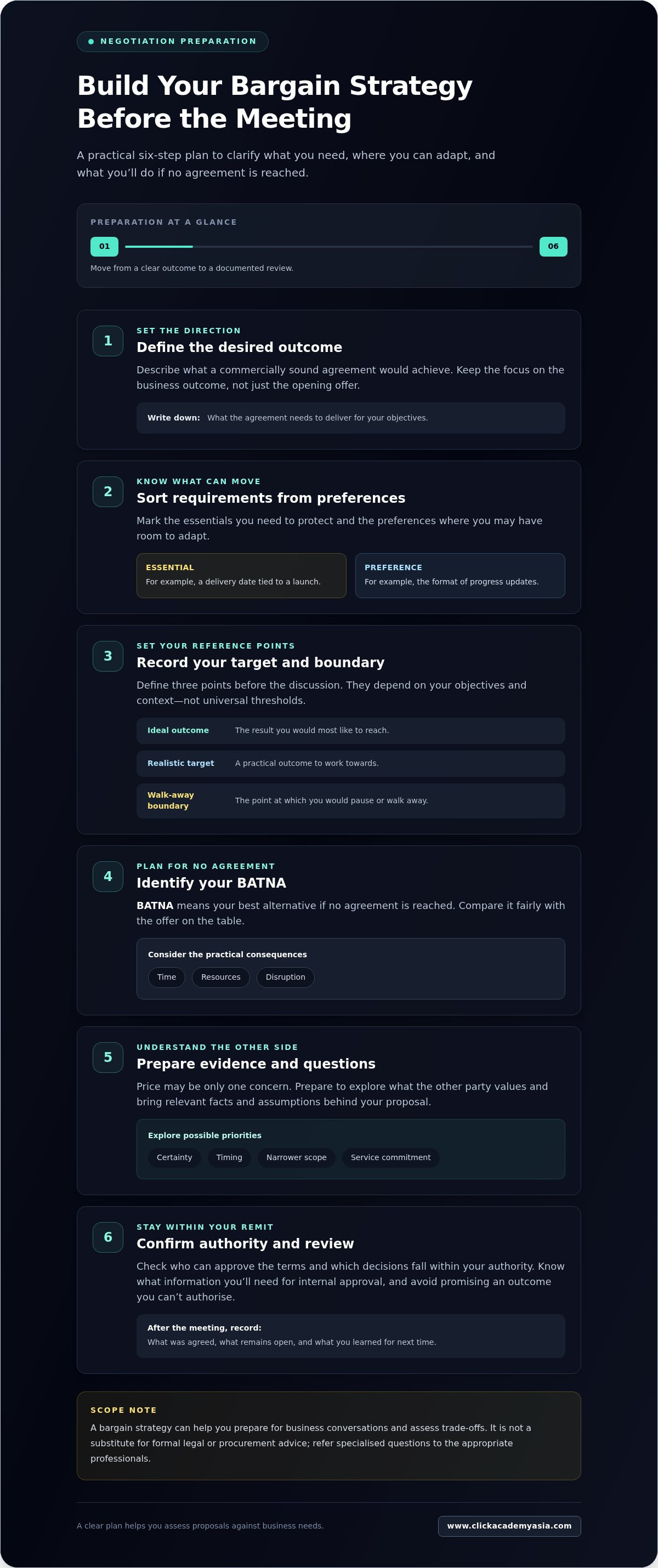
Preparation gives you more control over the decisions you make in the room. Before a supplier review, client proposal or internal resource discussion, clarify what a good outcome looks like, what you can adjust and what you’ll do if no agreement is reached.
A useful bargain strategy connects your objectives, limits and alternatives to the evidence you’ll use and the authority you hold. With these in place, you can assess proposals against business needs instead of reacting to pressure or treating the first offer as your only option.
Set targets, limits and alternatives
Separate essential requirements from preferences before you negotiate. An essential might be a delivery date tied to a launch; a preference might be the format of progress updates. Knowing the difference helps you stay firm on what matters while remaining flexible elsewhere.
Then define three reference points: your ideal outcome, a realistic target and a walk-away boundary. These depend on your objectives and context, not universal thresholds. Also identify your BATNA, or best alternative if no agreement is reached. Consider its practical consequences, such as the time, resources or disruption involved, so you can compare it fairly with the offer on the table.
Research interests, evidence and decision-makers
Price may be only one concern. The other party could value certainty, timing, a narrower scope or a particular service commitment. Prepare questions to understand those priorities, along with relevant evidence and the assumptions behind your proposal.
Before the meeting, check who can approve the terms and which decisions fall within your authority. If an item needs internal approval, know what information you’ll need to take back. Avoid promising an outcome you can’t authorise.
Use this preparation sequence to turn your notes into a practical plan:
1. Define the desired outcome. Describe what a commercially sound agreement would achieve.
2. Sort requirements and preferences. Mark what must be protected and where there may be room to adapt.
3. Set your target and boundary. Record your ideal outcome, realistic target and the point at which you would pause or walk away.
4. Identify your BATNA. Compare the best available alternative with the likely consequences of not agreeing.
5. Prepare evidence and questions. Bring relevant facts, check assumptions and explore what the other party values.
6. Confirm authority and review. Know your decision-making limits. After the meeting, record what was agreed, what remains open and what you learned for next time.
Practising clear objectives and strategic communication can strengthen commercial judgement. Explore [Internal Link: ClickAcademy Asia Sales and Leadership learning] to develop broader professional skills.
Bargain Strategy vs. Haggling: Protect Value Without Giving In
Haggling often reacts to the latest offer: one side asks for a lower price, the other counters, and the discussion narrows to the number. Structured bargaining takes a broader view. It uses preparation to explore priorities, compare possible trades and decide which terms support a sound agreement.
Effective bargaining doesn’t require pressure, conflict or resisting every request. A calm question can reveal what matters most to the other party, while a considered proposal gives both sides room to find common ground. The aim is to protect your business interests without treating the relationship as a contest.
Does a strong bargain strategy always mean paying less?
No. The headline price is only one part of the deal. Scope, reliability, timing and flexibility can all affect whether an agreement serves your needs. For example, a supplier’s offer may cost more but include a delivery schedule that supports a time-sensitive project. If a cheaper alternative risks delays that affect your own commitments, the lower price may not represent better overall value.
No single approach guarantees savings or suits every discussion. Assess the terms against the outcome you need, and consider the consequences of accepting or rejecting each option.
How can you make concessions without weakening your position?
Make a concession conditional on a specific reciprocal commitment. For instance, if you agree to a narrower scope, you might seek clearer delivery milestones in return. State the exchange plainly, then pause for the other party’s response instead of making a series of reductions without receiving anything back.
To keep the discussion focused, use a simple comparison table in your notes:
Priorities: What must each party achieve?
Concessions: What are you prepared to adjust, and what is the impact?
Reciprocal value: What specific commitment would make each adjustment worthwhile?
Unresolved risks: Which assumptions, dependencies or open terms still need attention?
Review the whole agreement against these points, not just the latest offer. If terms change during the conversation, summarise them before moving on: what is being adjusted, what each party is committing to and what remains unresolved. This gives both sides a chance to correct misunderstandings before they become expectations.
A well-used bargain strategy is neither automatic agreement nor automatic resistance. It’s a disciplined way to evaluate trade-offs, make measured proposals and protect value while keeping the conversation constructive.
How to Apply a Bargain Strategy in a Real Business Discussion
A prepared plan becomes useful when you can apply it naturally in conversation. In a supplier, client or internal discussion, move through four stages: open constructively, explore interests, propose a trade, then confirm next steps. This keeps the conversation purposeful without making it feel like a contest.
Open: Agree on the issue to resolve. “Could we start by aligning on the outcome this agreement needs to support?”
Propose: Link a possible adjustment to a reciprocal commitment. “If we adjust the scope, could we agree on these delivery milestones?”
Confirm: Summarise what has been agreed, what still needs approval and who will take each next step.
These prompts invite explanation rather than defensiveness. Listen for the priorities behind the stated position, then check your understanding before suggesting a trade. For related learning in strategic planning, see [Internal Link: ClickAcademy Asia Digital Marketing Strategy & Planning].
What should you say when the other party asks for a concession?
Resist the urge to answer immediately. A calm response could be: “I understand that price is a concern. If we revisit that term, what commitment could we agree on in return?” This keeps the discussion focused on shared priorities and makes the exchange explicit.
If the request changes your cost assumptions, introduces a risk you haven’t assessed or exceeds your authority, pause. You might say, “I’d like to review the impact before responding. Can we confirm the scope and timing you have in mind?” A short pause is more useful than agreeing under pressure and discovering later that the terms aren’t workable.
How do you close and review the agreement?
Before ending the meeting, recap the agreed terms, responsibilities and timing. Name any unresolved points, the person responsible for following up and when the matter will be revisited. Put the summary in writing so both parties can correct misunderstandings while the discussion is fresh.
Afterwards, compare the outcome with your original target and minimum requirements. Note which assumptions held, which trades created value and what you would handle differently next time. Keep your review focused on reusable lessons, and leave out confidential details that don’t belong in broader team notes.
Strong discussions rely on preparation as much as persuasive wording. [Internal Link: Explore practical digital marketing strategy learning] to develop planning and communication skills that support better commercial decisions.
Build Stronger Bargain Strategy Skills Through Practical Learning
A strong bargain strategy doesn’t depend on making the other party accept your terms. It depends on trading terms deliberately, so you protect important requirements while exploring what could create value for both sides. Preparation, whole-agreement comparison, reciprocal concessions and clear written follow-through turn that principle into a repeatable professional skill.
Confidence grows when you can connect commercial judgement with audience insight, relevant evidence and clear objectives. These capabilities help you explain why a recommendation makes sense, listen for what matters to the other party and assess trade-offs without reacting hastily to pressure.
Which capabilities help professionals negotiate with confidence?
Strategic thinking helps you see how a proposed agreement fits broader business goals. For example, a marketing professional weighing campaign scope can consider the intended audience, available evidence and priorities before recommending a change. Practising how to communicate that reasoning makes it easier to explain trade-offs clearly and respond constructively when new information emerges.
For a related learning perspective, explore [Internal Link: WSQ Digital Marketing Strategy & Planning]. Its focus on strategic planning connects with the judgement and communication professionals use in commercial discussions.
What is a practical next step for Singapore professionals?
Choose one upcoming business discussion and prepare using the framework in this guide. Write down the outcome you want, your essential requirements, the interests you need to understand and the alternatives you could pursue. After the discussion, review what changed, what each party committed to and what you would refine next time.
Small, deliberate practice helps make strategic thinking part of everyday work. In Singapore, the WSQ framework provides a professional learning context for building practical capabilities. Continuous learning can help individuals and teams strengthen how they assess evidence, communicate recommendations and make considered decisions.
Before your next discussion, keep these actions in view:
Prepare objectives, essential requirements and alternatives.
Compare the full value of terms, not just the headline price.
Make concessions in exchange for specific commitments.
Confirm responsibilities, timing and open points in writing.
Build on these habits through relevant professional learning. [Internal Link: Explore WSQ digital marketing strategy learning] to strengthen practical strategic capability for you or your team.
Make Your Next Negotiation More Deliberate
A commercially sound agreement isn’t always the one with the lowest price. A clear bargain strategy helps you prepare your target and limits, assess the full value of the terms and exchange concessions for meaningful commitments. Confirming responsibilities and open points in writing helps turn a constructive discussion into a shared understanding.
Put the approach to work in your next business conversation: identify what matters most, ask what the other party values and pause before accepting a trade-off you haven’t assessed. Each discussion is an opportunity to sharpen your judgement and communicate recommendations with greater confidence.
For Singapore professionals looking to build broader strategic capability, ClickAcademy Asia offers WSQ Digital Marketing Strategy & Planning. Explore practical digital marketing strategy learning and take a purposeful next step in your professional development. Strengthen your strategic skills and bring greater clarity to future decisions.
Frequently Asked Questions
What is a bargain strategy?
A bargain strategy is a planned approach to negotiating terms so the final agreement reflects the priorities of the people involved. It goes beyond seeking a lower price: you can discuss scope, timing, service, certainty and responsibilities. Preparation means defining your target and limits, gathering relevant evidence and identifying your best alternative if no agreement is reached. This helps you weigh the whole offer rather than react to one term.
How do you create a bargain strategy before a negotiation?
Start by defining the outcome you want and the minimum terms you can accept. Identify your alternative if discussions don’t lead to an agreement, then consider the practical consequences of taking it. Separate essential requirements from preferences, gather evidence and think about what the other party may value. Prepare questions and possible exchanges in advance. This bargain strategy gives you a clearer basis for responding to requests instead of conceding under pressure.
Is bargain strategy the same as haggling?
No. Haggling often centres on repeated price changes, while a bargain strategy considers the wider agreement and prepares for different outcomes. You might negotiate scope, timing or service commitments as well as price. The purpose isn’t to win every point or resist every request. It’s to reach terms that meet the most important needs and make the exchange worthwhile for both parties.
Can a bargain strategy protect a business relationship?
Yes, a respectful, transparent discussion can help protect a business relationship by focusing on interests rather than personal pressure. Explain your priorities, ask what matters to the other party and connect any concession to reciprocal value. Summarise changes clearly to reduce misunderstandings. This approach can support a constructive conversation, though it can’t guarantee agreement. If you disagree, explain your position calmly and keep the discussion focused on the terms.
What should you do if the other party refuses your proposed bargain?
Ask which part of the proposal doesn’t work, then listen for the concern behind the refusal. Before changing the price, explore whether scope, timing or responsibilities could be adjusted to address it. Recheck the revised terms against your priorities and acceptable boundary. If they still fall short, compare the offer with your alternative and decide whether continuing the discussion supports your objectives.
How can professionals in Singapore develop better negotiation skills?
Practise preparing objectives, alternatives, questions and conditional concessions for realistic work discussions. After each conversation, review which assumptions held, how you handled trade-offs and what you could improve. In Singapore, professional development through the WSQ framework can support broader workplace capabilities. ClickAcademy Asia offers WSQ Digital Marketing Strategy & Planning, which develops strategic planning skills relevant to commercial decision-making.


Comments