
Competitive Positioning and Differentiation Workshop in Singapore: A Practical Guide

What if your next positioning workshop ended with fewer ideas and firmer choices? For Singapore teams, a competitive positioning and differentiation workshop should do more than generate brand language. It should help people agree on who the business serves, what that audience values and which advantages the evidence can genuinely support.
If your brand description could fit a competitor, you’re not alone. Customer insight, competitor analysis and internal knowledge often sit in separate silos, while stakeholders debate which audience or advantage matters most. The result can be a lively discussion that leaves the real decisions unresolved.
This guide shows you how to structure a workshop that turns those inputs into practical strategic choices. You’ll learn how to define the market context, assess potential points of difference, test claims against evidence and document decisions your marketing and communications teams can use. It also explains how to carry the outcomes into a digital marketing plan, supported by strategic planning skills such as those developed through WSQ Digital Marketing Strategy & Planning.
Table of Contents
What a competitive positioning and differentiation workshop should help your team decide
How to turn customer and competitor evidence into a differentiated position
How to compare workshop formats, facilitation, and useful outputs
How to prepare for a positioning workshop and turn decisions into action
Build stronger positioning capability with WSQ training in Singapore
What a competitive positioning and differentiation workshop should help your team decide
In a Singapore team, marketing may describe the brand as innovative, sales may focus on service, and leadership may lead with expertise. Each view can be valid. But if they don’t add up to a shared position, customers may hear a message that sounds much like everyone else’s.
A competitive positioning and differentiation workshop is a facilitated process for making evidence-based decisions about which audience to prioritise, the market context to compete in and the advantages the business can credibly claim. It produces strategic choices, not simply a new tagline, campaign concept or list of competitors. For background, see these market positioning concepts.
For a practical overview of a structured approach, watch:
Which positioning decisions belong in the room?
Start by naming the choices the team needs to make. Clarify the priority audience, what that audience needs and the situation in which it considers your offer. Then map the alternatives customers might weigh, including a direct competitor, an internal solution or doing nothing at all.
Next, distinguish category expectations from potential points of difference. Expectations are the basics customers need to see before they consider an offer. A meaningful difference must go further: it should matter to the chosen audience and be supported by evidence, rather than relying on a claim the team simply wants to make.
Who should participate, and what should they bring?
Invite the perspectives needed to make the decision. Marketing can bring current messaging and campaign evidence; sales can share customer questions and objections; product teams can clarify capabilities; and leadership can set strategic boundaries. Choose the mix based on the decision, rather than trying to fill every seat.
Bring existing customer insights, performance evidence and current brand messaging as working inputs. Set a clear expectation: participants are there to test assumptions, not defend departmental preferences. Ask what the evidence supports, what remains uncertain and what the team needs to learn before committing.
The result should be a shared direction the team can explain and use. That clarity gives later research and planning a sharper brief, rather than leaving each function to interpret the brand in its own way.
How to turn customer and competitor evidence into a differentiated position
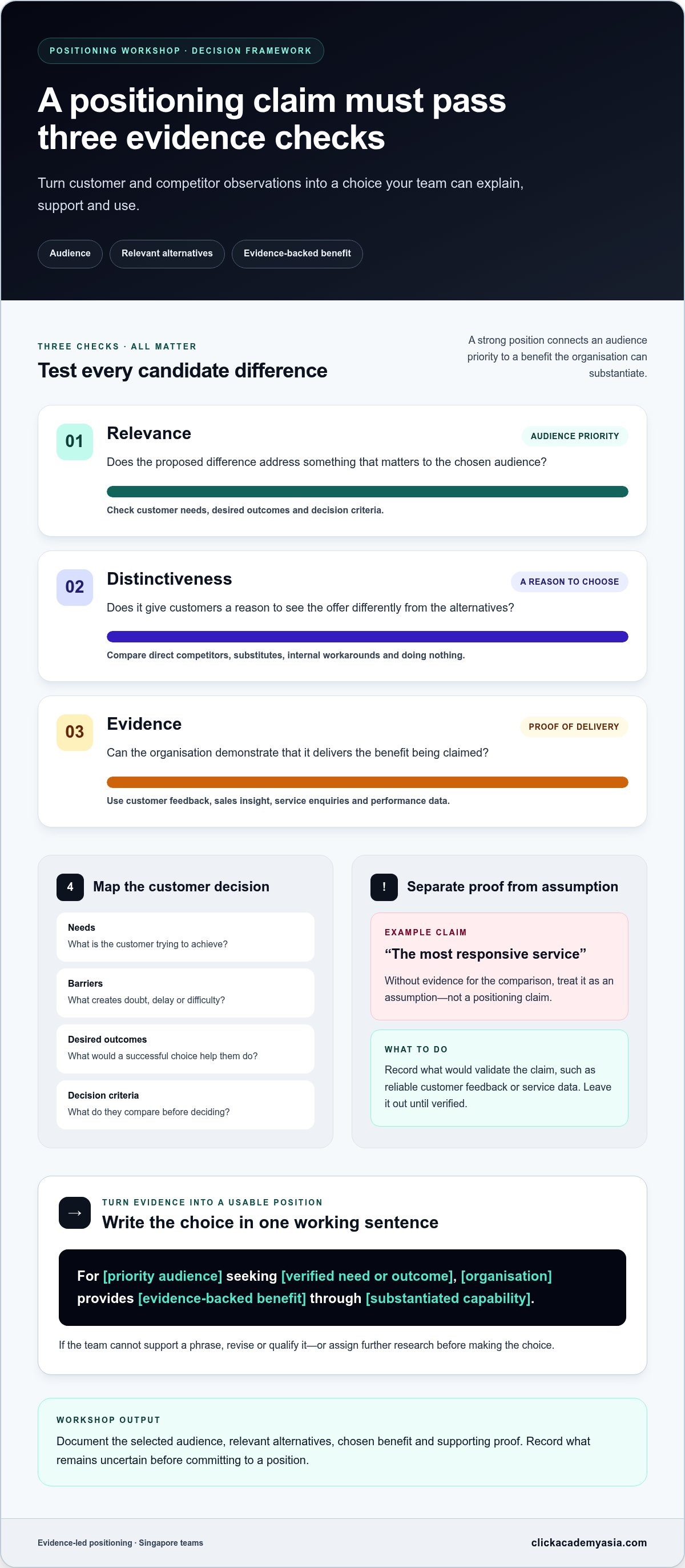
A competitor’s headline is a clue, not proof that customers value the same thing or that a gap exists. In a competitive positioning and differentiation workshop, move from observations to a defensible choice in sequence: define the decision, gather evidence, compare alternatives, test claims and choose what to prioritise.
Map customer priorities and competitive alternatives
Begin by stating the decision in practical terms, such as which audience to prioritise or which benefit to lead with. Then organise customer evidence around four areas:
Needs: What is the customer trying to achieve?
Barriers: What creates doubt, delay or difficulty?
Desired outcomes: What would a successful choice help them do?
Decision criteria: What do they compare before deciding?
Use customer conversations, sales feedback, service enquiries and performance data already available to the team. Keep direct competitors in view, but include substitutes too: an internal workaround, another type of solution or taking no action. These alternatives reveal what customers are really comparing, without assuming an unaddressed need is a proven market opportunity.
Test whether a point of difference is meaningful and believable
Assess each candidate position against three tests: relevance, does it address a priority for the audience; distinctiveness, does it give customers a reason to see the offer differently; and evidence, can the organisation demonstrate that it delivers the benefit? A feature may sound distinctive in a meeting but be easy for competitors to match. A stronger point of difference connects a capability to an outcome customers care about and the organisation can substantiate.
For example, a team might want to claim “the most responsive service”. Unless it has evidence to support that comparison, treat it as an assumption, not a positioning claim. Record what would validate it, such as reliable customer feedback or service data, and leave it out of the final position until verified.
A useful working sentence is: “For [priority audience] seeking [verified need or outcome], [organisation] provides [evidence-backed benefit] through [substantiated capability].” Fill each part using customer and organisational evidence. If the team can’t support a phrase, revise or qualify it, or assign further research before making the choice.
Finish by documenting the selected audience, relevant alternatives, chosen benefit and supporting proof. Teams looking to strengthen how they translate strategic choices into marketing plans can explore digital marketing strategy learning.
How to compare workshop formats, facilitation, and useful outputs
The right format depends on the decision your team needs to make, the evidence already available and how aligned stakeholders are. A short alignment session may be enough to resolve different interpretations of an agreed strategy. If the audience, alternatives or evidence are still unclear, a research-informed workshop or broader planning process may be more appropriate.
Use this comparison to match the process to the work, rather than choosing a format simply because it sounds comprehensive.
A workshop is useful when it produces owned decisions, not discussion alone. Before the session ends, name who will take each agreed action, record what remains unresolved and set out how the positioning direction will inform future work.
What makes facilitation valuable for a positioning decision?
Good facilitation keeps the group moving from opinions towards a decision. A facilitator can draw out quieter perspectives, test assumptions and ask what evidence supports a claim. That neutral challenge helps the team distinguish customer or market evidence from departmental preference, without promising consensus or a particular commercial result.
Which workshop outputs should teams expect to use?
Capture the agreed audience and market context, the selected positioning direction, the evidence that supports it and the questions that still need research. A concise positioning statement can guide messaging, but it isn’t the full strategy: it doesn’t replace decisions about objectives, channels, resources or measurement.
Teams in Singapore can build on these decisions by developing the strategic planning skills needed to apply them. Explore WSQ Digital Marketing Strategy & Planning as a learning pathway for connecting positioning with practical marketing plans.
How to prepare for a positioning workshop and turn decisions into action
A positioning session is easier to run well when people arrive with a decision to make, not a blank page. Prepare enough evidence to ground the discussion, but don’t delay the work while trying to gather every possible data point. The aim is to identify what the team can decide now and what needs further validation.
Prepare the right inputs without over-researching
Use a focused preparation sequence. First, write down the strategic decision the session needs to resolve, such as which audience to prioritise or which customer benefit to emphasise. Then invite participants whose perspectives inform that choice, and ask each person to bring one assumption they want tested.
Share a concise set of working inputs, such as:
Recent customer feedback and recurring needs or concerns.
Sales objections and questions that influence customer decisions.
Competitor claims drawn from current messaging.
Relevant performance evidence, such as engagement with existing messages or offers.
Label each input as known, assumed or still requiring research. For example, a competitor’s public claim is known; the belief that customers value that claim more than other benefits is an assumption unless customer evidence supports it. This distinction helps prevent confident opinions from being mistaken for verified insight.
Convert positioning choices into a working plan
At the close of the session, capture the chosen audience, market context, positioning direction and evidence behind it. Then translate each decision into follow-through. Assign an owner to validate outstanding evidence, another to refine the messaging, and someone to share the agreed direction with relevant teams.
Make the implications practical. Identify which core messages need updating, where they should appear across marketing channels, and what teams should review to assess whether the new direction is being applied. Match measures to the workshop’s purpose. If the goal is consistent messaging, review key materials for alignment; if it is to validate a customer assumption, decide what feedback or performance evidence would help answer the question. Don’t promise a particular commercial gain before it has been tested.
A competitive positioning and differentiation workshop creates value when its choices inform real work after the meeting. Teams can strengthen the skills needed to carry those choices into a practical marketing plan through WSQ Digital Marketing Strategy & Planning.
Build stronger positioning capability with WSQ training in Singapore
A workshop can help your team make immediate positioning choices. Applying those choices consistently takes ongoing strategic capability: teams need to translate the selected audience and value proposition into marketing priorities, then review what the evidence tells them.
Connect positioning decisions to broader digital marketing strategy
Audience, value proposition and differentiation should shape more than a brand statement. They inform which channels to prioritise, what campaigns need to communicate and how each activity supports the strategy. If a position centres on a specific customer need, for example, the team can check whether its campaign messages and channel choices reach and address that audience.
Measurement helps teams assess whether their assumptions hold up in practice. Agree what evidence to review, such as relevant engagement or campaign results, and use it to identify where the plan may need refinement. Marketing analytics, including GA4, can help teams evaluate activity against their objectives. The aim is informed adjustment, not a promise of a particular performance gain.
Choose a practical learning path for your team
For professionals and organisations in Singapore, ClickAcademy Asia’s WSQ Digital Marketing Strategy & Planning is a relevant learning option for building strategic marketing capability. It helps teams develop the skills to turn positioning decisions into practical digital marketing plans. The course is part of the WSQ framework, and SSG is part of Singapore’s broader skills and training context. Funding eligibility and support depend on the relevant arrangements.
To make learning relevant to your positioning work, connect it to a current business decision. Ask participants to bring the audience, value proposition and open questions from the workshop into their planning, then consider how they’ll apply the learning to channel choices, messaging and evaluation. This links professional development to real strategic work without treating training as a guaranteed business outcome.
Equip your team to carry its positioning choices into marketing plans with WSQ Digital Marketing Strategy & Planning. Build the capability to put a competitive positioning and differentiation workshop’s decisions into practice through focused, ongoing strategic learning.
Put your positioning decisions into practice
A useful competitive positioning and differentiation workshop turns customer and competitor evidence into clear choices: which audience to prioritise, what credible difference to communicate and what still needs validation. Select a format that fits the decision, then assign owners to carry the agreed direction into messaging, channel planning and review.
Keep building the capability to apply those choices. In Singapore, WSQ training offers a relevant professional learning pathway, while SSG sits within the wider local skills ecosystem. ClickAcademy Asia, established in 2011, offers WSQ Digital Marketing Strategy & Planning to help professionals and teams strengthen their strategic marketing skills.
Explore WSQ Digital Marketing Strategy & Planning and equip your team to turn positioning decisions into focused marketing plans. With a shared direction and practical skills to put it to work, your team can move forward with greater clarity and confidence.
Frequently Asked Questions
What is a competitive positioning and differentiation workshop?
A competitive positioning and differentiation workshop is a facilitated session where a team uses customer, competitor and organisational evidence to make strategic choices. Participants clarify the priority audience, the market context and the benefits the organisation can credibly offer. The aim is a shared positioning direction that can guide marketing decisions, not simply a tagline, campaign concept or competitor list. Record any claims lacking evidence for validation.
What should a competitive positioning workshop deliver?
A useful workshop should deliver an agreed priority audience and market context, a clear positioning direction, supporting evidence and a record of open questions. It should also identify who will take the next steps, such as validating an assumption or applying the direction to messaging. A concise positioning statement can help teams communicate the choice, but it doesn’t replace the broader marketing strategy or plan.
Who should attend a differentiation workshop?
Invite the people whose knowledge and authority are needed to make and apply the positioning decision. Marketing can bring current messages and campaign evidence; sales can share customer objections and questions; product teams can clarify capabilities; and leadership can provide strategic direction. Choose participants based on the decision. Ask them to examine evidence and test assumptions rather than defend departmental preferences.
How do you identify a genuine point of differentiation?
Test each potential difference for customer relevance, distinctiveness and credibility. It should address a need or decision criterion that matters to the chosen audience, give them a meaningful reason to prefer the offer, and be supported by evidence the organisation can demonstrate. A feature alone may be easy for competitors to match. Connect it to a verified customer benefit, and treat unsupported claims as assumptions requiring research.
Can a positioning workshop work without customer research?
Yes, a workshop can help teams organise existing information and identify what they still need to learn, even if formal customer research isn’t available. Use inputs such as customer feedback, sales objections, service enquiries and performance evidence, while clearly labelling assumptions. Don’t present internal opinion as proof of customer preference. If a key choice depends on an untested belief, make validation a follow-up action before finalising the position.
How long does a competitive positioning workshop take?
There isn’t one appropriate duration for every workshop. A focused alignment session may suit a team with an agreed market context and evidence, while a research-informed process may need more preparation and discussion. The right format depends on decision complexity, evidence availability and stakeholder alignment. Set the session scope accordingly, and avoid trying to resolve wider strategic questions if the available time and inputs don’t support them.
How does WSQ training relate to competitive positioning in Singapore?
WSQ training can help professionals build strategic marketing skills that support the application of positioning decisions. In Singapore, ClickAcademy Asia offers WSQ Digital Marketing Strategy & Planning, a relevant learning pathway for teams translating audience and differentiation choices into marketing plans. SSG is part of the wider skills and training context. Funding eligibility and coverage depend on the applicable arrangements.


Comments