
Australia B2B Marketing: 2026 Guide for Singapore Leaders
- ClickAcademy Asia

- 2 minutes ago
- 12 min read
Why are your high-intent leads from Sydney and Melbourne suddenly drying up, even as the Australian B2B e-commerce market scales toward a USD 279.3 billion valuation? You've likely felt the sting of stagnant lead quality and the friction caused by sales and marketing misalignment. Handling the cultural nuances of Australian professional services requires more than just a standard playbook; it demands a total shift in how you deploy b2b marketing strategies for the australian market.
It's understandable to feel concerned about the 10 December 2026 Privacy Act reforms or the new ACMA SMS Sender ID requirements. We're here to ensure your expansion doesn't stall. This guide promises to help you master the Australian landscape and implement high-revenue strategies through professional upskilling. You'll discover how to build trust in a market where privacy is now a primary brand differentiator and a legal necessity.
We'll provide a clear roadmap for AU market growth and a strategy to increase pipeline velocity. We'll also examine how your team can utilise SSG funding to access WSQ-certified training programmes. This ensures your PMEBs aren't just following trends but are leading global campaigns with practical, real-world expertise that delivers a measurable return on investment across the APAC region.
Table of Contents
Understanding the Australian B2B Marketing Landscape
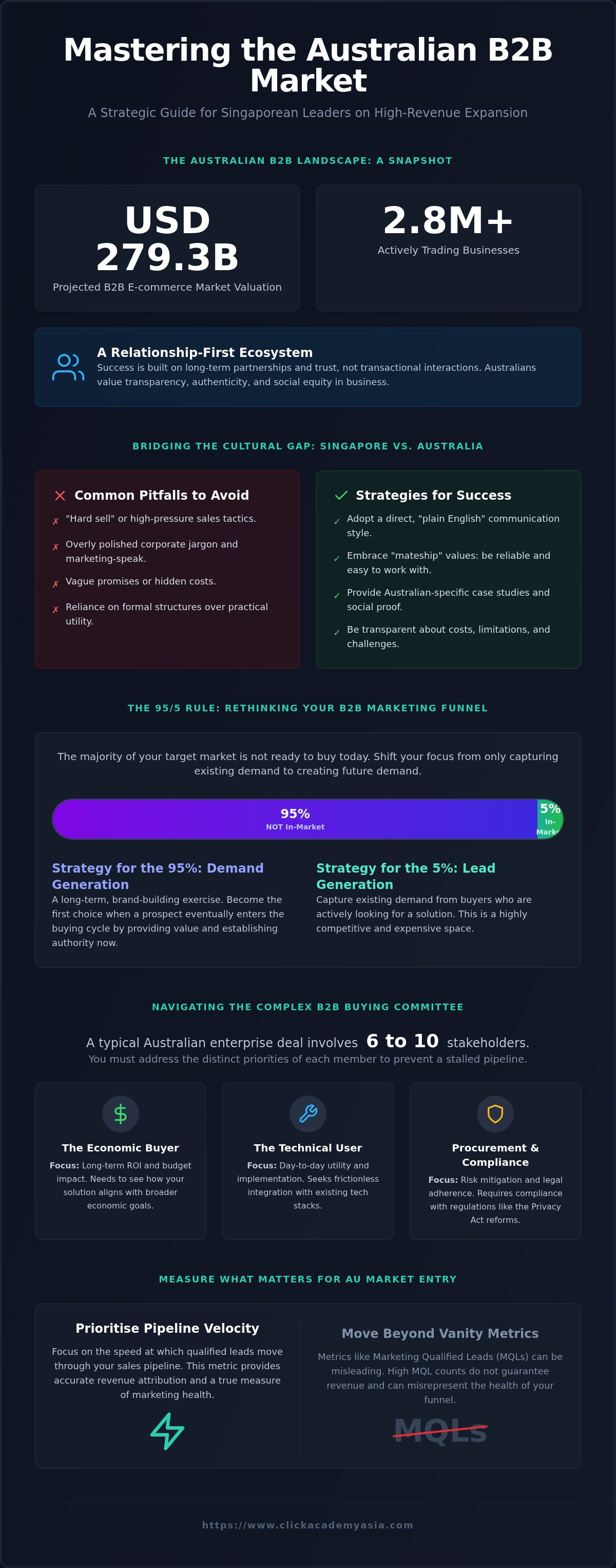
The Australian B2B market is a relationship-first, trust-based ecosystem where success isn't built on transactional interactions but on long-term partnerships. For Singaporean leaders, this shift requires a departure from the "hard sell" or high-pressure tactics that might work in faster-paced Asian hubs. Australians value transparency and authenticity above all else. If you're looking to refine your b2b marketing strategies for the australian market, you must first understand that professional services there are built on social equity. With 2,814,778 actively trading businesses in the Australian economy as of June 2026, the competition for attention is fierce. ClickAcademy Asia helps PMEBs bridge this knowledge gap by aligning regional expertise with global marketing standards.
Demand Generation vs Lead Generation in Australia
Many firms mistake lead generation for a complete strategy. Lead generation captures existing demand, while demand generation creates it. You need to account for the 95/5 rule: roughly 95% of your target AU B2B market isn't ready to buy right now. They aren't "in-market" for your services today. If you only focus on the 5% who are ready, you're competing in a crowded, expensive space with diminishing returns.
Instead, focus on building brand salience. Demand generation is a long-term brand-building exercise designed to ensure your firm is the first choice when a prospect eventually enters the buying cycle. By the time they need a solution, your brand should already be a trusted authority in their mind.
Cultural Nuances and Professional Etiquette
Australian professionals have a strong preference for "plain English" and directness. They tend to distrust overly polished corporate jargon or complex marketing-speak. To succeed, you must adapt your communication style to be transparent and accessible. Singaporean professionals often rely on high-level prestige and formal structures, but in Australia, practical utility and a "no-nonsense" approach win the day. Local buyers look for "mateship" values even in business; they want partners who are reliable and easy to work with.
Key cultural adjustments include:
Localised Social Proof: AU buyers want to see how you've helped their peers in Sydney, Melbourne, or Brisbane. Use Australian-specific case studies to build immediate credibility.
Transparency: Be upfront about costs and limitations. Hidden fees or vague promises are a quick way to lose trust in the Australian market.
Direct Communication: Avoid "face-saving" language. If there's a problem, Australians prefer to address it head-on and find a solution quickly.
High-Conversion B2B Marketing Strategies for the Australian Market
For Singapore-based leaders, scaling into Australia requires a sophisticated approach to the buyer journey. Unlike smaller markets, Australian enterprise deals involve multiple layers of scrutiny and a consensus-driven decision process. To succeed, your b2b marketing strategies for the australian market must account for a culture where procurement managers are highly risk-averse. Establishing brand authority early through educational content reduces this perceived risk and paves the way for smoother sales cycles.
Complex Stakeholder Mapping for AU Businesses
A typical Australian B2B purchase now involves between 6 and 10 stakeholders. You aren't just selling to one manager; you're selling to a committee. Each member has distinct priorities that your marketing must address simultaneously to move the deal forward. Failure to engage even one minor stakeholder can result in a stalled pipeline.
The Economic Buyer: Focuses on long-term ROI and budget impact. They need to see how your solution fits into the broader 2026 economic stabilisation in Australia.
The Technical User: Concerned with implementation and day-to-day utility. They want to know if your product integrates with their existing tech stack without causing friction.
Procurement and Compliance: Their primary goal is risk mitigation. They'll look for localised social proof and strict compliance with the 10 December 2026 Privacy Act reforms.
Utilise LinkedIn to map these decision-making units within target Australian firms. By identifying the specific individuals in these roles, you can serve tailored content that addresses their unique pain points. If your team needs to sharpen these precise targeting skills, exploring WSQ-certified digital marketing training is a strategic first step toward regional mastery.
Account-Based Marketing (ABM) Frameworks
ABM is the gold standard for high-value Australian accounts. It shifts the focus from broad lead generation to a highly targeted, resource-intensive approach. ABM is a surgical strike on specific high-value prospects where every touchpoint is personalised to the account's unique business challenges.
For the Australian mid-market, a "One-to-Many" approach works well by grouping accounts with similar needs. However, for major enterprise players in mining or banking, a "One-to-One" strategy is essential. This requires tight alignment between your sales and marketing teams. Marketing provides the deep insights and personalised assets, while sales executes the high-touch relationship building. This synergy ensures you aren't just sending generic emails but are providing genuine value at every stage of the funnel.
Digital Channels and Tactics That Drive Revenue in Australia
Winning in the AU market requires a decisive shift from passive advertising to active, value-driven engagement. While sponsored updates have their place, 2026 is the year of LinkedIn thought leadership for the professional services sector. Australian PMEBs look for insights that solve specific regional challenges rather than generic global templates. Video content is now the primary medium for this engagement; it builds a human connection and brand salience that text alone cannot replicate in a trust-based ecosystem.
High-revenue b2b marketing strategies for the australian market rely on a balanced digital mix that captures intent where it lives. This means moving beyond broad keywords to target the specific long-tail queries of a decision-maker in the mining, banking, or retail sectors. Your digital presence must act as a 24/7 consultant that educates the prospect long before they ever speak to your sales team.
Strategic SEO and SEM for the Australian Market
Technical SEO is your foundation for AU visibility. Without a fast, mobile-optimised, and secure site, you won't rank for competitive professional queries. Use Advanced Keyword Research Strategies to identify the exact pain points and localised terminology driving Australian search volume. Google's Performance Max can also be a powerful ally for B2B lead generation. It uses high-intent signals to find prospects across the entire Google ecosystem, provided your data inputs are clean and compliant with the expanded definition of personal information under the 2026 Privacy Act reforms.
Content Marketing and Thought Leadership
Australian buyers respond exceptionally well to "Edutainment." This involves making complex technical solutions digestible and engaging through short-form video or interactive industry reports. Whitepapers remain vital for mid-market and enterprise sectors, but they must be grounded in data that reflects the Australian economy. Referencing WSQ Digital Marketing courses provides the content strategy frameworks your Singapore-based team needs to produce these high-value assets. Remember that with the new ACMA SMS Sender ID Register regulations, even your mobile touchpoints must be verified to maintain professional trust.
Finally, integrate GA4 to track the multi-touch journey of an Australian buyer. Because the AU journey involves 6 to 10 stakeholders, a single-touch attribution model will consistently fail you. You need to see how a LinkedIn video leads to a whitepaper download and eventually a sales enquiry. This level of marketing analytics ensures every dollar spent on AU expansion is accounted for. Since the Privacy Act now includes IP addresses and cookie identifiers as personal information, your GA4 setup must be technically sound to remain compliant by the 10 December 2026 deadline.
Measuring Success: Pipeline Velocity and Revenue Attribution
Stop chasing Marketing Qualified Leads (MQLs). In 2026, relying on top-of-funnel downloads as a primary success metric is a strategic error that leads to friction between your Singapore HQ and Australian sales teams. If your b2b marketing strategies for the australian market don't result in closed-won revenue, the quantity of leads is irrelevant. You need to shift your focus to Pipeline Velocity, the ultimate metric for measuring how fast revenue moves through your funnel.
Pipeline Velocity accounts for your number of opportunities, average deal value, and win rate, all divided by the length of your sales cycle. This gives you a real-time dollar value of your marketing health. It allows Singaporean leaders to identify exactly where a campaign is stalling. Is it a lack of opportunities, or is the AU sales cycle simply too long? By implementing a shared Revenue Operations (RevOps) model, you ensure that both sales and marketing are incentivised by the same outcome: revenue growth. This alignment is critical when navigating the 6 to 10 stakeholders typical in an Australian enterprise purchase, where marketing must support sales at every touchpoint across the APAC region.
Advanced Analytics with GA4
Standard reporting won't cut it for the multi-touch AU buyer journey. You must leverage strategic marketing analytics frameworks to configure B2B conversion tracking that captures every interaction from the first LinkedIn touch to the final demo. GA4's predictive analytics can now help you anticipate when an Australian lead is nearing a purchase decision based on historical patterns. This allows your team to trigger high-intent ads or personal outreach at the perfect moment. For leaders in Singapore, custom dashboards provide the clarity needed to justify marketing spend to HR and C-suite stakeholders, showing exactly how marketing contributes to the bottom line.
Sales and Marketing Alignment (Smarketing)
Establishing a Service Level Agreement (SLA) is the first step toward true "Smarketing". This document defines exactly what constitutes a high-quality lead and how quickly sales must follow up. Regular feedback loops are essential to refine AU campaigns; if sales reports that leads from a specific whitepaper are poor, marketing must adjust the targeting immediately. Marketing's job doesn't end at the hand-off. It continues into the sales enablement phase, providing the specific case studies and technical data needed to close the deal. This ensures your PMEBs are working toward a unified goal rather than operating in silos.
Ready to turn data into a competitive advantage? Equip your team with the skills to master these complex frameworks through our WSQ Marketing Analytics & Insights programme.
Upskilling Your Team via WSQ-Funded Programmes in Singapore
Scaling your operations into Australia isn't just a matter of budget; it's a matter of internal capability. Your Singapore-based team needs the strategic depth to execute complex b2b marketing strategies for the australian market without constant oversight. The WSQ framework provides a rigorous, industry-validated pathway to ensure your PMEBs possess these skills. By aligning your team's development with the WSQ Digital Marketing Strategy & Planning course, you're investing in a future-ready workforce capable of navigating the APAC region's most competitive landscapes.
The WSQ Framework for Digital Marketing Strategy
The WSQ Content Marketing Strategy module is particularly vital for AU expansion. It teaches your team how to move beyond generic posts and create the high-value "Edutainment" and industry reports that Australian buyers demand. Unlike academic degrees, these programmes focus on practical application. Your staff won't just learn about the 95/5 rule; they'll learn how to build the specific demand generation campaigns that capture the attention of risk-averse AU procurement managers. PMEBs can also utilise their individual SkillsFuture Credit to offset costs for these specialised modules, making professional growth both accessible and affordable.
Accessing SSG Funding and Support
Singapore provides some of the world's most robust support for professional development through SkillsFuture Singapore (SSG). For Singapore Citizens and Permanent Residents, the financial barriers to high-level training are significantly reduced. Understanding these subsidies is a "quick win" for any HR manager or business leader looking to future-proof their organisation.
The current 2026 funding rates for WSQ-approved courses include:
Up to 70% funding of course fees for Singapore Citizens and Permanent Residents aged 40 and above.
Up to 50% funding for those under the age of 40.
Up to 90% funding for Singaporean SMEs training their employees.
Note that a 9% GST applies to the remaining course fees. HR managers can streamline this process by applying for corporate group training subsidies, allowing your entire marketing and sales department to upskill simultaneously. This collective growth is what drives the Revenue Operations (RevOps) model mentioned earlier. ClickAcademy Asia stands as your strategic partner in this journey, offering training delivered to professionals from over 30 countries. Visit ClickAcademy Asia to view our full 2026 course calendar and equip your team with the WSQ-certified skills needed for global success.
Master Your Australian Expansion with Strategic Excellence
Success in the AU market requires more than just a presence; it demands a deep alignment with local cultural nuances and a shift toward trust-based demand generation. You've seen how complex stakeholder mapping and surgical ABM frameworks can transform stagnant lead quality into high-velocity pipelines. By moving beyond vanity metrics and embracing GA4 predictive analytics, you can ensure your b2b marketing strategies for the australian market are both compliant and high-yielding.
The competitive advantage for Singaporean firms lies in the ability to upskill rapidly. Leveraging SSG funding for WSQ-certified training tracks allows your team to achieve hands-on practical mastery without the burden of high costs. It's time to bridge the capability gap and lead your regional campaigns with confidence. Equip your team with the WSQ Digital Marketing Strategy & Planning course today and secure your place as a leader in the APAC professional services landscape. Your growth in the Australian market is within reach with the right skills and a strategic mindset.
Frequently Asked Questions
How does B2B marketing in Australia differ from the Singapore market?
B2B marketing in Australia prioritises directness. Unlike the prestige-driven culture in Singapore, AU professionals value transparency over corporate jargon. They prefer authentic communication and localised social proof. While Singaporean firms excel at networking, success in the Australian market requires a shift toward value-driven demand generation. This respects the local preference for egalitarianism and practical utility. Building trust is your first priority in this relationship-first ecosystem.
What are the most effective B2B marketing channels for reaching Australian decision-makers?
LinkedIn remains the dominant channel for reaching Australian PMEBs, especially when used for thought leadership rather than just advertising. High-intent SEO and targeted SEM also play critical roles in capturing buyers during their research phases. In 2026, short-form video content has become a primary medium for engagement, as it builds human connection. Combining these with Account-Based Marketing (ABM) ensures your b2b marketing strategies for the australian market reach the right stakeholders across the country.
Can I use my SkillsFuture Credit for B2B marketing strategy courses?
Yes, you can utilise your SkillsFuture Credit to offset out-of-pocket expenses for WSQ-certified B2B marketing strategy courses in Singapore. This applies to individual PMEBs upskilling in Digital Marketing Strategy & Planning or Content Marketing Strategy. It's a strategic way to future-proof your career while mastering global expansion. For corporate teams, SSG funding is available, covering up to 70% or 90% of fees depending on age and company size. This support makes high-level professional training highly accessible.
What is the "95/5 rule" in Australian B2B marketing?
The 95/5 rule is simple. At any given time, only 5% of your target Australian B2B market is actively looking to buy. The remaining 95% are "out-of-market" and won't respond to direct sales pitches. Successful b2b marketing strategies for the australian market focus on demand generation to stay top-of-mind. By building brand salience today, you ensure your firm is the first choice when those prospects eventually enter their buying cycle in the future.
How much does it cost to train a team in WSQ-certified digital marketing?
Training costs vary based on the specific programme and the eligibility of your team members for SSG funding. Singapore Citizens and Permanent Residents aged 40 and above can receive up to 70% funding, while those under 40 may receive up to 50%. Singaporean SMEs can access even higher subsidies of up to 90%. Note that a 9% GST applies to the final course fees. We recommend checking your specific eligibility through the SSG portal for a tailored training roadmap.
Is LinkedIn still the best platform for B2B marketing in Australia in 2026?
LinkedIn continues to be the premier platform for B2B engagement in Australia due to its high concentration of professional decision-makers. However, the strategy has evolved from simple lead-gen forms to sophisticated thought leadership and community building. In 2026, AU buyers expect high-value content that addresses their specific industry pain points. To remain effective, your team must move beyond generic updates and use the platform to demonstrate genuine expertise and "edutainment" that resonates with the Australian professional services sector.
How do I align my sales and marketing teams for better revenue results?
Alignment starts with a shared model. A Revenue Operations (RevOps) framework ensures both teams are incentivised by revenue, not just lead volume. Establishing a clear Service Level Agreement (SLA) defines what a "sales-ready" lead looks like. Regular feedback loops are also essential; sales should report on lead quality so marketing can refine targeting. This "Smarketing" approach ensures marketing supports the entire buyer journey, providing the specific assets needed to close high-value enterprise deals.
What is the role of demand generation in a 2026 B2B strategy?
Demand generation serves as the engine for long-term growth by building brand salience before a prospect is ready to buy. In 2026, it's no longer enough to wait for a search query; you must proactively educate the market on the problems your solution solves. This involves creating high-value content like whitepapers or industry reports that establish your authority. By focusing on demand generation, you reduce the cost of acquisition and build a resilient pipeline that isn't dependent on lead-capture tactics.


Comments