
2026 Guide: Aligning Marketing and Customer Success
- ClickAcademy Asia

- 16 minutes ago
- 12 min read
Did you know that acquiring a new customer in Singapore's competitive 2026 market now costs up to seven times more than retaining an existing one? It's a frustrating reality for many PMEBs; your Marketing team hits lead targets, yet Customer Success struggles with high churn and content that doesn't fit the post-purchase journey. This disconnect is exactly why a structured workshop for aligning marketing and customer success is no longer optional for firms aiming to protect their bottom line.
We agree that traditional silos are costing your business revenue and that sitting through quarterly reviews where departments point fingers is a waste of your leadership's time. You deserve a unified strategy that turns handovers into seamless transitions. This guide provides a practical framework designed to help you bridge these internal gaps and optimise your customer journey for long-term loyalty.
We'll walk you through a clear roadmap for cross-departmental collaboration that boosts Customer Lifetime Value (CLV) and ensures your messaging remains consistent. By the end of this article, you'll have the tools to transform your internal culture and prepare your teams for advanced WSQ-certified training tracks that drive real-world results.
Table of Contents
Why siloed departments fail in Singapore’s 2026 economy
Business leaders often search for a workshop for aligning marketing and customer success only after they notice a sharp spike in churn rates. By then, the cost of misalignment has already begun to erode profit margins. In Singapore's saturated 2026 market, PMEBs can't afford to obsess solely over top-of-funnel acquisition. A holistic lifecycle approach is now the standard for firms that want to remain competitive in the APAC region.
Fragmented data creates a dangerous information silo where valuable insights are trapped within specific teams. When Marketing teams don't have visibility into what happens after a sale, they continue to spend budget on lead profiles that eventually churn. This lack of coordination leads to inconsistent customer experiences and significant waste in annual marketing spend. Alignment isn't just a "nice-to-have" internal project; it's a core requirement for sustainable business growth.
The cost of the Marketing-CS gap
The gap between these two departments often manifests as broken promises. Marketing might promote specific features or service levels that Customer Success (CS) cannot realistically deliver. This creates immediate friction for the user, damaging brand reputation before the relationship has even matured. It's a costly mistake that drives up the already high acquisition costs in Singapore.
On the other hand, CS teams possess "gold mines" of customer data that Marketing rarely sees. This includes common pain points, success stories, and the specific language customers use when they find value. Without a structured workshop for aligning marketing and customer success, this intelligence stays buried in support tickets. Marketing continues to create content that misses the mark, while CS continues to struggle with mismatched customer expectations.
Moving from "Sales-First" to "Customer-Centric" alignment
Traditional alignment models focus almost entirely on the lead hand-off. Modern alignment focuses on the entire customer journey, from the first touchpoint to long-term advocacy. Many Singaporean firms are now adopting Revenue Operations (RevOps) frameworks to bridge these silos. This move ensures that every department is incentivised to care about the customer's long-term success rather than just the initial transaction.
Visibility is the foundation of this transition. Teams must be able to track performance beyond the initial conversion to understand which marketing efforts lead to the highest lifetime value. You can find more detail on this in our guide on Marketing Analytics with GA4. Establishing these data connections is the first step toward a unified, customer-centric strategy that protects your bottom line.
Core pillars of a workshop for aligning marketing and customer success
A workshop for aligning marketing and customer success isn't just another internal meeting; it's a strategic intervention. It serves as a structured session where teams unify their goals, messaging, and data to create a seamless experience for the user. Without this synchronisation, departments often work at cross-purposes. This leads to the churn issues and wasted spend that plague many Singaporean firms. Alignment starts with a shared vision.
The first step is establishing a shared "North Star" metric. While Marketing traditionally tracks leads and CS tracks retention, both must pivot toward Customer Lifetime Value (CLV) or Net Promoter Score (NPS). Leaders should look for ways to align marketing and sales goals with success metrics to ensure everyone is pulling in the same direction. This shift ensures that Marketing is incentivised to find the right customers, not just any customers.
Identifying "Critical Hand-off" points is equally vital. This is where customers often feel a sudden drop in service quality as they move from the sales cycle to implementation. Mapping these points allows teams to develop a shared vocabulary. When both departments use the same terminology, it reduces customer confusion and builds trust. It makes the transition feel like a continuation of the same relationship.
Developing a unified Value Proposition
Marketing hooks must match the reality of the product experience. If your ads promise a "five-minute setup" but CS knows it takes five hours, you've already lost the customer's trust. Use CS insights to refine your Ideal Customer Profiles (ICPs). By formalising a "Feedback Loop" protocol during your workshop, you ensure that front-line data consistently informs marketing strategy. This keeps your messaging grounded in real-world utility.
The Empathy Exercise: Walking in each other’s shoes
Alignment requires more than just shared data; it requires mutual understanding. Marketers need to hear actual customer complaints from the CS front lines to understand the consequences of over-promising. Conversely, CS teams need to understand the constraints and lead-generation targets that the marketing department faces. This builds respect between the teams.
Encourage "shadowing" sessions as a post-workshop action item. When a marketer listens to a support call, or a CS manager reviews a campaign brief, the silos begin to crumble. This practical approach to upskilling is exactly what we focus on in our Sales Leadership and Marketing programmes, where we help Singaporean PMEBs master these collaborative frameworks. Real growth happens when teams learn together.
Evaluating alignment frameworks: Shared metrics vs. operational integration
Choosing the right framework is the most critical decision you'll face during a workshop for aligning marketing and customer success. Not every organisation requires a total Revenue Operations (RevOps) overhaul from day one. For many Singaporean SMEs, a well-defined Service Level Agreement (SLA) provides enough structure to stop the finger-pointing. The goal is to match your alignment strategy to the current maturity of your business operations.
Understanding the customer's journey doesn't end at the point of purchase. It's essential to apply advanced keyword research strategies to uncover post-purchase search intent. When Marketing understands the "how-to" and "troubleshooting" queries customers use after buying, they can create content that supports the Customer Success (CS) mission. This synchronisation ensures your messaging remains relevant throughout the entire lifecycle.
The SLA Model: Defining clear boundaries
The SLA model works best for teams that need to establish trust through accountability. It defines exactly what Marketing owes CS: high-quality leads who have been educated with realistic expectations about the product. In return, CS owes Marketing consistent retention data and a steady stream of success stories. These stories become the raw material for high-impact case studies that drive further acquisition.
To make this work, you must set "Lead Quality" standards that both teams agree on. If Marketing is rewarded for volume while CS is penalised for churn, conflict is inevitable. Standardising these definitions during your alignment sessions prevents future friction. It turns departmental targets into a cohesive programme for growth.
The RevOps Model: Full lifecycle integration
Larger organisations or rapidly scaling tech firms in Singapore often find the SLA model too restrictive. They instead pivot toward a RevOps model, which merges data stacks to create a "Single Source of Truth." This integration ensures that every team member sees the same customer data in real-time. It eliminates the discrepancies that often lead to inconsistent customer experiences.
Shared incentives are the heartbeat of this model. Bonuses shouldn't just be tied to acquisition; they should be linked to retention and expansion revenue as well. Technology plays a massive role here by automating the hand-off process and alerting teams to churn risks before they become terminal. This level of operational integration is a hallmark of future-ready PMEB leadership.
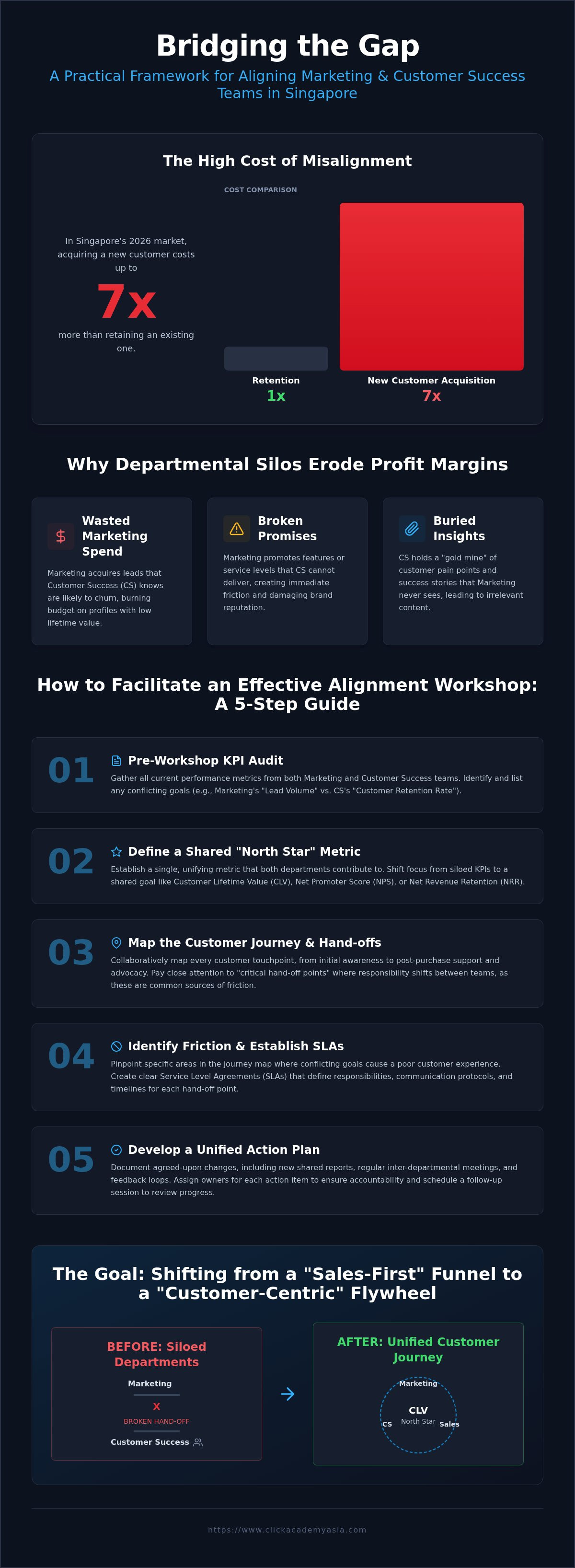
How to facilitate an effective alignment workshop: A 5-step guide
Execution is where most leaders stumble. While the theory of collaboration is sound, a workshop for aligning marketing and customer success requires rigorous preparation to be effective. Before the session begins, gather your data on churn rates, lead conversion, and customer feedback from the last six months. This ensures your discussion is grounded in reality rather than departmental assumptions.
Follow this structured sequence to move from friction to a unified strategy:
Step 1: The Goal Audit. Review your current KPIs. If Marketing is measured purely on lead volume while Customer Success (CS) is measured on retention, you've identified a primary source of conflict.
Step 2: Journey Mapping. Plot the customer path from the first touchpoint to the second renewal. Identify the specific moments where customers feel a drop in service quality during the handover.
Step 3: Content Gap Analysis. Determine what CS needs from Marketing to help customers succeed. Often, Marketing creates "top-of-funnel" content while CS is left to build their own technical guides from scratch.
Step 4: The Agreement. Draft a preliminary Service Level Agreement (SLA) or a shared goal document. This should define exactly what constitutes a "success-ready lead."
Step 5: The Implementation Roadmap. Assign owners to every action item. Define what success looks like in 30, 60, and 90 days to maintain momentum.
Facilitation tips for Singaporean PMEBs
Keep the session action-oriented. Avoid "death by PowerPoint" and instead use interactive whiteboards or breakout groups to solve specific problems. In many Singaporean corporate environments, hierarchy can sometimes stifle open dialogue. Using a neutral facilitator can prevent department heads from dominating the conversation, allowing front-line staff to share the "gold mine" of data they encounter daily. Focus on "Quick Wins" that your team can implement within 30 days to build immediate confidence in the new framework.
Turning workshop ideas into permanent habits
A single session won't fix years of siloed thinking. Establish a monthly "Alignment Sync" to review progress on the outcomes of your workshop for aligning marketing and customer success. Create a shared dashboard that both teams check daily to monitor their unified "North Star" metrics. For leaders looking to drive this cultural shift, exploring strategic leadership and marketing programmes can provide the formal frameworks needed to sustain long-term change. Upskilling your team through WSQ-certified tracks ensures that these new habits are backed by industry-standard best practices.
Scaling alignment through WSQ-funded leadership training
While an internal workshop for aligning marketing and customer success provides the initial spark for change, formal training provides the high-octane fuel needed for long-term operational shifts. Alignment isn't a one-off event; it's a strategic habit that requires a deep understanding of industry-standard frameworks. By moving from a single session to a structured certification path, your organisation ensures that these new collaborative behaviours become permanent fixtures of your corporate culture.
In Singapore, the financial barrier to this high-level upskilling is significantly lowered through government support. Leveraging SSG funding allows your business to invest in its workforce without straining the bottom line. Eligible Small and Medium Enterprises (SMEs) can receive up to 90% subsidies on course fees through the Enhanced Training Support for SMEs (ETSS) programme. Even for larger corporations, a baseline subsidy of up to 50% is available for Singaporean and Permanent Resident employees. Additionally, the Mid-Career Enhanced Subsidy (MCES) provides up to 90% funding for Singapore Citizens aged 40 and over, ensuring your senior leaders can stay at the cutting edge of digital strategy.
Why WSQ frameworks matter for alignment
Standardising skills across your organisation is the only way to ensure everyone uses the same methodologies and vocabulary. When both your Marketing and Customer Success leads are trained under the same WSQ frameworks, the friction of "speaking different languages" disappears. These programmes offer a clear career progression path for PMEBs, ensuring your top talent remains engaged and future-ready. It's about moving beyond theory and into practical mastery. You can explore the specific pathways available in our guide on WSQ Digital Marketing Courses in Singapore. This consistency is what allows a workshop for aligning marketing and customer success to translate into actual revenue growth.
Your next move: Equip your leaders
Your first step is to identify the key PMEBs who will lead the alignment charge within your business silos. These individuals need the authority and the technical expertise to implement the shared metrics and data integrations discussed in your sessions. Booking a consultation with an expert training partner can help you tailor a WSQ-funded track specifically for your team's needs. Encourage a culture of continuous learning to stay ahead of 2026 digital trends and ensure your customer journey remains seamless. Investing in your people is the most effective way to future-proof your business against rising acquisition costs.
Future-Proof Your Customer Journey Today
Success in Singapore's 2026 economy requires more than just high lead volumes; it demands a seamless transition from acquisition to advocacy. By implementing a structured workshop for aligning marketing and customer success, you've taken the first step toward eliminating departmental silos and protecting your revenue. You now have the framework to establish shared "North Star" metrics and define clear accountability through Service Level Agreements.
The next phase of your growth involves turning these strategic ideas into permanent habits. Continuous upskilling ensures your team remains agile and proficient in industry-standard methodologies. Our WSQ-certified modules are led by expert trainers with real-world APAC experience, providing the practical mastery your leaders need to excel.
Don't let internal misalignment stall your progress. Equip your team with WSQ-funded alignment strategies at ClickAcademy Asia and take advantage of up to 70% SSG funding available for eligible Singaporeans. It's time to transform your customer experience into a sustainable engine for growth. We're here to support your journey toward professional excellence.
Frequently Asked Questions
What is the main goal of a marketing and customer success alignment workshop?
The primary goal is to bridge the gap between acquisition and retention to create a unified customer journey. By conducting a workshop for aligning marketing and customer success, teams establish shared metrics like Customer Lifetime Value (CLV) instead of working in silos. This ensures Marketing attracts the right leads while Customer Success has the tools to retain them, ultimately reducing churn and increasing long-term profitability in Singapore's competitive market.
How often should we hold alignment workshops?
You should ideally hold these sessions quarterly to review progress and adjust strategies based on real-time data. Singaporean PMEBs often face rapid market shifts, making regular check-ins essential for maintaining operational integration. If a full-day session isn't feasible every three months, a shorter "Alignment Sync" can suffice. The key is consistency to ensure that the collaborative habits formed during the initial workshop don't fade over time as priorities evolve.
Can we run an alignment workshop virtually for remote teams?
Yes, you can effectively facilitate a workshop for aligning marketing and customer success using digital whiteboards and video conferencing platforms. Virtual sessions require more structured breakout groups and shorter, punchy activities to maintain engagement. While face-to-face interaction is valuable for building empathy, remote workshops allow APAC-wide teams to collaborate on shared Service Level Agreements (SLAs) without logistical hurdles, provided you use the right collaborative technology to maintain a single source of truth.
What are the best KPIs to track for Marketing-CS alignment?
The most effective KPIs are those that measure the entire customer lifecycle rather than just departmental wins. Focus on Customer Lifetime Value (CLV), Net Promoter Score (NPS), and expansion revenue from existing accounts. Tracking the "Lead to Renewal" rate is also vital for identifying where handovers fail. These shared metrics incentivise both teams to care about the quality of leads and the success of the post-purchase experience, driving sustainable growth for your organisation.
Who should attend the alignment workshop?
Attendance should include leadership from both departments along with key front-line staff who manage the customer transition. Including your Marketing Managers and Customer Success Leads ensures that strategic goals are grounded in daily operational reality. It's often beneficial to include a neutral facilitator or an HR decision-maker to manage the conversation. This mix of high-level vision and granular experience is what makes the outcomes actionable for the whole organisation and its PMEB workforce.
How does SSG funding work for marketing and sales leadership programmes?
SSG funding provides significant subsidies to reduce the cost of professional development for Singaporean employees. Eligible SMEs can receive up to 90% subsidies through the Enhanced Training Support for SMEs (ETSS) programme. Non-SME corporations receive a baseline subsidy of up to 50% for their staff. Singapore Citizens aged 40 and over can also access the Mid-Career Enhanced Subsidy (MCES), which covers up to 90% of course fees for WSQ-certified leadership and marketing tracks.
What is the difference between Sales-Marketing alignment and Marketing-CS alignment?
Sales-Marketing alignment focuses primarily on the transition from a lead to a closed deal at the top of the funnel. In contrast, Marketing-CS alignment looks at the entire customer journey, ensuring that marketing promises match the post-purchase reality. While the former aims for conversion volume, the latter prioritises retention and long-term loyalty. Both are essential for growth, but Marketing-CS alignment is the primary driver for improving Customer Lifetime Value in a saturated landscape.
What tools are needed to support cross-departmental alignment after a workshop?
Successful alignment requires a "Single Source of Truth," typically provided by an integrated CRM system like HubSpot or Salesforce. You'll also need shared dashboards to track unified KPIs in real-time across both departments. Communication tools like Slack or Microsoft Teams should have dedicated channels for cross-departmental feedback loops. These technologies ensure that the agreements made during your workshop translate into daily habits and transparent data sharing across your entire Singaporean team.


Comments