
AI-Powered Marketing Automation: The 2026 Professional Guide to Intelligent Growth
- ClickAcademy Asia

- Apr 27
- 12 min read
Updated: May 22
By 2026, the traditional marketing funnel won't just be outdated; it'll be a liability for any Singaporean business still relying on manual triggers. You've likely felt the exhaustion of manual segmentation taking days to execute, only to find your data is siloed across three different platforms. It's difficult to prove ROI when you're spending more time cleaning spreadsheets than actually scaling campaigns. This is where AI-Powered Marketing Automation becomes your most valuable asset, turning static rules into intelligent, predictive machine learning workflows.
We're here to help you master this transition so you can stop fearing AI tools and start leading with them. You'll discover how to achieve predictive customer targeting and automated data cleaning to boost your campaign efficiency by at least 35%. This guide outlines the path to gaining an industry-recognised WSQ certification, ensuring your skills remain sharp in a competitive market. We'll walk through the exact steps to integrate these intelligent systems into your 2026 growth strategy.
Key Takeaways
Transition from rigid, rules-based triggers to self-optimising, predictive machine learning workflows that allow your marketing ROI to scale autonomously.
Master the four essential pillars of an intelligent framework—Data, Algorithms, Workflows, and Attribution—to build a robust foundation for modern campaign execution.
Gain a competitive edge by learning how to implement AI-Powered Marketing Automation - https://www.clickacademyasia.com/course/ai-powered-marketing-automation to solve complex multi-touch attribution challenges.
Follow a practitioner-led roadmap to establish clean data management protocols and ensure seamless interoperability across your entire marketing tech stack.
Accelerate your career in the Singapore market by securing industry-recognised certifications that prove your mastery of high-level digital transformation.
Table of Contents Understanding AI-Powered Marketing Automation in 2026 The Core Pillars of an Intelligent Automation Framework AI-Powered vs. Traditional Marketing Automation: The Strategic Shift Implementing AI Workflows: A Practical Roadmap for Professionals Future-Proofing Your Career with AI-Powered Marketing Automation Training
Understanding AI-Powered Marketing Automation in 2026
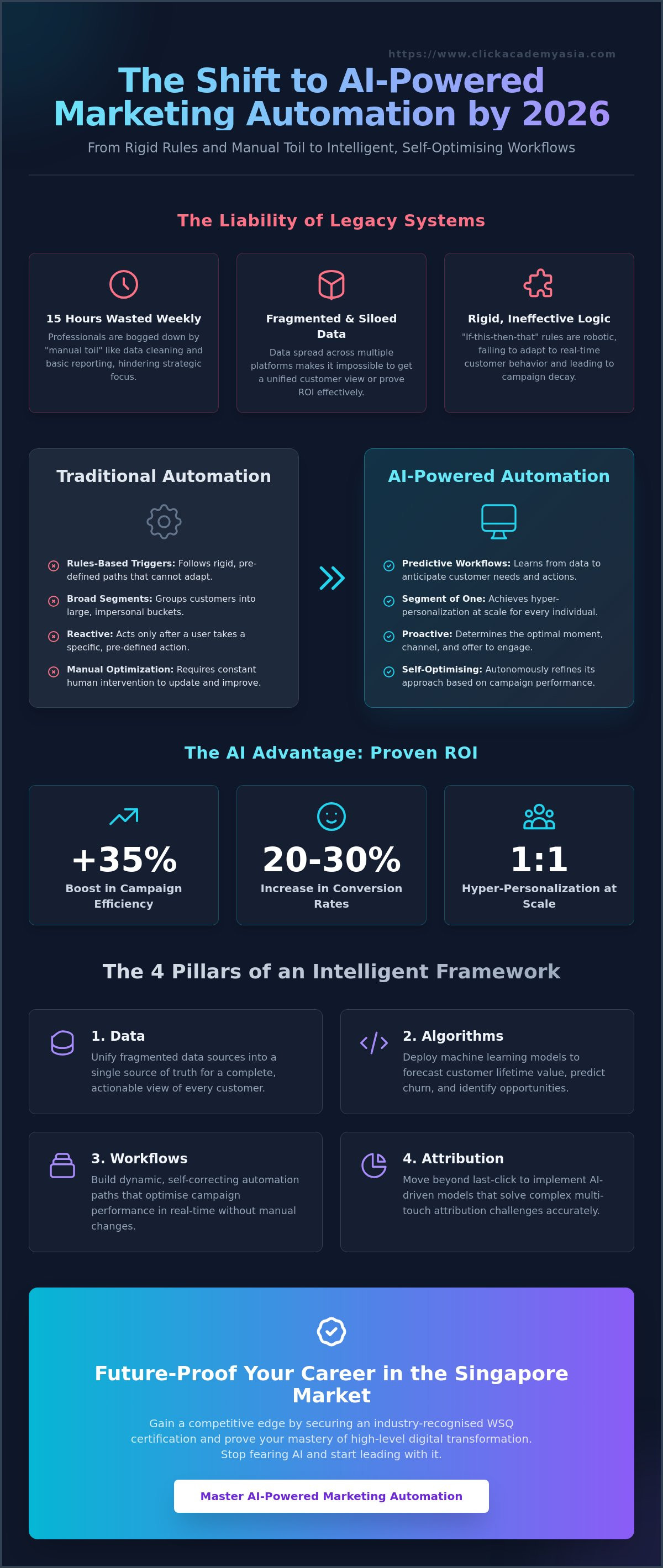
By 2026, the gap between traditional digital tools and intelligent systems has become a defining chasm for businesses in Singapore. Professionals are moving away from static platforms to embrace systems that don't just follow instructions but actually learn from results. AI-Powered Marketing Automation represents the sophisticated fusion of machine learning and real-time campaign execution.
This shift is fundamental for any marketer who wants to lead in the current landscape. It moves the focus from setting up manual triggers to overseeing predictive, self-optimising workflows that adjust based on live consumer data. Modern Marketing Automation relies on these intelligent layers to ensure every touchpoint is relevant, timely, and data-backed.
To better understand how these systems function in a real-world professional setting, watch this helpful video:
The Evolution from Legacy Automation to Intelligent Systems
Traditional automation relied on rigid "if-this-then-that" logic which often felt robotic to the end user. If a customer abandoned a cart, they received a generic email three hours later. Intelligent systems in 2026 have replaced this with predictive decisioning. Machine learning algorithms now analyse thousands of historical data points to determine the exact moment, channel, and offer that will resonate with a specific individual.
This evolution enables hyper-personalisation at scale. Instead of segmenting audiences into broad buckets, AI treats every customer as a segment of one. It constantly refines its approach based on how users interact with content, ensuring that your marketing efforts remain agile and effective without constant manual intervention.
Why AI is the Essential Catalyst for Marketing Growth
The sheer volume of data generated in the Singaporean market today is impossible for human teams to process manually. Marketing teams often spend up to 15 hours a week on "manual toil," such as cleaning data or basic campaign reporting. AI acts as a catalyst by taking over these repetitive tasks, allowing professionals to focus on high-level strategy and creative direction.
AI-Powered Marketing Automation is a strategic framework that aligns algorithmic precision with business objectives rather than just a collection of software tools. By implementing this framework, brands can achieve a 20% to 30% increase in conversion rates through better timing and message accuracy.
To master this landscape, professionals must focus on several core learning objectives:
Data Management: Learning how to unify fragmented data sources into a single source of truth.
Predictive Modelling: Understanding how to use AI to forecast customer lifetime value and churn.
Workflow Deployment: Building self-correcting automation paths that optimise themselves in real-time.
Ethical Governance: Navigating data privacy regulations in Singapore while maintaining high levels of personalisation.
For those ready to advance their careers, ClickAcademy Asia
The Core Pillars of an Intelligent Automation Framework
To master AI-Powered Marketing Automation, you must look beyond the shiny interfaces of software tools. A robust framework rests on four essential pillars: Data, Algorithms, Workflows, and Attribution. These components function as a single ecosystem to guide a customer from their first interaction to becoming a loyal brand advocate. When these pillars align, they create a seamless journey that feels personal to the consumer but remains scalable for the business.
A common misconception is that AI serves as a "set and forget" solution. This mindset often leads to campaign decay. A 2024 industry report indicated that 65% of marketing leaders see better ROI when they move away from total automation toward a practitioner-led approach. You need human expertise to calibrate the system, interpret nuances in the Singapore market, and ensure the technology serves your specific business objectives. AI is your engine, but you remain the driver.
Machine Learning and Predictive Analytics
Algorithms take raw information and turn it into foresight. By using statistical models, you can enhance customer targeting and segmentation accuracy by over 40% compared to manual methods. These statistics form the backbone of a robust implementation framework, allowing you to move from reactive to proactive marketing.
In a B2B context, predictive lead scoring is a game-changer. Instead of treats all leads equally, the system analyses historical data to identify which prospects are most likely to close. A Singapore-based software firm might use this to prioritise leads that have visited their pricing page three times in 48 hours, assigning them a higher score for immediate sales follow-up. Understanding the Future of Marketing means recognising that your competitive edge lies in these predictive capabilities.
Data Interoperability and Interoperability Protocols
Your AI is only as good as its fuel. Data interoperability refers to the ability of different platforms, such as your CRM, email engine, and social media tools, to communicate effectively. Without data transformation mapping, your insights stay trapped in silos. This mapping ensures that a "customer ID" in one system matches the "user profile" in another, creating a unified view of the person behind the screen.
Clean data acts as the essential fuel for AI-Powered Marketing Automation. If your input is messy or outdated, the resulting automation will be flawed. Professionals who want to excel in this area often find that a practitioner-led training programme helps them master the technical protocols required to keep their data ecosystems healthy and functional. Focusing on these pillars ensures your marketing remains intelligent, agile, and results-driven.
AI-Powered vs. Traditional Marketing Automation: The Strategic Shift
Traditional marketing automation relies on "if-then" logic. If a lead downloads a whitepaper, then send them an email three days later. This rules-based approach worked well in 2015, but it lacks the scalability required for the modern Singaporean market. When you try to manage 50 different customer journeys using manual rules, the system inevitably breaks under its own weight. It becomes a tangled mess of conflicting triggers that require constant human maintenance.
The transition to AI-Powered Marketing Automation represents a fundamental move from rigid programming to fluid learning. Instead of a marketer guessing which path a customer might take, machine learning models analyse millions of data points to predict the next best action. This shift solves the biggest bottleneck in growth: human bandwidth. AI doesn't get tired of segmenting lists or checking for broken links; it thrives on the complexity that usually overwhelms marketing teams.
One common hurdle for professionals in Singapore is the belief that AI tools are too technical for non-coders. This is a misconception. Most modern platforms are designed for practitioners, not programmers. They feature intuitive interfaces that allow you to set strategic goals while the engine handles the underlying mathematics. These systems even troubleshoot themselves. By using automated severity classifications, the software can flag a "Level 1" critical error if a payment gateway fails, or a "Level 4" minor suggestion if a subject line underperforms. You spend less time fixing "leaky" funnels and more time on high-level strategy.
Moving from Static Segments to Dynamic Personas
In the past, marketers relied on static lists that were often outdated by the time the campaign launched. AI changes this by creating dynamic personas that evolve in real-time. If a prospect's browsing behaviour shifts from "awareness" to "intent" at 2:00 AM, the system updates their profile instantly. According to recent industry insights on AI's transformation of marketing, this level of precision is what drives the 20% to 30% lift in conversion rates seen by early adopters. Your messaging finally aligns perfectly with the user's immediate needs, rather than a category you assigned them three months ago.
Attribution Analysis and Mathematical Optimisation
Proving marketing ROI has historically been a guessing game. Linear attribution models give 100% of the credit to the last click, ignoring the five touchpoints that actually built the trust. AI-driven multi-touch attribution uses mathematical models to weigh every interaction fairly. This allows you to see exactly which social media post or webinar contributed to a sale in S$ terms. When you can measure performance with this level of granularity, you can justify your budget with total confidence. Learn more about Digital Marketing Strategy to see how these metrics fit into a broader corporate framework.
Implementing AI Workflows: A Practical Roadmap for Professionals
Building a robust system for AI-Powered Marketing Automation requires moving beyond simple plug-and-play tools. You need a structured engineering mindset to ensure your tech stack delivers measurable growth. Professionals in Singapore must transition from manual campaign management to a four-step framework that treats marketing as a scalable software product.
Step 1: Establish data management principles by auditing your current sources and cleaning legacy records to remove duplicates.
Step 2: Develop protocols for data interoperability, ensuring your CRM, website analytics, and social media platforms communicate via secure APIs.
Step 3: Configure marketing workflows using Agile methodologies, treating each campaign as a "sprint" with defined version controls.
Step 4: Monitor performance through real-time dashboards and document every test result to prevent model drift.
Data Transformation and Cleaning Techniques
You cannot feed messy spreadsheets into a machine learning model and expect precision. The process of producing a cleaned dataset involves deduplicating records, correcting formatting errors, and validating email addresses. In Singapore, ensuring all contact numbers follow the +65 prefix is a basic but essential standardisation step. When information is standardised, the AI can accurately identify patterns across different segments without being confused by varied data entries. For example, if your "Industry" field contains both "F&B" and "Food and Beverage," the AI will treat them as separate entities, diluting your insights. Quick win: To identify data silos, compare a single customer's record in your CRM against their record in your email tool; any discrepancy in their last interaction date signals a silo that needs immediate integration.
Deploying Automated Customer Journeys
Modern customer journeys must be adaptive rather than linear. Successful AI-Powered Marketing Automation uses branching logic that reacts to real-time user behaviour. If a prospect downloads a whitepaper but doesn't open the follow-up email, the system should pivot, perhaps serving a targeted case study via a LinkedIn ad instead of sending a second email. This level of sophistication requires deep collaboration with technology service providers to ensure your tracking pixels and server-side events are firing correctly. It's not just a marketing task; it's a technical integration that demands clear communication between your creative and IT teams. Successful deployment requires a comprehensive implementation checklist to ensure no lead falls through the cracks during the transition.
Ready to lead your organisation's digital transformation? Master the latest automation strategies with ClickAcademy Asia
Future-Proofing Your Career with AI-Powered Marketing Automation Training
The shift toward AI-driven workflows isn't a distant trend; it's the current reality for Singapore's marketing sector. By 2026, professionals who can orchestrate complex algorithms will command significantly higher salaries than those who rely on manual processes. Transitioning your skill set now ensures you don't just survive the automation wave but lead it. Mastering AI-Powered Marketing Automation transforms you from a traditional executor into a high-value strategist capable of driving measurable business growth. Research from the World Economic Forum suggests that 40% of workers will need to reskill by 2026, and those with AI competencies will be at the front of the queue for leadership roles.
The Value of WSQ Certification and SSG Funding
Singapore's Workforce Skills Qualifications (WSQ) framework provides a gold standard for professional training. These certifications guarantee that your skills meet rigorous national benchmarks, making your expertise immediately recognisable to employers across the region. For Singapore Citizens and Permanent Residents, the financial barrier to entry is remarkably low. SSG subsidies can cover up to 70% or 90% of course fees, depending on your age and eligibility. You can also utilise your SkillsFuture credits to offset any remaining out-of-pocket costs, making this an accessible investment in your future. This structured support system ensures that high-level education remains affordable for both individual learners and corporate cohorts looking to upskill entire teams at once.
Why Practitioner-Led Training Matters
Theoretical knowledge often fails when it meets the messy reality of live data and shifting algorithms. Practitioner-led workshops bridge this gap by placing you in the room with experts who manage million-dollar budgets daily. Unlike passive online videos, these intensive bootcamps focus on rapid skill acquisition through hands-on simulations. You'll benefit from:
Real-world case studies: Learn from actual campaigns rather than hypothetical scenarios.
Immediate feedback: Get your questions answered by mentors who understand the nuances of the Asian market.
Practical toolkits: Walk away with frameworks you can implement in your office the very next day.
Networking opportunities: Connect with a cohort of ambitious peers and industry leaders.
Choosing a practitioner-led path means you're learning the "how" and the "why" behind every automated trigger. This deep understanding is what separates a technician from a future-ready leader who can navigate the complexities of the 2026 job market with confidence. The window for early adoption is closing fast as more businesses integrate these tools into their core operations.
Don't let your skills stagnate while the industry evolves. Secure your place at the forefront of digital excellence and enrol in the AI-Powered Marketing Automation course to accelerate your professional growth today.
Secure Your Competitive Edge in the AI Era
The shift toward 2026 demands more than just basic software updates. It requires a fundamental move from manual triggers to self-optimising systems that predict customer needs before they arise. By building a robust framework and mastering AI-driven workflows, you're not just keeping up; you're setting the pace for your entire industry in Singapore. Success in this new landscape depends on your ability to integrate these intelligent tools into a cohesive strategy that prioritises high-value human creativity.
Staying ahead means investing in skills that the market actually values. Since 2011, over 30,000 professionals have upskilled with ClickAcademy Asia to remain relevant. Our practitioner-led training ensures you gain hands-on experience that translates directly to your daily tasks. Because our curriculum is WSQ-certified and SSG-funded, you can access high-level expertise while making a smart financial decision for your career growth.
Now is the time to lead your team with AI-Powered Marketing Automation - https://www.clickacademyasia.com/course/ai-powered-marketing-automation. You've got the potential to transform your strategy and achieve unprecedented growth. Master AI-Powered Marketing Automation Today and start your journey toward becoming a future-ready leader. We're excited to see what you'll achieve next.
Frequently Asked Questions
What is AI-Powered Marketing Automation and how does it differ from standard automation?
AI-Powered Marketing Automation uses machine learning to make real-time decisions instead of relying on fixed, manual rules. Standard automation follows basic "if-this-then-that" logic, such as sending a welcome email after a sign-up. AI goes further by analysing historical data to predict when a customer is most likely to buy. This allows you to scale personalised experiences that adapt to individual user behaviours without constant manual intervention.
Can I take the AI-Powered Marketing Automation course if I don't have a technical background?
You don't need any coding or data science experience to enrol in this course. Our curriculum is specifically designed for marketing professionals and business owners who want to master the strategic implementation of tools. You'll learn to navigate user-friendly platforms that bridge the gap between complex algorithms and everyday tasks. This practitioner-led approach ensures you gain practical mastery regardless of your current technical starting point.
What are the specific WSQ learning outcomes for this automation bootcamp?
Participants will achieve three core WSQ learning outcomes focused on operational excellence. First, you'll learn to evaluate and select the right AI tools for specific business needs. Second, the course covers the setup and management of automated workflows to improve lead nurturing. Third, you'll master the ability to interpret performance data to refine marketing strategies, ensuring every campaign meets 2026 industry standards for efficiency.
How much can I save on course fees using SkillsFuture Credit and SSG grants?
Singapore Citizens and Permanent Residents can access SSG grants that cover a large portion of training costs. Eligible individuals often receive up to 70% in subsidies; those aged 40 and above may qualify for even higher support through the Mid-Career Enhanced Subsidy. You can use your SkillsFuture Credit to pay for the remaining balance. This significantly reduces your personal financial investment while you future-proof your career skills.
Will I receive an industry-recognised certification upon completion of the training?
You'll receive a Statement of Attainment (SOA) under the WSQ framework once you successfully complete the course assessment. This certification is widely recognised by employers across Singapore as a mark of practical proficiency in digital marketing. Because ClickAcademy Asia is a premier regional leader, your credential validates your expertise to both local firms and global tech giants, helping you stand out in a competitive job market.
How does machine learning improve customer targeting in marketing campaigns?
Machine learning improves targeting by identifying subtle patterns in vast datasets that human marketers often miss. It segments your audience dynamically, moving users between groups as their behaviour changes in real-time. By applying these algorithms, businesses can see a 20% increase in conversion rates. You'll deliver hyper-personalised content to the individuals most likely to engage at any given moment, which reduces wasted ad spend and boosts ROI.
What is data interoperability and why is it essential for AI marketing?
Data interoperability is the capacity for different software systems to share and use information without friction. It's the backbone of AI-Powered Marketing Automation because algorithms need a clean, holistic view of customer data to work accurately. When your CRM, email platform, and website talk to each other, the AI can deliver a consistent message across every touchpoint. This prevents data silos that often lead to fragmented and ineffective customer experiences.
What kind of troubleshoot reporting is taught in the marketing automation course?
The course teaches you how to build and interpret diagnostic reports that identify bottlenecks in your automated funnels. You'll learn to spot "drop-off" points where users stop engaging and use data to determine if the issue is technical or content-related. These sessions ensure you can maintain a healthy marketing ecosystem. You'll gain the confidence to fix errors before they impact your overall revenue, ensuring your automated systems run smoothly.


Comments