
2026 E-commerce Pricing Guide for Singapore Businesses
- ClickAcademy Asia

- 20 minutes ago
- 11 min read
With e-commerce now accounting for 16.2% of total retail sales in Singapore, the margin for error in your valuation has never been thinner. You've likely felt the sting of shrinking profit margins as global and local competitors engage in aggressive price wars. It's a common struggle for PMEBs who feel uncertain about deploying complex dynamic pricing tools or simply lack the internal expertise to execute sophisticated models effectively.
This guide is designed to help you master the most effective e-commerce pricing strategies to optimise your profit margins and dominate the Singapore market. We'll provide a clear framework for selecting the right pricing model, explain how to leverage data for precision, and detail how your team can utilise SSG funding for essential upskilling. By the end of this article, you'll have a practical roadmap to transform your pricing from a guessing game into a strategic competitive advantage.
Table of Contents
Why E-commerce Pricing Strategies are the Ultimate Lever for Singapore Brands
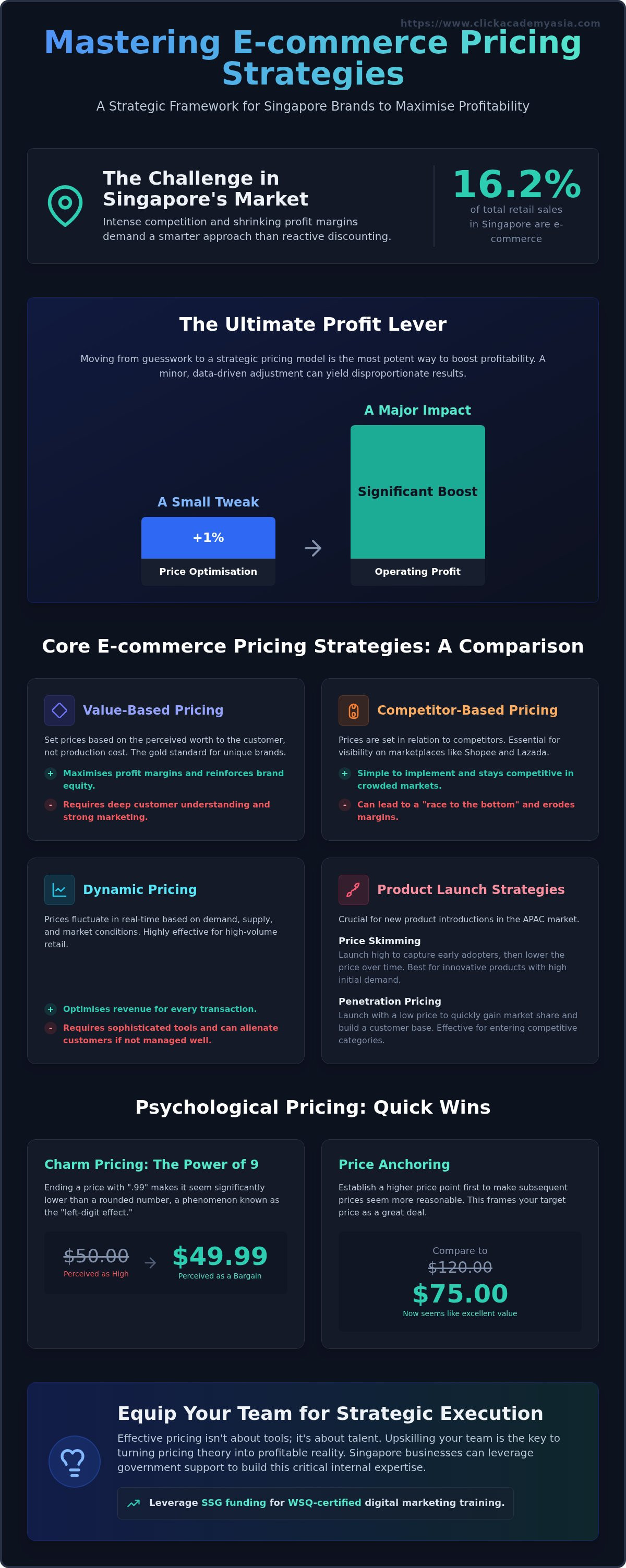
Singapore's e-commerce market in 2026 is defined by intense saturation and rising customer acquisition costs (CAC). For local PMEBs, simply buying traffic is no longer a sustainable path to profitability. Instead, sophisticated e-commerce pricing strategies represent the most potent lever to offset these overheads. A mere 1% improvement in price execution can lead to a disproportionate increase in operating profit, particularly within the fast-moving APAC region where consumer price sensitivity is high but brand loyalty is still winnable.
Moving from reactive discounting to a proactive strategy is the primary challenge for Singaporean executives. While a flash sale might provide a temporary revenue spike, constant price slashing trains customers to wait for discounts, which eventually destroys your brand equity. Strategic pricing intelligence helps you identify when to hold your ground and when to pivot, ensuring your brand remains a premium choice in a crowded digital gallery. It's about shifting the focus from "how much can I sell?" to "how much value can I capture?".
The Shift from Cost-Plus to Strategic Value in 2026
Cost-plus models are essentially relics in a globalised digital marketplace where price transparency is absolute. These models fail because they ignore the perceived value in the eyes of the consumer and the real-time fluctuations of the market. Today, many local brands are successfully leveraging the "Singapore Premium" to justify higher price points. This premium is built on Singapore's reputation for quality, trust, and logistical excellence. By applying the WSQ Digital Marketing Strategy & Planning framework, you can learn to quantify these intangible benefits and incorporate them into your valuation. Advanced techniques like Dynamic Pricing allow you to stay competitive in real-time by adjusting to demand shifts without sacrificing your bottom line.
Pricing as a Component of Digital Marketing Strategy & Planning
Pricing shouldn't exist in a vacuum; it's a critical component of your broader 4Ps. Your price point directly influences your SEO and SEM performance, as click-through rates on Google Ads often fluctuate based on how your price compares to competitors in the same search result. Higher margins from optimised pricing also provide more "breathing room" for aggressive SEM bidding, allowing you to dominate high-intent keywords that competitors might find too expensive. Strategic pricing is the deliberate practice of aligning price points with customer value and market conditions to drive sustainable business growth for Singaporean executives. When integrated correctly, your pricing becomes a silent salesperson that reinforces your brand's position every time a user views your product listing.
Core E-commerce Pricing Strategies: A Comparative Analysis
Selecting between different e-commerce pricing strategies isn't just a financial decision; it's a statement of brand intent. In Singapore's hyper-competitive digital economy, your chosen model must reflect both your operational costs and the specific value you provide to a discerning PMEB audience. Your pricing architecture dictates how customers perceive your quality before they even click "add to cart."
Value-Based Pricing represents the gold standard for brands with a unique value proposition. Instead of looking at what it costs to produce a product, you look at what it's worth to the user. This approach requires deep customer empathy and strong brand storytelling to justify higher margins. Research into hybrid retail pricing models by SMU highlights that maintaining this value perception across both brick-and-mortar and online storefronts is critical for Singaporean retailers to avoid channel conflict.
Competitor-Based Pricing remains a necessity for those selling on marketplaces like Shopee or Lazada. Here, the goal is staying relevant within the platform's algorithm. While effective for shifting volume, it often leads to a race to the bottom unless you pair it with a superior service experience or unique bundles that make direct price comparisons difficult.
Utilising real-time data to optimise for demand is the hallmark of Dynamic Pricing. This is particularly useful for travel, hospitality, or high-volume retail where supply fluctuates. Brands launching new products in 2026 must also choose between Price Skimming and Penetration Pricing. Skimming targets early adopters at a high price point to recover costs quickly. Penetration pricing involves setting a low initial price to gain rapid market share in the APAC region, a tactic frequently used by new entrants to disrupt established incumbents.
Value-Based Pricing for High-Growth Brands
To quantify value for Singaporean professionals, focus on tangible outcomes like time saved or risk mitigated when developing your e-commerce pricing strategies. Moving from the "cheapest" label to the "best" label involves shifting the narrative from price to performance. This transition is a key module in our WSQ Digital Marketing Strategy & Planning course, where we teach leaders how to align price with brand equity.
Pricing Strategies for SaaS Products and Subscriptions
SaaS leaders in Singapore often move towards usage-based models to scale revenue alongside their clients' growth. Finding the "Goldilocks" zone in tiered pricing ensures that users don't feel overwhelmed while still providing a clear path for account expansion. Managing the "Churn" factor involves strategic price adjustments or offering "value-add" tiers that provide more features without a significant price hike, keeping long-term retention high.
The Psychology of Price: Quick Wins for Singaporean E-tailers
Price is rarely just a mathematical calculation; it's a psychological trigger. For Singaporean e-tailers, mastering the subtle cues of perception is vital for refining e-commerce pricing strategies. These "quick wins" don't require massive software overhauls but do demand a deep understanding of consumer behaviour. When you change the context of a price, you change the perceived value of the product itself.
Charm Pricing: Ending prices with .99 or .90 remains effective because the "left-digit effect" makes $19.90 feel substantially lower than $20.00. It's a simple yet powerful way to reduce the psychological barrier to purchase.
Price Anchoring: By displaying a premium version of a product first, you set a high "anchor." This makes your mid-range, high-volume products appear much more affordable and attractive to PMEBs looking for quality at a fair price.
The Decoy Effect: Introduce a third pricing option that is priced similarly to your premium tier but offers significantly less value. This nudges customers toward the more expensive, higher-value option you actually want to sell.
Bundling: Combine related products into a single SKU to increase your Average Order Value (AOV). It reduces the "pain of paying" by masking the individual cost of each item, making the overall deal feel like a significant win.
Leveraging Scarcity and Urgency in Pricing
Flash sales and countdown timers create immediate action, yet they must be balanced with brand integrity. If every day is a "closing down sale," Singaporean consumers will quickly lose trust. A more sustainable approach involves using "exclusive" pricing for loyalty programme members. This rewards your most valuable customers and prevents your brand from being sucked into the race to the bottom during major Singapore sales events like 11.11 or the Great Singapore Sale. Strategic scarcity should feel like a privilege, not a gimmick. It builds a sense of community while protecting your long-term margins.
Transparency and Trust in Professional Pricing
Hidden fees are the absolute killer of e-commerce conversions in Singapore. Savvy PMEBs expect the price they see on the product page to be the price they pay at checkout. Whether you're in B2C or B2B, providing clear payment options and agreed pricing structures is non-negotiable for building long-term credibility. Honest, value-aligned pricing structures prove that you respect your customer's intelligence. This transparency is a cornerstone of professional excellence, distinguishing market leaders from those just looking for a quick transaction. By being upfront, you reduce friction and foster a relationship based on mutual respect rather than bait-and-switch tactics.
How to Implement and Optimise Your Pricing Strategy
Executing successful e-commerce pricing strategies in Singapore isn't a one-time event; it's a continuous cycle of refinement. To stay ahead in 2026, you need a structured workflow that combines market intelligence with internal performance data. This ensures your prices remain competitive without sacrificing the profit margins necessary for long-term growth.
Step 1: Market Intelligence. Use Singapore-specific tools to track competitor movements across local marketplaces like Shopee, Lazada, and Amazon SG. Knowing your relative position is the first step toward strategic adjustment.
Step 2: Internal Data Audit. Analyse your transaction history and user behaviour. If your team needs to sharpen their data interpretation skills, consider enrolling them in WSQ Marketing Analytics & Insights to turn raw numbers into actionable pricing pivots.
Step 3: Controlled A/B Testing. Experiment with different price points for specific segments. Small, incremental changes often reveal the optimal conversion trigger where customer demand and profitability meet.
Step 4: Continuous Monitoring. Economic shifts, such as the 9% GST rate, and seasonal peaks require agile responses. Regularly review your strategy to ensure it aligns with the current Singaporean business climate.
Data-Driven Decisions: The Role of Marketing Analytics
GA4 provides the granular detail needed to track how price shifts influence user behaviour in real-time. By monitoring the 'Price Sensitivity' metric, you can identify which products are highly elastic and which ones can sustain a premium. Maintaining rigorous data hygiene is the only way to ensure your pricing accuracy remains untainted by skewed or duplicate numbers. This level of precision allows you to move beyond broad assumptions and target specific audience segments with surgical accuracy.
Tools and Automation for Dynamic Pricing
Selecting software to automate competitor tracking can save hundreds of man-hours, but "set and forget" automation is a significant risk. Without professional oversight, algorithms can accidentally trigger a race to the bottom that destroys your brand equity. Integrate these tools with your existing e-commerce platform to ensure seamless updates while keeping a human strategist in the loop to make final calls. Master the data behind your dollars by equipping your team with a WSQ Marketing Analytics & Insights certification today.
Future-Proof Your Business with WSQ Digital Marketing Training
High-tech tools provide the raw data, but high-touch expertise makes the final call. Mastering e-commerce pricing strategies requires more than just a subscription to a price tracker; it demands a trained mind capable of interpreting market shifts and consumer psychology. In a landscape where algorithms can trigger a race to the bottom, human intervention is the safeguard that protects your brand's premium status and long-term profitability.
The WSQ Digital Marketing Strategy & Planning programme equips your team with this exact framework. This course moves beyond basic tactics to foster a deep understanding of how price interacts with brand positioning, search visibility, and customer lifetime value. By empowering your team to lead digital transformation through certified programmes, you ensure that your business remains agile and results-driven in the face of rising competition.
Professional development is exceptionally accessible for Singaporean businesses. SSG provides baseline subsidies of up to 50% for Singapore Citizens and Permanent Residents. For those aged 40 and above, the Mid-Career Enhanced Subsidy (MCES) covers up to 70% of course fees. SMEs sponsoring eligible employees via the Enhanced Training Support for SMEs (ETSS) can even receive up to 90% funding, making it a cost-effective way to future-proof your workforce.
Upskilling as a Competitive Advantage in Singapore
Bridging the skill gap in your marketing and sales departments is the most direct way to improve corporate ROI. When your staff can confidently navigate complex e-commerce pricing strategies, they become strategic assets rather than mere executors. Certified training also plays a significant role in employee retention; professionals are more likely to stay with an organisation that invests in their tangible career growth. Applying for SSG subsidies is a straightforward process that ClickAcademy Asia can guide you through, ensuring your team gets the expertise they need without the heavy financial burden.
Next Steps: Enrolling in a WSQ-Accredited Programme
ClickAcademy Asia has been a premier destination for specialised education since 2011, acting as both an expert mentor and a modern consultancy. Our programmes focus on practical, real-world application rather than just academic theory. You'll learn from industry practitioners who understand the unique nuances of the Singaporean market. Equip your team with the strategic skills needed to dominate 2026 by enrolling in a WSQ-certified track with ClickAcademy Asia today.
Dominating the Singapore Market with Strategic Pricing
Refining your e-commerce pricing strategies is the most effective way to protect your margins against rising acquisition costs in Singapore. Success in 2026 requires a sophisticated blend of psychological triggers, real-time data analysis, and a shift toward value-based models. By aligning your price point with consumer perception and leveraging analytics for precision, you position your brand for sustainable growth across the region.
Analytical tools are only as powerful as the experts who manage them. Equipping your team with the strategic skills to navigate complex pricing models is your business's ultimate competitive advantage. Master your digital strategy and optimise your pricing with our SSG-funded WSQ Digital Marketing Strategy & Planning course.
As an Official Google Global Training Partner, ClickAcademy Asia provides WSQ-certified training with up to 70% SSG funding available for eligible Singaporeans. Take the lead and transform your pricing from a reactive tactic into a proactive engine for profit and market leadership.
Frequently Asked Questions
What is the best pricing strategy for a new e-commerce store in Singapore?
Start with penetration pricing if your goal is to gain quick market share in the competitive Singapore landscape. This involves setting a lower initial price to attract customers from established competitors. However, pairing this with a long-term transition to value-based e-commerce pricing strategies is essential to protect your margins. This dual approach ensures you build a customer base quickly while establishing the quality of your brand for the future.
How often should I change my e-commerce prices using dynamic pricing?
The frequency of updates depends on your specific industry and sales volume. For high-turnover sectors like electronics or fashion on marketplaces, daily adjustments might be necessary to stay competitive. In contrast, B2B or niche luxury brands should monitor prices weekly. Use analytics to track how these changes impact your conversion rates, ensuring you don't alienate loyal customers with excessive volatility that undermines their trust in your brand.
Can I use psychological pricing for B2B products and services?
Psychological pricing is highly effective in B2B settings, especially through price anchoring and tiered options. Corporate leaders often look for the "safest" choice, so presenting a premium tier makes your mid-range "professional" option seem like the best value. Using transparent, agreed pricing structures also builds significant credibility. It helps PMEBs justify the investment to their stakeholders by focusing on the tangible ROI and long-term benefits rather than just the initial cost.
Is there government funding available for digital marketing training in Singapore?
Yes, significant SSG funding is available for WSQ-certified digital marketing training in Singapore. Singapore Citizens and Permanent Residents can receive baseline subsidies of up to 50%. Those aged 40 and above qualify for the Mid-Career Enhanced Subsidy (MCES), which covers up to 70% of course fees. SMEs can also access up to 90% funding through the ETSS scheme, making upskilling an affordable strategic priority for local businesses.
What is the difference between price skimming and penetration pricing?
Price skimming involves launching at a high price point to capture early adopters before gradually lowering it as the market matures. This is ideal for innovative tech or luxury goods. Penetration pricing is the opposite; you set a low price to enter a crowded market and gain volume quickly. Choosing between them depends on whether your 2026 goal is immediate margin recovery or rapid expansion of your local customer base.
How do I calculate the optimal profit margin for my SaaS product?
Calculating SaaS margins requires a deep dive into your Customer Acquisition Cost (CAC) and Lifetime Value (LTV). While a gross margin of 70% to 80% is a common benchmark for established SaaS firms, your optimal net margin depends on your current growth phase. Use tools like GA4 to track user retention and churn rates. This data allows you to adjust your subscription tiers and ensure your e-commerce pricing strategies support sustainable scaling.
What are the common pitfalls of competitor-based pricing?
The biggest pitfall of competitor-based pricing is the race to the bottom where margins are sacrificed for volume. This strategy assumes your competitors have calculated their costs accurately, which isn't always true. It also ignores your brand's unique value proposition, making your product a mere commodity. Relying solely on this method can destroy your brand equity and leave you vulnerable to larger players with much deeper pockets and lower overheads.
How does pricing affect my Google Ads and SEM strategy?
Your price point directly impacts your Google Ads Click-Through Rate (CTR) and overall conversion performance. If your price is significantly higher than competitors in the same search result, your ad copy must work harder to justify that Singapore Premium. Conversely, a competitive price can boost your Quality Score by improving user engagement. Integrating pricing data into your SEM strategy allows for more aggressive bidding on high-intent keywords where your offer is clearly superior.


Comments