
AI-Powered Marketing Automation: A Professional Guide to 2026 Strategy

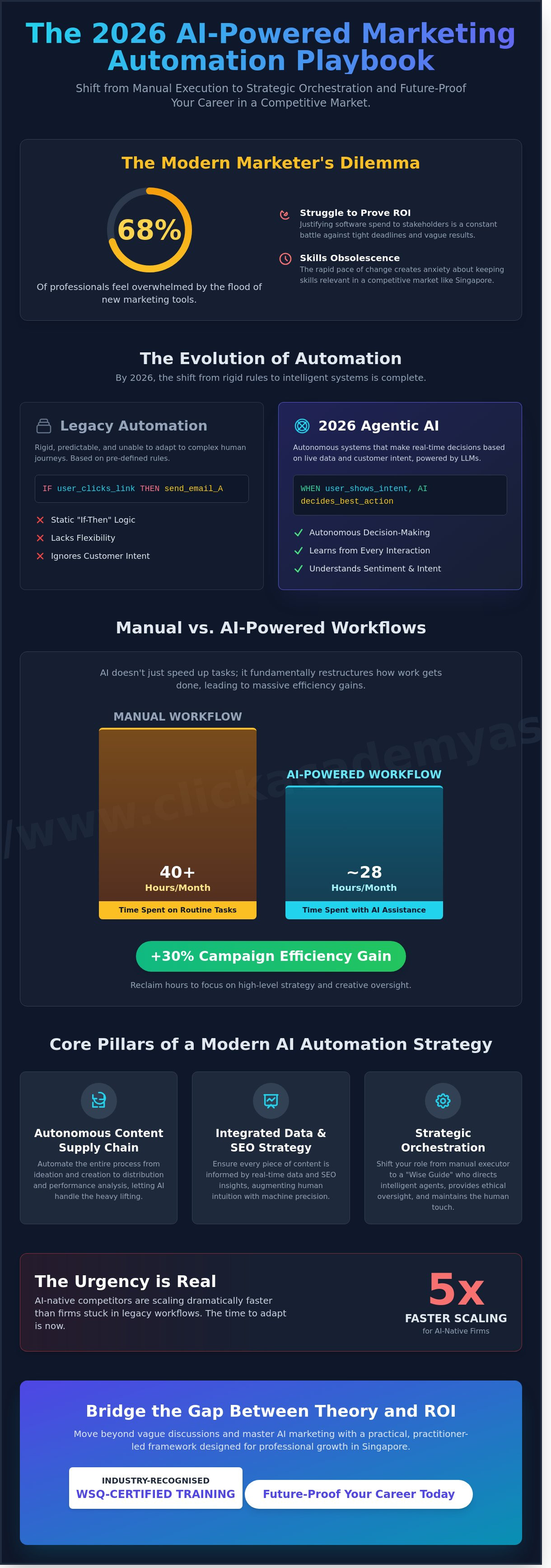
What if your current marketing tech stack is actually the biggest bottleneck in your department? It's a sobering thought for the 68% of professionals who, according to 2024 industry reports, feel consistently overwhelmed by the monthly flood of new tool releases. You likely agree that mastering AI-Powered Marketing Automation feels like trying to repair a jet engine while it's in mid-flight. It's increasingly difficult to justify software spend when you're struggling to prove a specific ROI to your stakeholders by the end of each financial quarter.
You don't have to navigate this shift alone or worry about your skills becoming obsolete in a competitive market like Singapore. This practitioner-led framework helps you move from manual execution to a sophisticated AI-driven strategy. We'll show you how to improve campaign efficiency by 30% and gain the industry-recognised certification needed to future-proof your career. We'll start by breaking down the 2026 strategy into actionable steps that you can implement to see immediate results.
Key Takeaways
Shift from rigid "if-then" logic to agentic AI models that autonomously manage complex marketing tasks and decision-making.
Master the three essential pillars of AI-Powered Marketing Automation to transform your results through a practitioner-led strategic framework.
Compare time-intensive manual workflows with 2026 efficiency gains to reclaim hours spent on lead nurturing and routine campaign management.
Follow a practical, step-by-step roadmap to implement advanced automation tools without getting lost in vague theoretical discussions.
Bridge the gap between theory and ROI by leveraging industry-recognised WSQ-certified training designed for professional growth in Singapore.
Table of Contents What is AI-Powered Marketing Automation in 2026? Core Pillars of a Modern AI Automation Strategy Manual vs. AI-Powered Workflows: A Strategic Comparison How to Implement AI Automation Without the Fluff Mastering AI Marketing with WSQ-Certified Training
What is AI-Powered Marketing Automation in 2026?
By 2026, the marketing landscape has shifted from static tools to autonomous systems. AI-Powered Marketing Automation is no longer a luxury for large enterprises; it is the standard for any professional in Singapore looking to scale effectively. This technology represents the fusion of machine learning and workflow software, allowing systems to learn from every interaction rather than just following a rigid script.
To understand the foundation of this shift, it helps to revisit What is Marketing Automation and how it has evolved from basic CRM integrations into a predictive powerhouse. Modern systems now categorise data patterns in seconds, a task that previously took human teams weeks to analyse. For professionals in Asia, mastering this orchestration is the key to maintaining a competitive edge in a market where 75% of consumers expect personalised real-time responses.
To better understand this concept, watch this helpful video:
The Evolution from Legacy Automation to Agentic AI
Traditional automation relied on rigid, "if-then" logic. If a user clicked a link, the system sent a specific email. This approach was predictable but lacked the flexibility to handle complex human journeys. By 2026, we have moved into the era of agentic AI. These modern agents make real-time decisions based on live data streams rather than pre-defined rules.
Large Language Models (LLMs) play a central role here by interpreting customer intent. Instead of just tracking a click, the AI understands the sentiment behind a customer's query. It can distinguish between a user who is ready to buy and one who is just researching. This allows the system to adjust its messaging instantly, ensuring every touchpoint feels bespoke and relevant.
Why Professionals Must Pivot to an AI-First Strategy
The urgency of the 2026 market cannot be overstated. AI-native competitors are now scaling up to 5 times faster than firms stuck in manual workflows. This shift changes your job role from manual content creation to high-level oversight and prompt engineering. You aren't just a marketer anymore; you're a strategic architect of automated ecosystems.
At ClickAcademy Asia, we advocate for the "Wise Guide" approach. This means using technology to enhance, not replace, human empathy. While the AI handles the heavy lifting of data processing, you provide the emotional intelligence and ethical oversight. Your goal is to move from execution to strategic orchestration, ensuring your brand stays human in an automated world.
Master the shift: Move from managing tools to directing intelligent agents.
Optimise for speed: Use real-time data to outpace traditional competitors.
Enhance empathy: Use AI insights to build deeper, more meaningful customer connections.
Our learning objectives for this guide are clear. We will show you how to transition from being a tool operator to becoming a leader who directs AI-Powered Marketing Automation with confidence. By the end of this series, you will have the framework to future-proof your career and lead your organisation through this technological transformation.
Core Pillars of a Modern AI Automation Strategy
Success in 2026 requires moving beyond basic task automation toward a practitioner-led framework. You need to understand how AI-Powered Marketing Automation restructures the entire content supply chain. This chain represents the end-to-end process of content creation, from ideation to distribution and performance analysis. By mastering these connections, you transform from a tool-user into a strategic architect of digital growth.
Integrating SEO and content strategy into this automated loop ensures that every piece of data informs your next creative move. This isn't about replacing human intuition; it's about augmenting it with precision. Practitioners who lead these initiatives focus on high-level orchestration rather than manual execution. This approach allows you to scale quality without sacrificing the human touch that defines your brand.
Hyper-Personalisation at Global Scale
AI allows you to move away from broad segments toward true one-to-one messaging. By analysing vast datasets, algorithms can adjust email subject lines or ad copy in real-time based on specific user history. A 2023 McKinsey report noted that companies seeing the fastest growth drive 40% more of their revenue from personalisation than their slower-growing peers. This level of dynamic content optimisation ensures that your emails and ads change automatically based on how a user behaves on your site.
Quick Win: Use AI to segment your audience based on predicted lifetime value.
Benefit: This ensures your budget focuses on high-potential customers rather than generic leads.
Scale: Deliver these tailored messages to thousands of prospects simultaneously without increasing your headcount.
Predictive Analytics and Journey Mapping
Modern strategy shifts from reporting on what happened to forecasting what will happen next. Using GA4 data alongside WSQ Marketing Analytics & Insights training helps you spot patterns before they peak. When Designing an AI Marketing Strategy, you must include predictive lead scoring. This prioritises prospects who show intent signals that humans might miss. It turns your CRM from a static database into a living map of future revenue.
Omnichannel Orchestration and Consistency
Maintaining a unified brand voice across Singapore and international markets is a major challenge. AI guardrails ensure that whether a customer interacts with a chatbot or a social post, the tone remains professional and consistent. Tools now synchronise messaging across different time zones automatically, ensuring your brand is active when your audience is awake. This orchestration prevents the fragmented experience that often plagues multi-channel campaigns.
Grounding these tactics in a WSQ Digital Marketing Strategy & Planning framework ensures your automation serves a larger business goal. Mastering these tools will help you accelerate your career growth in an AI-driven market. By focusing on these pillars, you build a resilient strategy that adapts as quickly as the technology does.
Manual vs. AI-Powered Workflows: A Strategic Comparison
In 2021, a digital marketer typically spent four hours every day manually segmenting email lists or cleaning spreadsheet data. By 2026, these repetitive tasks have largely vanished. AI-Powered Marketing Automation isn't just a slight upgrade to your existing tools; it's a complete structural shift. You're moving from being a data entry clerk to a strategic architect who designs systems rather than managing rows of data.
One common worry is that automation makes your brand sound like a cold machine. This is a misconception. Modern LLMs use your specific brand voice to create content that feels more personal than a generic template. Small teams in Singapore can now run 50 variations of a single ad headline in one afternoon. This level of rapid A/B testing was once only possible for massive agencies with huge budgets. Now, it's the standard for any agile business looking to stay competitive.
Efficiency Gains in Lead Scoring and Nurturing
Manual lead tagging is officially dead. In the past, you'd wait for a prospect to click a specific link before tagging them as "hot." Today, AI-driven behavioural scoring analyses every interaction, from how long they dwell on a pricing page to the sentiment of their social media comments. Citing AI in Marketing Automation as a foundation, we see that these systems reduce "speed to lead" response times from hours to mere milliseconds.
Precision Scoring: AI identifies intent signals that humans often miss, like specific navigation patterns.
Agent-Led Qualification: AI agents handle initial queries, ensuring only high-value prospects reach your inbox.
Strategic Focus: Your sales team stops chasing cold leads and spends 100% of their time on high-level negotiations.
Real-Time Campaign Adjustments via Machine Learning
The "set it and forget it" mindset of 2021 automation was a massive budget killer. If a campaign underperformed on a Tuesday, you usually didn't catch it until the Friday report. Machine learning has replaced this lag with live optimisation. AI monitors performance hourly and makes micro-adjustments that a human eye simply couldn't track fast enough. It's about being proactive rather than reactive.
This technology allows you to manage your resources with surgical precision. We define automated budget fluidly as the ability for AI to shift spend to the highest-converting channel in real-time. If LinkedIn is suddenly delivering a lower cost-per-acquisition than Meta at 2 PM, the system reallocates your funds instantly. This ensures your marketing dollars are always working in the most profitable environments without you needing to lift a finger.
How to Implement AI Automation Without the Fluff
Stop chasing every shiny new tool that hits your LinkedIn feed. True AI-Powered Marketing Automation isn't about collecting software; it's about solving specific bottlenecks in your workflow. You don't need a total overhaul on day one. Instead, focus on high-impact areas where manual repetition is currently draining your team's creative energy.
Auditing Your Current Marketing Stack
Start by identifying your "leaky buckets." These are the manual processes, such as data entry or basic lead scoring, that consume more than 10 hours of your team's week. Many legacy platforms have simply rebranded old features as "AI" to stay relevant. To spot the difference, ask if the tool uses machine learning to predict outcomes or if it just follows a rigid "if-then" script. Ensure any new addition meets 2026 data privacy standards, particularly regional regulations like the PDPA in Singapore or GDPR, to keep your customer data secure.
Check for Predictive Capability: Does the tool learn from new data or stay static?
Verify Integration: Can it talk to your CRM without custom coding?
Compliance Check: Does it offer end-to-end encryption and clear data residency options?
Building an AI-Ready Team Culture
Technology fails when people are too intimidated to use it. Your role as a leader is to act as a supportive mentor, shifting the narrative from "AI will replace you" to "AI will promote you to a strategist." You can reduce anxiety by hosting practitioner-led workshops where staff get hands-on experience in a low-stakes environment. Encouraging your team to attend a Marketing Automation Bootcamp is a practical way to standardise skills and build collective confidence across the department.
Selecting the Right Practitioner-Led Tools
By 2026, the market has shifted toward Agentic Workflows and LLM-Orchestrators. These are tools that don't just follow instructions but can plan and execute multi-step tasks independently. Don't over-tool your department. A single orchestrator that connects your existing apps is often more cost-effective than five niche subscriptions. Focus on tools that offer "human-in-the-loop" features, allowing your experts to approve or edit AI outputs before they go live. This balance ensures you maintain brand quality while benefiting from AI-Powered Marketing Automation efficiency.
Practical mastery is the only way to stay ahead of the curve. If you're ready to move beyond theory and start building workflows that actually convert, master the latest tools with ClickAcademy Asia.
Mastering AI Marketing with WSQ-Certified Training
Theoretical knowledge alone won't deliver the returns your board expects by 2026. While many marketing leaders plan to increase their tech spend, a 2023 Salesforce report found that 82% of employees feel they lack the necessary skills to use new tools effectively. Professional education serves as the vital bridge between reading about trends and achieving measurable ROI. As a regional leader in digital education, ClickAcademy Asia provides the structured environment needed to turn technical curiosity into certified mastery. Our programmes ensure you don't just learn the theory; you gain the ability to deploy AI-Powered Marketing Automation in a way that drives bottom-line growth.
The path forward requires more than just a passing interest in technology. It demands a commitment to high-level training that aligns with global standards. By choosing a WSQ-certified route, you're opting for a curriculum that the Singapore government has vetted for quality and industry relevance. This certification acts as a signal to employers that your skills are current, practical, and ready for immediate application in any professional setting. We've seen professionals from over 500 regional organisations use these credentials to pivot their careers and lead digital transformation within their firms.
Why Practitioner-Led Learning Beats Self-Study
Watching online videos often leads to a "tutorial trap" where you follow steps without understanding the underlying strategy. You're left isolated when technical hurdles appear or when the software updates. Practitioner-led bootcamps offer a supportive mentor environment where you learn from experts who manage high-stakes budgets daily. These instructors bring 15 or more years of experience to the classroom, providing a depth of insight that static content simply cannot match.
Interactive sessions allow for real-world case studies and peer-to-peer learning. You'll see exactly how AI-Powered Marketing Automation works in live environments, from lead scoring to personalised email flows. This collaborative approach helps you avoid common pitfalls and accelerates your learning curve. Additionally, our courses prepare you for official Google and Meta certifications. These industry-recognised badges are essential for any modern professional portfolio, proving you can handle the most sophisticated platforms on the market.
Navigating SSG Subsidies and SkillsFuture Credits
Upskilling for the future shouldn't be a financial burden for ambitious professionals. The SSG and WSG frameworks in Singapore provide substantial subsidies that significantly reduce out-of-pocket costs for local talent. These initiatives are designed to keep the workforce competitive as automation becomes the standard. If you're a PMEB (Professional, Manager, Executive, or Technician), you can use your SkillsFuture credits to offset your course fees, making elite training highly accessible.
The process is straightforward and designed to support lifelong learning. By leveraging these government grants, you can access premium digital marketing modules without the premium price tag. This financial support ensures that staying ahead of the curve is a matter of initiative rather than budget. Now is the time to move from being a spectator to being a specialist. You can transform their career with ClickAcademy Asia by enrolling in our next intake and future-proofing your expertise for the years ahead.
Future-Proof Your Marketing Career for 2026
The transition to AI-Powered Marketing Automation represents a fundamental shift from simple task repetition to sophisticated predictive intelligence. By 2026, analysts at Gartner predict that 80% of creative marketing tasks will involve some form of generative AI. You've learned that the difference between success and obsolescence lies in how you integrate these tools into your existing workflows. Focus on the core pillars of strategy and practical implementation rather than just chasing the latest software update.
It's time to move beyond theoretical knowledge and start applying these insights to your daily operations. You don't have to navigate this complex shift alone. Our practitioner-led training ensures you learn from experts who are actively shaping the digital landscape. As an official Google and Meta training partner, we offer industry-recognised certifications that carry weight in the global market. Eligible participants in Singapore can access up to 70% SSG subsidies to support their professional development journey.
Accelerate your career with our WSQ-certified AI and Digital Marketing courses. Take the next step today to ensure your expertise remains relevant, impactful, and ahead of the curve.
Frequently Asked Questions
Is AI-powered marketing automation suitable for small businesses?
Yes, AI-powered marketing automation is an ideal solution for small businesses because it allows lean teams to punch well above their weight. According to a 2024 Salesforce report, 68% of small business owners say AI helps them compete with much larger firms by handling repetitive tasks. By automating your email sequences and social media scheduling, you can save roughly 12 hours of manual work every week.
What is the difference between AI and traditional marketing automation?
Traditional automation follows rigid "if-this-then-that" rules, while AI-powered marketing automation uses machine learning to predict customer behaviour and adapt in real-time. A traditional system might send a follow-up email exactly 24 hours after a download. In contrast, an AI system analyses over 50 data points to send that email at the exact minute the lead is most likely to engage.
Can I use SkillsFuture credits for AI marketing courses?
You can certainly use your SkillsFuture credits to offset the costs of approved AI and digital marketing programmes in Singapore. As of May 2024, the Singapore government introduced the SkillsFuture Level-Up Programme, providing a $4,000 credit top-up for mid-career professionals aged 40 and above. This initiative specifically targets high-growth areas like AI to ensure the local workforce remains competitive in a tech-driven economy.
How do I ensure my AI-automated content doesn't sound robotic?
You ensure authenticity by using AI as a "first draft" tool followed by human-led editorial refinement. A 2023 study by Content Marketing Institute found that 72% of successful marketers use AI for brainstorming but maintain human oversight for final tone checks. Always feed your specific brand style guide into your prompts to maintain your unique personality and avoid generic, repetitive phrasing that bores readers.
What are the most important skills for a marketing automation specialist in 2026?
The most critical skills for 2026 include advanced data literacy, expert prompt engineering, and strategic journey mapping. It's no longer enough to just set up a workflow; you must know how to audit AI outputs for bias and accuracy. Professionals who combine technical proficiency with a deep understanding of human psychology will lead the most successful practitioner-led marketing departments.
Is it difficult to integrate AI with my existing CRM?
Integration is straightforward for most modern platforms like HubSpot or Salesforce, which now offer native AI modules. If you're using legacy software, third-party connectors like Zapier can bridge the gap between your CRM and new AI tools in under 30 minutes. The key is ensuring your data is clean before syncing, as 40% of automation failures stem from poor data quality.
How long does it take to see ROI from AI-powered automation?
Most businesses begin to see a measurable return on investment within 3 to 6 months of implementation. Initial wins often appear as a 20% reduction in lead response times or a 15% increase in email open rates through better personalisation. Over a 12-month period, the compounding efficiency of automated workflows significantly lowers your customer acquisition costs while freeing up your team for creative work.
What is a WSQ-certified marketing course and why does it matter?
A WSQ-certified course is a programme aligned with the Workforce Skills Qualifications, a national credential system in Singapore that trains for specific industry competencies. These certifications matter because they're developed in collaboration with industry leaders and SSG to ensure practical, real-world relevance. Earning a WSQ-certified qualification proves to employers that you've mastered the specific skills needed to excel in the current digital economy.


Comments