
Advanced LinkedIn Ads for Lead Generation in Singapore: 2026 Playbook

More LinkedIn form submissions do not necessarily mean better leads. In Singapore’s B2B market, a campaign can attract plenty of prospects yet still fall short if they are not ready for a sales conversation. The challenge is making advanced LinkedIn Ads for lead generation work as a connected system, not as a set of disconnected targeting and creative choices.
Lead volume, cost per lead and click-through rate are useful, but they do not show whether the right people are responding or progressing through your pipeline. A stronger approach connects audience selection, offer, ad format and follow-up to the quality of leads sales teams actually receive.
This playbook sets out a practical workflow for planning, capturing and optimising LinkedIn leads in Singapore. Compare lead capture approaches, choose campaign measures that reflect business outcomes and use sales feedback to guide improvements. Structured upskilling in digital advertising and marketing analytics can also help teams build repeatable capabilities within Singapore’s WSQ learning ecosystem.
Table of Contents
Why advanced LinkedIn Ads for lead generation need a connected strategy in Singapore
Plan LinkedIn Ads audiences, offers and campaign structure before launch
Optimise advanced LinkedIn Ads with testing, tracking and sales feedback
Build your LinkedIn lead generation capability with Singapore-based training
Why advanced LinkedIn Ads for lead generation need a connected strategy in Singapore
A high form count can look like campaign success until sales finds that few contacts fit the buying committee or are ready for a useful conversation. In a B2B purchase, a prospect may need input from colleagues in finance, operations or procurement before a decision moves forward. Build the campaign around a relevant next step for the right people, not simply a form that is easy to submit.
Advanced LinkedIn lead generation coordinates audience, offer, capture route, follow-up and measurement to attract relevant prospects and assess their contribution to business goals. Each choice affects the next. An offer for an early-stage researcher may not suit a decision-maker comparing solutions, and neither will produce useful leads if follow-up is slow or unclear.
LinkedIn’s role as a professional networking service and B2B content platform makes it relevant for reaching professional audiences, but the platform alone does not determine lead quality. Audience fit, value exchange and what happens after submission all matter.
What makes a LinkedIn lead generation campaign advanced?
It is not the ad format by itself. An advanced campaign links a business goal to a defined audience, a useful offer and a capture experience that gathers appropriate information without unnecessary friction. It also establishes who will respond, what they will do next and how the team will judge whether a lead is useful.
For example, a software provider may need input from both a department head and a technical evaluator. A message that addresses only one role could generate responses without building momentum across the buying committee. Audience relevance and offer value help shape the conversation, while timely, appropriate follow-up helps determine whether a response can progress. Results still depend on the organisation’s sales cycle, proposition and execution.
Set a business objective before opening Campaign Manager
Choose one primary objective tied to the next meaningful sales or marketing action. That might be securing a relevant conversation, prompting a prospect to request a product demonstration or identifying organisations interested in a particular business challenge. Define the action first, then make campaign settings and creative support it.
Keep these measures distinct in your planning:
Lead volume: How many people submit their details?
Lead quality: How many match your agreed fit and readiness criteria?
Pipeline contribution: Which leads progress into sales opportunities or influence active opportunities?
Then check follow-up capacity. Before increasing campaign scale, agree who reviews incoming leads, how sales records outcomes and what response process the team can sustain. If marketing generates more submissions than sales can assess, extra volume may create a backlog rather than business value. Relevant WSQ learning in planning and measurement can help Singapore teams make these decisions more consistently.
Plan LinkedIn Ads audiences, offers and campaign structure before launch
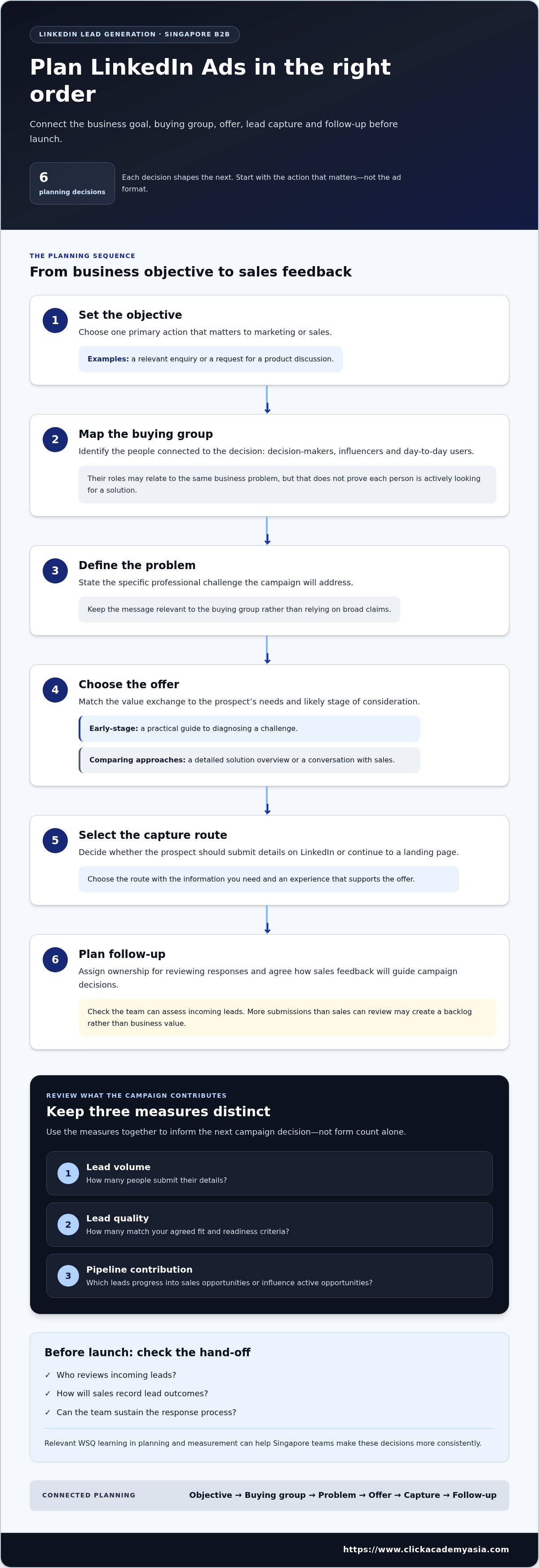
Before building a campaign, put the decisions in the right order. This helps audience selection, the promise in your ad and the action you want prospects to take work towards the same business goal. Start with the buying decision you need to influence, then plan how to reach relevant people and what happens after they respond.
Set the objective. Choose one primary action that matters to marketing or sales, such as a relevant enquiry or a request for a product discussion.
Map the buying group. Identify the decision-makers, influencers and day-to-day users connected to that action.
Define the problem. State the specific professional challenge the campaign will address, rather than relying on broad claims.
Choose the offer. Match the value exchange to the prospect’s needs and likely stage of consideration.
Select the capture route. Decide whether the prospect should submit details on LinkedIn or continue to a landing page.
Plan follow-up. Assign ownership for reviewing responses and agree how sales feedback will inform campaign decisions.
Translate the B2B buying group into audience hypotheses
Turn your buying-group map into a testable audience hypothesis. For a company considering a new business system, the department head may approve the investment, a technical specialist may assess fit and operational users may influence adoption. Their roles relate to the same problem, but that does not prove each person is actively looking for a solution.
Use role relevance, seniority and business context to guide audience planning. Keep the initial hypothesis focused, then review whether delivery reaches relevant professionals and whether responses fit your lead criteria. Check LinkedIn Campaign Manager’s current audience options and settings before launch, since platform features can change.
Match the offer and campaign structure to intent
A generic asset can miss the mark when different prospects need different information. An early-stage audience may value a practical guide to diagnosing a challenge; someone comparing approaches may respond better to a detailed solution overview or a conversation with sales. Gather language from customer discussions and use advanced keyword research strategies to understand how people describe the problem across search and other channels. Treat that language as insight for your message, not proof of an individual’s intent on LinkedIn.
Keep the campaign structure clear enough to analyse later. Name campaigns consistently by objective, audience hypothesis and offer, and separate segments only when doing so will help you make a decision. Avoid splitting audiences into narrow groups without a reason to compare them. The aim is useful learning, not complexity for its own sake.
Check the full journey: does the ad promise what the offer delivers, does the capture route ask for information suited to that exchange, and can the follow-up continue the same conversation? These are practical foundations for advanced LinkedIn Ads for lead generation. Teams looking to strengthen campaign planning can explore WSQ-aligned digital marketing learning to develop those skills.
Choose between LinkedIn Lead Gen Forms and landing pages
The capture route shapes what happens between an ad click and a sales conversation. A LinkedIn Lead Gen Form keeps the response on the platform, while a landing page takes prospects to your website. Neither is automatically better. Choose based on the campaign objective, the context prospects need and the information your team requires to follow up effectively.
When an on-platform lead form may fit
Consider a form when the offer is straightforward, such as a relevant event registration or a concise resource, and a low-friction response supports your objective. Review every requested field: keep information that helps assess fit or tailor follow-up, and remove fields that add effort without a clear purpose. Before launch, verify the current form fields, settings and capabilities in LinkedIn Campaign Manager.
Make the exchange clear. Explain what the prospect is requesting, how the business will use the submitted details to respond and where to find the applicable privacy information. This helps people make an informed choice and sets expectations for contact. Keep follow-up aligned with the offer they responded to.
When a dedicated landing page may fit
Use a landing page when prospects need more context before deciding, perhaps because the offer involves a considered B2B solution or a detailed professional resource. The additional space can explain the problem, approach and next step. Keep the page headline, offer and call to action consistent with the ad, so the click leads into the conversation the creative promised.
Measure the journey, not just the final submission. Review page engagement alongside completed forms, then compare those responses with lead quality and sales outcomes. If people visit but do not submit, investigate whether the page answers their questions and makes the next step clear. If submissions arrive but do not progress, reassess the offer, qualification questions and follow-up. This helps you make advanced LinkedIn Ads for lead generation decisions based on the campaign objective rather than a preferred format.
Optimise advanced LinkedIn Ads with testing, tracking and sales feedback
A campaign can deliver clicks and form submissions yet tell you little about whether the right prospects are moving towards a business conversation. Make reporting more useful by connecting what happens in Campaign Manager with agreed lead outcomes and sales feedback. This turns optimisation from a reaction to surface metrics into a disciplined process of learning and decision-making.
A submitted lead is a contact who has responded; a sales-qualified opportunity is a prospect that meets agreed criteria for meaningful sales follow-up. Keep that distinction clear in reports. Otherwise, a rise in submissions can be mistaken for stronger commercial performance, even if the contacts are not progressing.
Build a measurement framework beyond form submissions
Track delivery indicators, such as impressions, clicks and submissions, separately from lead-quality and downstream business indicators. Agree with sales what each lead status means, who updates it and where it is recorded. Use the same definitions across teams so a lead marked “qualified” reflects a shared standard rather than an individual interpretation.
Connect the initial campaign action to the next meaningful outcome. Depending on the objective, this might be a completed conversation, an accepted sales lead or an opportunity progressing through your pipeline. A simple reporting view can show:
Delivery: whether the campaign reached its intended audience and generated responses.
Quality: whether responses matched the agreed audience and readiness criteria.
Progression: whether suitable leads advanced to the next agreed sales or marketing action.
Conversion tracking helps connect an ad interaction with a later action, such as a completed enquiry on your website. It gives the team a more complete view than click data alone, provided the tracking reflects the action that matters. Before implementation, verify LinkedIn’s current setup instructions and your organisation’s analytics requirements, as platform settings can change.
Turn campaign results into the next test
Review audience, offer, creative and capture experience as related hypotheses. If submissions are plentiful but sales finds few relevant, investigate whether the audience definition or offer is attracting the wrong need. If the audience looks suitable but few people respond, assess whether the creative makes the value and next step clear. Sales comments can reveal patterns that campaign metrics alone will not explain.
Where practical, test one meaningful variable at a time and record your reasoning before making a change. For each test, note the hypothesis, what changed, what happened across delivery and lead outcomes, and what the team will test next. Digital marketing educators such as Olgu Şengül often emphasise this disciplined approach to testing, which creates a useful decision trail and helps prevent repeated changes without a clear learning goal.
Stronger analytics capability can help teams build this routine into campaign planning and review. Explore WSQ Marketing Analytics & Insights and WSQ Digital Advertising to support more confident measurement and optimisation.
Build your LinkedIn lead generation capability with Singapore-based training
A repeatable campaign process depends on more than platform familiarity. Teams need to plan objectives, audience hypotheses, offers and capture routes, then interpret results with sales input. A focused learning pathway can help marketers build these capabilities and apply them consistently as platforms and campaign requirements evolve.
Choose a learning pathway that supports campaign work
ClickAcademy Asia is a Singapore-based professional training provider offering WSQ-funded Digital Marketing Courses, including WSQ Digital Advertising and WSQ Marketing Analytics & Insights. These learning areas can support broader campaign planning and measurement skills. Explore WSQ digital marketing courses in Singapore to consider how structured learning could complement your team’s work.
Use this checklist to turn the playbook into a team routine:
Define the objective: agree on the next meaningful marketing or sales action.
Map the audience: identify relevant roles, seniority and business context.
Select the capture route: match the form or landing page to the offer and information needs.
Measure the journey: distinguish campaign delivery from lead quality and progression.
Review and learn: combine performance data with sales feedback, then document the next test.
Take the next step with ClickAcademy Asia
ClickAcademy Asia’s curriculum is practitioner-led and AI-integrated, connecting learning with practical digital marketing work. This foundation can help professionals build campaign planning, advertising and analytics skills. Teams can also use structured development to create a shared approach to evaluating campaign decisions, rather than relying on isolated platform tactics.
Eligibility requirements for funding: age ≥ 21, Level 2 basic computer literacy, GCE N/O/A Level or NITEC or diploma plus 2 years work experience, English proficiency (GCSE N/O pass, WPLN Level 5, IELTS 5.5, or TOEFL iBT 46-59), and bring a personal laptop. Eligible Singaporeans and PRs can claim up to 70% subsidy on qualifying courses.
Equip your team to plan, assess and improve campaigns with relevant WSQ learning. To discuss learning options, email TeamSG@clickacademyasia.com or call or WhatsApp 9388 8755. Appointment requests receive a response within 1-2 working days.
Make your next campaign a stronger team capability
Your next LinkedIn campaign can also be a learning opportunity. Use its planning and review process to build shared habits across marketing and sales, from agreeing what makes a lead relevant to recording what happens after follow-up. Over time, that discipline can help your team make clearer decisions about where to focus and what to improve.
ClickAcademy Asia has upskilled 30,000+ professionals and trained 6,000+ companies and teams, with 3,000+ 5-star Google reviews. For Singapore organisations, WSQ-funded digital marketing learning can support the practical skills behind advanced LinkedIn Ads for lead generation, without treating any campaign outcome as automatic.
Give your team a structured next step. Explore professional digital marketing training with ClickAcademy Asia and build the capability to plan, measure and refine campaigns with confidence. Equip your people to turn each campaign into a more informed next move.
Frequently Asked Questions
Can LinkedIn Ads generate B2B leads?
Yes, LinkedIn Ads can support B2B lead generation when the audience, offer, capture experience and follow-up work together. For example, a software firm promoting a consultation should connect its ad to a relevant business need and offer a useful next step. Before launch, define that action and agree how sales will assess fit. A high submission count alone cannot show whether leads contribute to business outcomes.
How should I target decision-makers with LinkedIn Ads?
Start with the business problem, then identify the people involved in addressing it. For a workplace technology purchase, that might include a department lead, an IT evaluator and the employees who will use the system. Build audience hypotheses around professional responsibilities and organisational context, but do not assume a job title signals active buying intent. Check LinkedIn Campaign Manager’s current targeting labels and controls before writing setup instructions.
Are LinkedIn Lead Gen Forms better than landing pages?
Neither option is universally better. A concise offer, such as registering interest in a focused briefing, may suit an on-platform form. A complex service that needs explanation before someone enquires may call for a landing page. Compare the effort required to respond, the context prospects need and the information your team needs. Then assess lead relevance and progression, not just which route collects more submissions.
What should a LinkedIn lead generation form ask?
Ask only for details that serve a clear purpose in qualification or follow-up. For instance, a team arranging a business consultation might need enough context to route an enquiry to the right colleague, but extra questions can add effort without improving the response. State what the offer is, what happens after submission and how the information will be used. Review current LinkedIn form settings and relevant privacy requirements before launch.
How do I measure lead quality from LinkedIn Ads?
Agree with sales what makes a lead relevant, then record whether each submission meets that definition and what happens next. A useful review might compare campaign responses with enquiries accepted for follow-up, while noting common reasons for rejection. For advanced LinkedIn Ads for lead generation, combine those records with sales comments about fit and readiness. Use the findings to guide a specific campaign adjustment, and document why you made it.
How often should I optimise a LinkedIn Ads campaign?
Review performance often enough to make considered decisions, but do not change a campaign simply because a calendar date has arrived or one result fluctuates. Choose a review rhythm that reflects campaign delivery and the evidence available to your team. If you test a new message, keep other major elements stable where practical. Record the hypothesis, the change and what you observed, so the next decision builds on learning rather than guesswork.
Can marketing and sales improve LinkedIn lead generation together?
Yes. Marketing can brief sales on the campaign’s audience and offer, while sales can share whether enquiries match the agreed criteria and what conversations reveal. For example, if prospects misunderstand what a demonstration covers, that feedback can inform the ad’s wording or the follow-up message. Use a shared place to record lead status and comments, then review patterns together. This connects campaign decisions to real prospect conversations.


Comments