
Account-Based Marketing for Enterprise Accounts: A Strategic 2026 Guide for SINGAPORE Professionals
- ClickAcademy Asia

- 19 minutes ago
- 11 min read
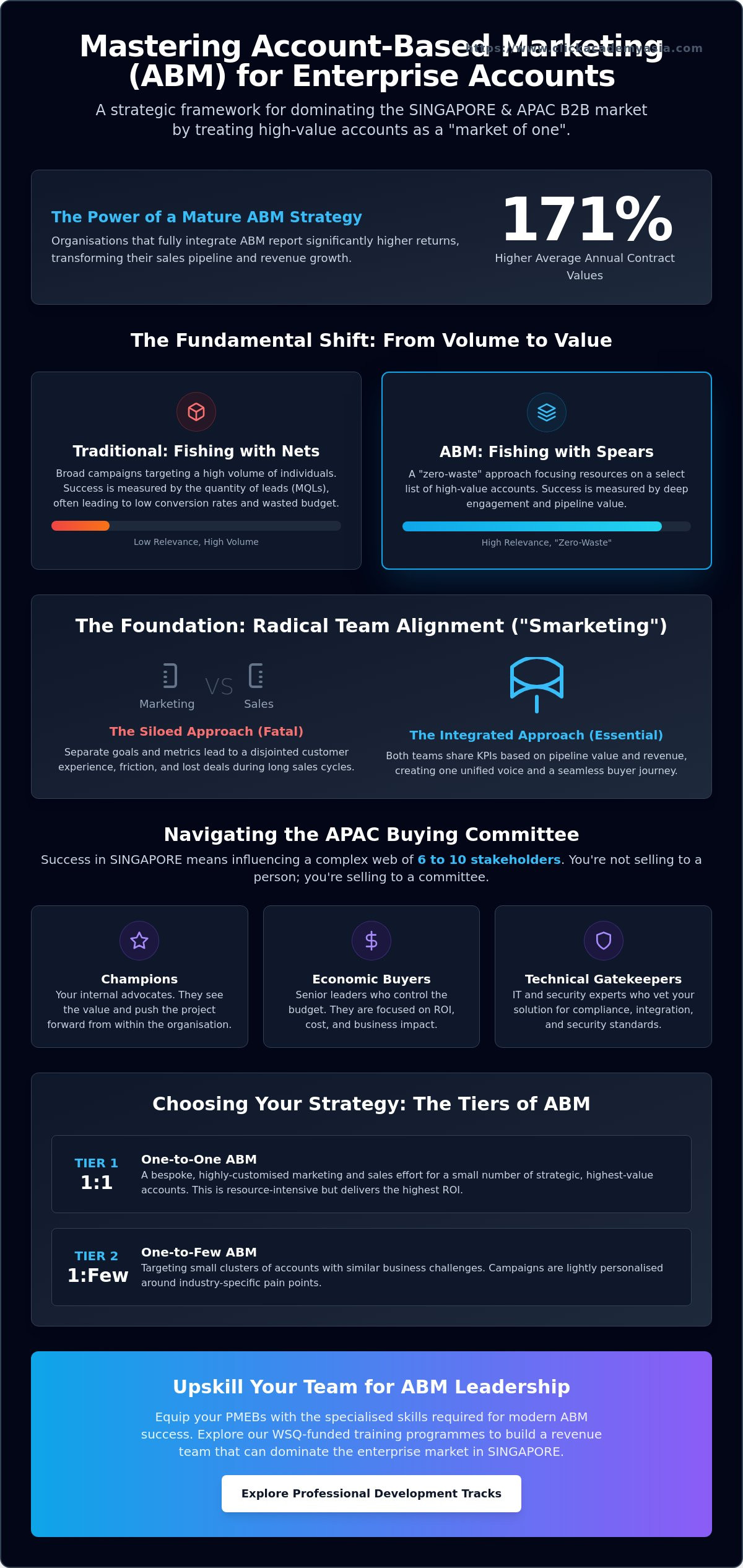
Did you know that companies with mature strategies report 171% higher average annual contract values than their competitors? You've likely felt the frustration of watching your marketing budget vanish into low-quality leads. It's even worse when your sales team struggles to penetrate complex buying committees in large organisations. This is why mastering account-based marketing for enterprise accounts has become the gold standard for firms looking to thrive in the SINGAPORE business ecosystem.
We're here to help you bridge the gap between effort and impact. This guide provides the strategic framework needed to align your revenue teams and dominate the APAC enterprise market through high-value targeting. You'll learn how to optimise scalable campaigns and leverage WSQ-aligned professional mastery to secure larger deals and future-proof your career in 2026.
Table of Contents
Defining Account-Based Marketing for Enterprise Accounts in SINGAPORE
ABM isn't just a marketing tactic; it's a strategic Go-To-Market approach that treats a single high-value organisation as its own unique market. While traditional demand generation focuses on "fishing with nets" to capture a high volume of leads, account-based marketing for enterprise accounts is about "fishing with spears." This precision is vital in SINGAPORE, where high-competition sectors like Fintech and Logistics require a surgical approach to win over global corporate giants. Success here doesn't come from broad awareness; it comes from deep relevance.
Building trust with local C-suite executives requires hyper-personalised content that addresses the specific regulatory or operational hurdles their firm faces. This strategy is intrinsically linked to Account-Based Selling, ensuring that your outreach is consistent across every touchpoint. When marketing and sales teams speak with one voice, they create the professional authority needed to navigate complex local hierarchies.
To better understand how this framework functions in a B2B context, watch this helpful video:
The Shift from Lead Quantity to Account Quality
In the enterprise space, the traditional Marketing Qualified Lead (MQL) often fails because it focuses on individuals rather than the collective buying committee. A single whitepaper download from a junior executive doesn't necessarily signal a deal. This is why PMEBs are pivoting toward the Marketing Qualified Account (MQA). When executing account-based marketing for enterprise accounts, the MQA tracks the engagement level of the entire organisation, providing a holistic view of interest. This focus on quality over quantity significantly reduces the sales cycle, allowing your team to spend time only on accounts with a genuine intent to buy.
Key Principles of the Enterprise ABM Mindset
Adopting an ABM mindset requires a move away from "batch and blast" marketing toward insight-led orchestration. You must use data to map out exactly who holds the decision-making power within an account before launching any campaigns. This "zero-waste" approach ensures that every marketing dollar targets a high-propensity buyer who fits your Ideal Customer Profile. In the 2026 digital landscape, this also means continuous optimisation. You can't just set a campaign and forget it; you must constantly analyse account interactions to refine the journey and maintain a competitive edge in the APAC region.
Why Enterprise ABM Requires Radical Sales and Marketing Alignment
Many organisations treat marketing and sales as separate entities. In enterprise deals, this siloed approach is fatal. Effective account-based marketing for enterprise accounts relies on "Smarketing", which is the total integration of these two functions. It's not just about syncing your CRM; it's about a shared strategic mindset. When teams operate in isolation, the customer experience suffers, leading to friction during the long sales cycles typical in the APAC region.
According to industry experts, the customer-centric nature of this approach is what makes it so potent. As highlighted in this foundational look at What Is Account-Based Marketing?, alignment isn't a luxury; it's the heartbeat of the strategy. Shared KPIs are the only way to ensure this works. Teams must ditch vanity metrics like clicks or impressions. Both sales and marketing should be measured on pipeline value and revenue generated from the target account list.
Navigating the APAC Buying Committee
Closing a deal in SINGAPORE often involves navigating a complex web of 6 to 10 stakeholders. You aren't just selling to one person; you're selling to a committee. This requires mapping specific personas:
Champions: Your internal advocates who push the project forward.
Economic Buyers: Senior leaders who control the budget and focus on ROI.
Technical Gatekeepers: Experts who ensure your solution meets security and compliance standards.
Successful PMEBs use multi-threading to build relationships across different departments simultaneously. This ensures the deal doesn't collapse if your primary contact changes roles. By aligning your messaging, your marketing team can nurture the technical gatekeepers while your sales team focuses on the economic buyers.
Creating a Feedback Loop for Account Intelligence
Sales teams are on the front lines, gathering invaluable insights from every conversation. This intelligence shouldn't stay in a salesperson's head. It needs to flow back to marketing to inform the creation of highly specific collateral that addresses real-world objections. Weekly "account stand-ups" can synchronise these efforts, ensuring marketing's content perfectly supports the sales outreach.
Developing these collaborative skills is a core part of modern revenue leadership. To bridge the gap between your departments, you might explore Sales Leadership programmes that focus on cross-functional excellence. Radical alignment ensures that every interaction adds value to the prospect's journey, making your firm the obvious choice for enterprise partnerships.
The Three Tiers of ABM: Choosing Your Strategy
Implementing account-based marketing for enterprise accounts requires a disciplined approach to resource allocation. You shouldn't treat a global logistics giant with the same intensity as a mid-market firm. By categorising your target list into three distinct tiers, you ensure that your team's energy is spent where the potential ROI is highest. This structured approach prevents your marketing spend from being spread too thin across low-quality leads.
To succeed in the competitive SINGAPORE business environment, you must decide which accounts deserve a "market of one" treatment and which can be grouped. This decision dictates everything from your content production budget to the frequency of your sales outreach. A balanced portfolio across these tiers allows you to secure immediate wins while nurturing long-term, high-value partnerships.
Tier 1: High-Touch Personalisation for Top Accounts
Tier 1 is reserved for your top 10 to 20 "must-win" organisations. This strategy involves deep, bespoke research and the creation of content specifically for the stakeholders within those accounts. You'll need executive alignment, where your senior leaders engage directly with their counterparts to build high-level trust. Tier 1 ABM is the pinnacle of bespoke enterprise marketing.
Bespoke Content: Creating custom reports or landing pages for a single account.
Executive Outreach: Facilitating 1:1 meetings between C-suite leaders.
Deep Insights: Using financial reports and local news to identify specific organisational triggers.
Tier 2 and 3: Scaling ABM Without Losing Relevance
Tier 2, or ABM Lite, focuses on clusters of accounts (usually 50 to 100) that share similar pain points or belong to the same industry vertical. For example, you might create a campaign specifically for the SINGAPORE Fintech sector. This allows you to scale your efforts by using vertical-specific messaging that still feels personalised to the reader's industry context.
Tier 3, known as Programmatic ABM, uses automation to reach hundreds of accounts. Here, you leverage specialised techniques and dynamic web content to tailor the user experience based on the visitor's company. This ensures your brand stays top-of-mind across a broader market without requiring manual intervention for every lead. Understanding how to integrate these layers is a core part of a modern WSQ Digital Marketing Strategy.
To maximise your ROI, consider a 50-30-20 budget split. Allocate 50% of your resources to Tier 1, 30% to Tier 2, and the remaining 20% to Tier 3. This ensures you're prioritising the deals that will move the needle for your organisation while maintaining a healthy pipeline of future opportunities.
Building an Enterprise ABM Framework for the APAC Market
Success in account-based marketing for enterprise accounts depends on a structured framework that moves beyond gut feeling. In the SINGAPORE market, where business relationships are often built on long-term trust and technical credibility, your framework must be repeatable and data-driven. It's not enough to simply "target" a firm; you must orchestrate a sequence of interactions that provide value at every stage of the buyer's journey. A well-constructed framework ensures your revenue teams aren't wasting effort on accounts that will never convert.
A robust ABM strategy typically follows a five-step execution model:
Step 1: Account Selection: Define your Ideal Customer Profile (ICP) based on high-propensity signals rather than just brand recognition.
Step 2: Deep Account Research: Utilise LinkedIn, local news, and financial reports to gather specific organisational insights.
Step 3: Content Orchestration: Develop assets like bespoke whitepapers or case studies that speak to the account's unique business challenges.
Step 4: Multi-Channel Execution: Launch coordinated campaigns across LinkedIn ads, direct email outreach, and social selling.
Step 5: Measurement and Attribution: Track engagement at the account level to see how the entire buying committee is interacting with your brand.
Identifying Your Ideal Customer Profile (ICP)
Your ICP is the foundation of your entire framework. For SINGAPORE firms, this includes firmographics like company size and location, but also technographics—the specific software stack they currently use. You should also look for intent signals that indicate an organisation is actively searching for a solution. You can learn how to uncover these signals by mastering advanced keyword research strategies. Selecting accounts based on their "propensity to buy" ensures your budget is focused on the most promising opportunities in the APAC region.
Measuring ABM Success Beyond the Click
In enterprise marketing, a single click doesn't tell the whole story. You need to look at the Account Engagement Score, which aggregates all interactions from various stakeholders within a target firm. Pipeline velocity and win rates are also critical indicators of whether your account-based marketing for enterprise accounts is actually driving revenue. Equally important are "negative metrics"—identifying accounts that are not engaging so you can reallocate resources elsewhere. Advanced PMEBs use marketing analytics with GA4 to track these complex account journeys with precision.
Building this framework requires a team that understands both the strategy and the tools. To equip your staff with these essential skills, consider enrolling them in WSQ Digital Marketing Strategy & Planning programmes to ensure your ABM initiatives are grounded in industry best practices.
Upskilling Your Team: WSQ-Funded ABM Training in SINGAPORE
Even the most sophisticated account-based marketing for enterprise accounts will fail without a team that possesses the right strategic mindset. The talent gap remains the primary hurdle for APAC organisations looking to scale their revenue operations. It's one thing to invest in high-end software; it's quite another to have a team that understands the nuances of stakeholder mapping and insight-led orchestration. To dominate the 2026 landscape, your staff must move beyond generalist marketing into specialised, high-value execution.
SINGAPORE professionals have a distinct advantage through the Workforce Skills Qualifications (WSQ) framework. This national system ensures that professional development is grounded in practical, industry-recognised standards rather than just theory. By aligning your team's skills with these frameworks, you ensure a consistent level of excellence across your entire marketing and sales departments. This shared knowledge base is what allows for the radical alignment discussed earlier in this guide.
Leveraging SSG funding is a strategic move for any corporate leader looking to future-proof their workforce. Large organisations are currently eligible for up to 70% funding for accredited courses. For SMEs, the Enhanced Training Support for SMEs (ETSS) provides up to 90% in course fee subsidies. Additionally, Singaporean citizens aged 40 and above can utilise the SkillsFuture Mid-Career Enhanced Subsidy (MCES) to receive up to 90% coverage, significantly offsetting the cost of world-class professional training.
WSQ-Certified Digital Marketing and Sales Tracks
ClickAcademy Asia provides the practical mastery needed to lead account-based marketing for enterprise accounts through structured WSQ modules. These tracks cover essential areas such as Digital Marketing Strategy & Planning, Marketing Analytics, and Sales Leadership. Each programme is designed specifically for busy PMEBs and corporate cohorts, ensuring that the learning is actionable and immediately applicable to your current accounts. A WSQ certification carries significant weight in the SINGAPORE job market, acting as a recurring signature of quality and professional authority.
Actionable Next Steps for HR and Marketing Leaders
To begin your upskilling journey, conduct a thorough skills audit to identify the current ABM readiness within your revenue team. Look for gaps in data analysis, content strategy, and multi-channel orchestration. Once these gaps are identified, you can plan a structured upskilling roadmap that takes advantage of available government grants and subsidies. This proactive approach ensures your team is ready to reach complex buying committees and close larger deals. Equip your team for enterprise success by exploring our WSQ-funded training programmes to start building your 2026 strategy today.
Dominating the 2026 Enterprise Market
Success in the APAC region requires more than just a high volume of leads; it demands a surgical focus on the accounts that truly matter to your bottom line. By integrating radical "Smarketing" alignment and a disciplined tiered framework, your organisation can significantly increase its pipeline velocity and win rates. Mastering account-based marketing for enterprise accounts is the definitive way to secure complex deals and build lasting corporate partnerships in SINGAPORE.
As an Official Google Power Partner, ClickAcademy Asia provides WSQ-certified training excellence designed for the modern PMEB. Eligible SINGAPOREANS and PRs can access up to 70-90% SSG funding to offset these costs, making professional mastery more accessible than ever. Equip your team with the strategic skills to dominate enterprise accounts; explore our WSQ-funded marketing and sales courses today.
The path to professional excellence is well-mapped, and the rewards for those who lead this strategic shift are substantial. Start your journey today and position your firm at the forefront of the APAC business landscape.
Frequently Asked Questions
What is the difference between ABM and traditional B2B lead generation?
ABM treats individual accounts as a market of one, whereas traditional lead generation aims for a high volume of individual leads. While traditional methods use "nets" to catch anyone interested, account-based marketing for enterprise accounts uses "spears" to target specific, high-value organisations. This focus ensures your resources are spent on accounts with the highest revenue potential rather than chasing low-quality leads.
How many accounts should be in an enterprise ABM programme?
The number of accounts depends on the tier of your strategy and the size of your revenue team. For a Tier 1 (One-to-One) strategy, most firms limit the list to 10 or 20 top-tier accounts to maintain high personalisation. Tier 2 (One-to-Few) usually covers 50 to 100 accounts with similar pain points, while Tier 3 (Programmatic) can target hundreds using automation.
Is ABM only for large companies with massive budgets?
ABM is a strategic mindset that any organisation can adopt regardless of budget size. While large enterprises use expensive software, smaller teams can execute effective Tier 2 strategies using LinkedIn and basic CRM tools. The key is the shift from broad outreach to narrow, high-value targeting that maximises your existing marketing spend and reduces wasted effort.
How do I get started with ABM if our sales and marketing teams are siloed?
Launch a small pilot programme with a single high-potential account to demonstrate success and build trust between departments. This allows both teams to work together on shared KPIs like account engagement rather than conflicting metrics like lead volume. Establishing weekly stand-ups and using a common strategic language through WSQ-certified training can help break down these long-standing silos.
What tools are essential for executing an account-based marketing strategy?
A robust CRM system and a marketing automation platform are the foundational requirements for any ABM initiative. You also need tools for intent data and social selling, such as LinkedIn Sales Navigator, to identify when stakeholders are active. Integrating these with analytics platforms like GA4 allows you to track account-level engagement with high precision across the entire buying committee.
Can I use SSG funding for ABM-related marketing courses in SINGAPORE?
Yes, you can utilise SSG funding for various WSQ-certified marketing and sales programmes in SINGAPORE. These courses often cover the strategic frameworks required for account-based marketing for enterprise accounts. Eligible Singaporeans and Permanent Residents can receive up to 70-90% in subsidies, making it a cost-effective way to upskill your revenue teams for the 2026 landscape.
How long does it take to see ROI from an enterprise ABM initiative?
ROI for enterprise deals in the APAC region typically takes 3 to 5 months from the initial contact to a final decision. However, you should see improvements in "leading indicators" like account engagement and pipeline velocity much earlier. Tracking these mid-funnel metrics ensures your strategy is on the right path before the final contract is signed.
What are the most common mistakes to avoid in enterprise ABM?
The most common mistake is failing to achieve radical alignment between your sales and marketing departments. Other errors include poor account selection based on brand names rather than a genuine "propensity to buy" and over-automating your content too early. Personalisation must remain authentic to build the trust required for complex enterprise-level partnerships in the SINGAPORE market.


Comments