
2026 Market Research & Competitive Analysis: Singapore PMEBs
- ClickAcademy Asia

- 1 day ago
- 11 min read
What if your 2026 growth strategy is being sabotaged by the very data you rely on? Many PMEBs in Singapore struggle with a surplus of "big data" that lacks the actionable depth required to stay ahead. It's difficult to justify marketing spend to stakeholders when your current research methods miss emerging trends or fail to provide a clear benchmark against agile rivals.
Mastering advanced market research and competitive analysis is the essential step toward transforming raw information into a proactive business advantage. This guide provides a clear framework for competitive intelligence, helping you outpace rivals and dominate the local Singapore market. You'll discover how to leverage WSQ-funded training to bridge skill gaps and implement proven methodologies that drive sustainable growth across your organisation.
Table of Contents
Why Advanced Market Research and Competitive Analysis is Non-Negotiable in 2026
In the high-stakes environment of Singapore's 2026 economy, standing still is the same as moving backwards. Companies that rely on reactive tracking are finding themselves blindsided by agile startups and shifting consumer priorities. True advanced market research and competitive analysis has evolved from a periodic report into a proactive, data-integrated strategy that powers every departmental decision. It's no longer about looking at what happened last quarter; it's about predicting what will happen in the next one.
A simple SWOT analysis no longer provides the differentiator it once did. In 2026, identifying strengths and weaknesses is merely the baseline for entry. To dominate, PMEBs must shift toward predictive market intelligence, using data to forecast shifts before they manifest as lost market share. This requires a move away from static observations toward a dynamic understanding of the local ecosystem, ensuring that marketing spend is always backed by objective benchmarks.
The Evolution of Consumer Insights in Singapore
Demographics alone won't help you win in a market as nuanced as ours. While knowing age or income brackets was sufficient a decade ago, today's leaders focus on ethnographic and psychographic data. This involves understanding the underlying motivations and lifestyle values that drive Singaporean consumers. By implementing sophisticated sentiment analysis across digital touchpoints, professionals can anticipate local market shifts with startling accuracy. Market intelligence is the strategic synthesis of multi-source data and business strategy to inform real-time execution.
Moving Beyond Secondary Data
Relying solely on published industry reports is a recipe for mediocrity. By the time a report is curated and sold, the insights are often already priced into the market. Primary research is the key to maintaining a competitive edge in a hyper-competitive national landscape. This involves:
Conducting bespoke surveys and focus groups tailored to specific Singaporean niches.
Utilising real-time data streams to monitor competitor pricing and promotion shifts instantly.
Integrating internal CRM data with external market signals to find unique opportunities.
For those looking to master these skills, upskilling through a WSQ Digital Marketing Strategy & Planning programme provides the framework needed to turn raw data into a formidable business weapon. This practical approach ensures your research efforts result in actionable growth rather than just more spreadsheets. By bridging the theory-practice gap, you can ensure your team is equipped to handle the volatility of the 2026 market with confidence.
Sophisticated Methodologies for Deep-Dive Market Intelligence
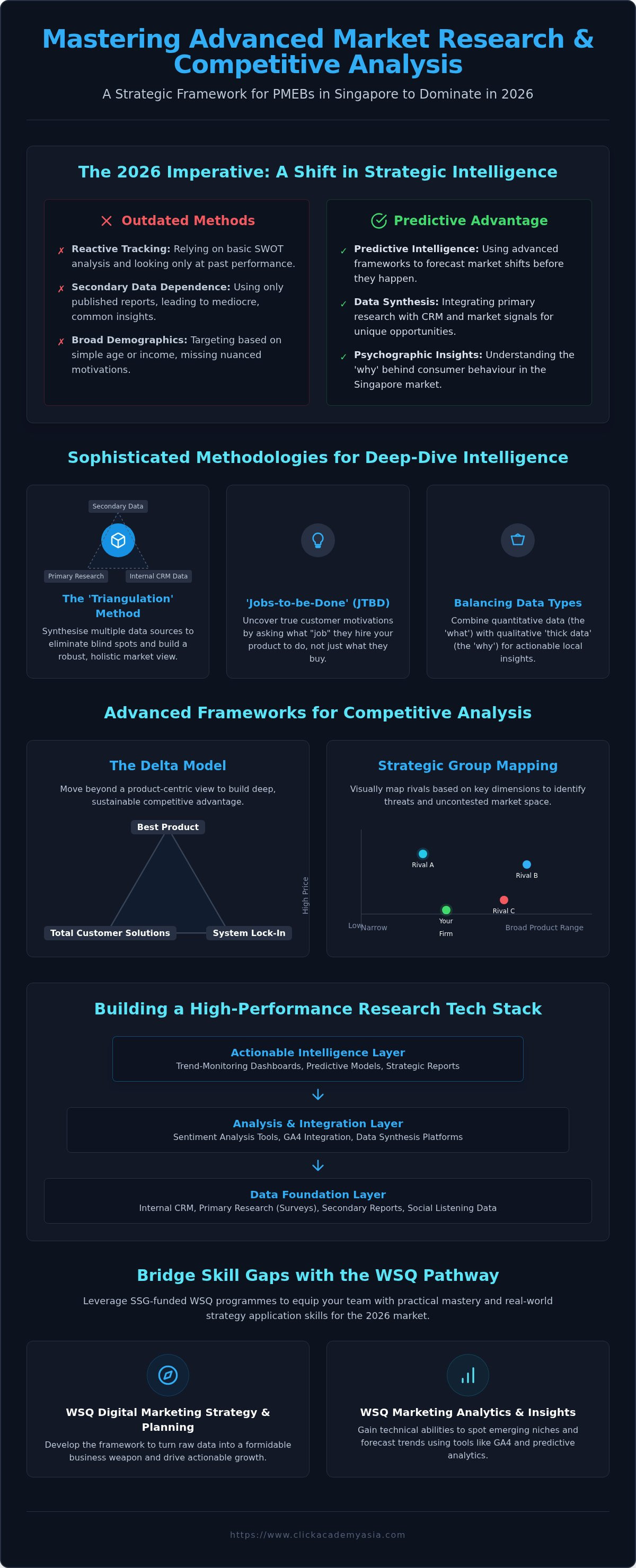
Data silos are the enemy of effective strategy. To achieve a truly holistic view, Singaporean leaders are adopting the 'Triangulation' method. This involves synthesising primary field research, secondary industry reports, and internal CRM data. By blending these sources, you eliminate the blind spots that come from relying on a single data stream. It's the foundation of any robust strategy for advanced market research and competitive analysis in a volatile market.
Beyond data collection, the 'Jobs-to-be-Done' (JTBD) framework is essential for 2026. Instead of looking solely at what customers buy, JTBD asks what "job" they are hiring your product to do. When combined with AI-driven predictive modelling, this allows PMEBs to forecast demand with high precision. You stop reacting to historical sales figures and start anticipating the specific needs your competitors haven't even noticed yet.
Quantitative vs. Qualitative: The 2026 Balance
Numbers tell you what is happening, but qualitative insights tell you why. In Singapore, high-volume quantitative data needs the context of 'thick data', the deep, descriptive insights found in digital focus groups and social listening. These methods reveal the cultural nuances of local consumers that a spreadsheet might miss. Understanding the emotional drivers behind a purchase is what makes your advanced market research and competitive analysis truly actionable for local brands.
Predictive Analytics and Trend Forecasting
Anticipating the next big shift requires more than a gut feeling. By using GA4 to identify future purchase patterns, you can build a trend-monitoring dashboard that flags emerging opportunities before they go mainstream. This is where mastering WSQ Marketing Analytics & Insights becomes a game-changer. It equips your team with the technical ability to spot emerging niches through strategic keyword analysis, ensuring you're always one step ahead of the competition.
Mapping these digital touchpoints across the customer journey allows you to see exactly where your brand can win. Conducting a thorough audit of these interactions reveals friction points that might be costing you conversions. When you understand the path your customer takes, from initial awareness to the final click, your research moves from theoretical to tactical. This level of granular detail ensures your 2026 business strategy is grounded in reality, not assumptions.
Strategic Frameworks for Advanced Competitive Analysis
While Porter's Five Forces remains a foundational tool, it often focuses too heavily on external rivalry. In 2026, Singaporean PMEBs are turning to the Delta Model to prioritise customer bonding and total system lock-in. This shift ensures that your advanced market research and competitive analysis doesn't just track rivals but actively builds defensive barriers through superior value delivery. By focusing on the customer relationship rather than just the product, you create a strategic moat that is difficult for competitors to breach.
Strategic Group Mapping is another vital technique for identifying where direct and indirect threats overlap. It allows you to visualise the competitive landscape based on strategic dimensions like price, service quality, or digital maturity. Complement this with 'War Gaming', where your team simulates competitor responses to your own strategic moves. You should also adopt 'Benchmarking 2.0', which involves looking beyond your specific industry to find innovation in customer service or logistics that can be adapted for the local market.
Reverse-Engineering Competitor Success
Understanding a rival's digital footprint requires more than just looking at their homepage. You need to audit their SEO and SEM strategies to identify which high-value keywords they are targeting and where their content gaps lie. Digital 'Mystery Shopping' also provides invaluable insights into their customer service standards and user experience. Always maintain high ethical standards by gathering intelligence through publicly available data and transparent interactions, ensuring your competitive intelligence is both robust and reputable.
Identifying Competitive Gaps and Blue Oceans
Finding uncontested market space is the ultimate goal for any Singaporean firm looking to scale. Use a Strategy Canvas to map out current industry standards and identify where you can offer 'Value Innovation'. This isn't just about being cheaper; it's about being different in ways that truly matter to the local consumer. When your research suggests a saturated market, use that intelligence to pivot your strategy toward a 'Blue Ocean' where competition becomes irrelevant. Mastering these frameworks through a WSQ Digital Marketing Strategy & Planning programme ensures you have the practical tools to lead your organisation toward sustainable growth.
Building Your Research Tech Stack for Actionable Insights
A robust tech stack is the backbone of any modern business strategy. It's not just about having the latest tools; it's about how those tools communicate to provide a unified view of your market. For Singaporean PMEBs, selecting software that integrates seamlessly with your existing infrastructure, such as your Marketing Analytics with GA4, is vital. This connectivity ensures that your advanced market research and competitive analysis isn't siloed but instead informs every stage of your marketing funnel.
Choosing between 'All-in-One' platforms and specialised point solutions depends on your team's specific maturity. While all-in-one tools offer convenience, specialised solutions often provide deeper insights into niche areas like local social sentiment or specific search trends. Automation is the key to efficiency here. By setting up automated alerts for competitor price changes or content updates, you save hours of manual tracking every week, allowing you to focus on high-level execution.
Data privacy isn't just a legal checkbox; it's a critical trust factor. In Singapore, ensuring your tech stack is fully PDPA compliant is non-negotiable. This means vetting every third-party tool for how they handle consumer data and ensuring your internal processes protect sensitive competitive intelligence. A breach doesn't just cost money; it destroys the brand equity you've worked hard to build.
Top Tools for Competitive Intelligence in 2026
For SEO and SEM research, platforms like SEMrush and Ahrefs remain industry standards for identifying keyword gaps. SimilarWeb offers unparalleled insights into where your rivals are getting their traffic from, whether it's organic, paid, or referral. These platforms are the engines behind advanced market research and competitive analysis, providing the granular detail needed to win. For those looking deeper, AI-based sentiment tools like Brandwatch or Meltwater allow you to track the public mood surrounding your rivals. Validating these external findings against your own internal CRM data ensures your strategy is grounded in what your actual customers are doing.
Visualising Data for Stakeholder Buy-In
Raw data rarely convinces a board of directors to increase your budget. Using Looker Studio to create executive-level reports transforms complex metrics into clear, visual narratives that anyone can understand. When presenting to HR or C-suite decision-makers, focus on the 'so what' of your findings. Data storytelling is the bridge between raw research and securing the investment needed for your next campaign. To build a team capable of managing this sophisticated stack, consider enrolling in a WSQ Marketing Analytics & Insights programme to turn your data into a formidable competitive weapon.
Upskilling Your Team: The WSQ Digital Marketing Strategy Pathway
Building a high-performance team requires more than just hiring for technical skills. It's about fostering a culture of continuous learning where every member can perform advanced market research and competitive analysis with precision. The Mastering Strategy: The WSQ Digital Marketing Framework programme at ClickAcademy Asia is designed to bridge the gap between theoretical knowledge and real-world execution. By training your staff in these sophisticated methodologies, you ensure that every marketing dollar spent is backed by data-driven intelligence.
The ROI of a well-trained team is clear. Professionals who understand how to synthesise competitive intelligence into agile execution are better equipped to defend market share and identify new growth avenues. Instead of relying on guesswork, your team will have the tools to justify marketing spend to stakeholders using objective benchmarks. This investment in human capital is what separates market leaders from those merely trying to keep up in Singapore's competitive landscape.
Why WSQ Certification Matters for Singapore Professionals
WSQ-certified programmes are the gold standard for industry recognition in Singapore. These modules aren't just about attending lectures; they involve rigorous assessments that prove your ability to apply complex frameworks to actual business challenges. This ensures practical mastery rather than just superficial understanding. By joining the ClickAcademy Asia community, PMEBs gain access to a network of peers and mentors who are actively shaping the future of professional expertise in the region.
Maximising SSG Funding for Corporate Training
HR managers can significantly offset the cost of upskilling through various government initiatives. SSG funding remains a cornerstone for local workforce development, making premium training accessible to businesses of all sizes. Eligible firms can also utilise the SkillsFuture Enterprise Credit (SFEC) to cover out-of-pocket expenses for qualified programmes. To secure your competitive edge, HR leaders should follow this simple checklist:
Verify your company's eligibility for SSG subsidies via the Training Management System.
Check if your business has an active SFEC account to claim additional credits for advanced market research and competitive analysis training.
Ensure staff meet the minimum attendance and assessment requirements to qualify for subsidised rates.
Book training slots early, as 2026 schedules for popular WSQ modules fill up quickly.
Taking immediate action to upskill your team isn't just a training requirement; it's a strategic imperative. As the Singapore market continues to evolve, having a team that is agile, tech-savvy, and results-driven will be your greatest advantage. Future-proof your organisation by equipping your people with the skills to dominate the 2026 market.
Securing Your Strategic Lead in the 2026 Singapore Market
The landscape of 2026 demands a decisive shift from simple data collection to sophisticated synthesis. By integrating advanced tech stacks with predictive frameworks like the Delta Model, your organisation can move beyond reactive tracking to achieve true market leadership. Mastering advanced market research and competitive analysis isn't just a technical requirement; it's a strategic necessity for any PMEB looking to outpace rivals in Singapore's hyper-competitive ecosystem.
ClickAcademy Asia bridges the theory-practice gap with WSQ-certified modules trusted by professionals in over 30 countries. These programmes are highly accessible through SSG funding, providing a cost-effective pathway for corporate teams to achieve practical mastery. It's time to transform raw data into actionable intelligence that drives measurable results and secures stakeholder buy-in.
Equip your team with advanced strategy skills through our WSQ-funded training tracks and turn your competitive intelligence into a formidable business weapon. Your journey toward market dominance starts with a commitment to continuous upskilling. The future belongs to those who are prepared to lead today.
Frequently Asked Questions
What is the difference between market research and competitive analysis?
Market research focuses on the broader consumer landscape and industry trends, while competitive analysis zooms in on the specific strengths and weaknesses of your direct and indirect rivals. Both are essential components of advanced market research and competitive analysis. While research helps you understand the general direction of the market, analysis explains how specific players are positioning themselves against your brand's unique value proposition.
How can I use SSG funding for advanced marketing courses in Singapore?
You can access SSG funding by enrolling in WSQ-certified courses like those offered at ClickAcademy Asia. Singapore Citizens and Permanent Residents are typically eligible for significant subsidies, often covering a large portion of the course fees. HR managers can claim these subsidies through the Training Management System, provided the staff meet the minimum attendance and assessment requirements. This makes upskilling your team both strategic and cost-effective.
What are the best tools for advanced market research in 2026?
The best tools for 2026 include SEMrush for search insights, Meltwater for AI-driven sentiment tracking, and SimilarWeb for competitor traffic audits. Integrating these with GA4 allows for a more holistic view of the market. Choosing tools that automate data collection helps PMEBs save time while ensuring that their advanced market research and competitive analysis is based on real-time, actionable intelligence rather than static, outdated reports.
Is the WSQ Digital Marketing Strategy & Planning course suitable for senior executives?
Yes, the WSQ Digital Marketing Strategy & Planning course is specifically designed for senior leaders who need to move beyond tactical execution into strategic oversight. It focuses on sophisticated frameworks like the Delta Model and Strategic Group Mapping. This ensures executives can lead their organisations with a data-driven approach, bridging the gap between high-level vision and practical market application in a volatile economy.
How often should a business conduct advanced competitive analysis?
Businesses should conduct a comprehensive deep dive quarterly, though tactical monitoring of competitor pricing and promotions should be automated and reviewed weekly. A quarterly rhythm allows you to adjust your strategic positioning based on significant shifts in the landscape. This regular cadence ensures your strategy remains agile and that you aren't blindsided by emerging threats or new market entrants in the Singapore ecosystem.
Can I use SkillsFuture credits for ClickAcademy Asia programmes?
Individual learners can certainly use their SkillsFuture credits to offset out-of-pocket costs for ClickAcademy Asia’s WSQ-certified programmes. This applies to various modules, including those focused on strategy and analytics. It's a fantastic way for professionals to take ownership of their career growth. Simply select the relevant course and apply your credits through the SkillsFuture portal during the registration process to begin your journey.
What are the most important competitive metrics to track in 2026?
In 2026, the most critical metrics include digital share of voice, net promoter scores relative to competitors, and conversion efficiency across specific customer touchpoints. It's no longer enough to track simple traffic numbers. You must understand the emotional sentiment behind brand interactions and how efficiently your rivals are moving prospects through their funnels. These insights provide the objective benchmarks needed to justify your marketing investment.
How does PDPA affect market research practices in Singapore?
PDPA mandates that all market research involving personal data must be conducted with explicit consent and robust security measures. This affects how you collect survey data and how you store customer insights. In Singapore, failing to comply with these regulations can result in heavy fines and significant damage to your brand’s reputation. Ensure your research tech stack and internal processes are fully audited for compliance to maintain consumer trust.



Comments