
2026 Guide: E-commerce Customer Retention in Singapore
- ClickAcademy Asia

- 6 minutes ago
- 11 min read
Is your marketing budget leaking through a bucket of high churn and rising acquisition costs? Many PMEBs in Singapore find that despite aggressive ad spend, the cost to acquire a new shopper in the APAC region continues to climb. It's a common struggle to implement effective customer retention strategies for e-commerce when your team is stuck in a cycle of constant acquisition.
You've likely noticed that high-traffic numbers don't always translate into long-term profit if those users never return. It's frustrating to see GA4 data that points to churn but offers no clear solution for fixing it. This guide promises to change that by showing you how to transition from expensive acquisition to sustainable growth using advanced retention frameworks optimised for the local digital ecosystem.
We'll provide a clear roadmap for team upskilling and demonstrate how to leverage SSG funding to offset training costs. By the end of this article, you'll understand how to use WSQ-standard strategic planning to lower your CAC and build a loyal customer base that drives consistent revenue throughout 2026.
Table of Contents
Why Customer Retention Strategies for E-commerce are the New Growth Engine in Singapore
The era of 'growth at all costs' has ended for digital retailers in Singapore. As we move into 2026, the local market has reached a point of saturation where competing solely on top-of-funnel reach is no longer viable. Brands find that high ad spend on platforms like Meta and Google often results in one-off transactions that barely cover the cost of the click. This 'Acquisition Trap' is eroding margins and forcing PMEBs to reconsider their strategic priorities.
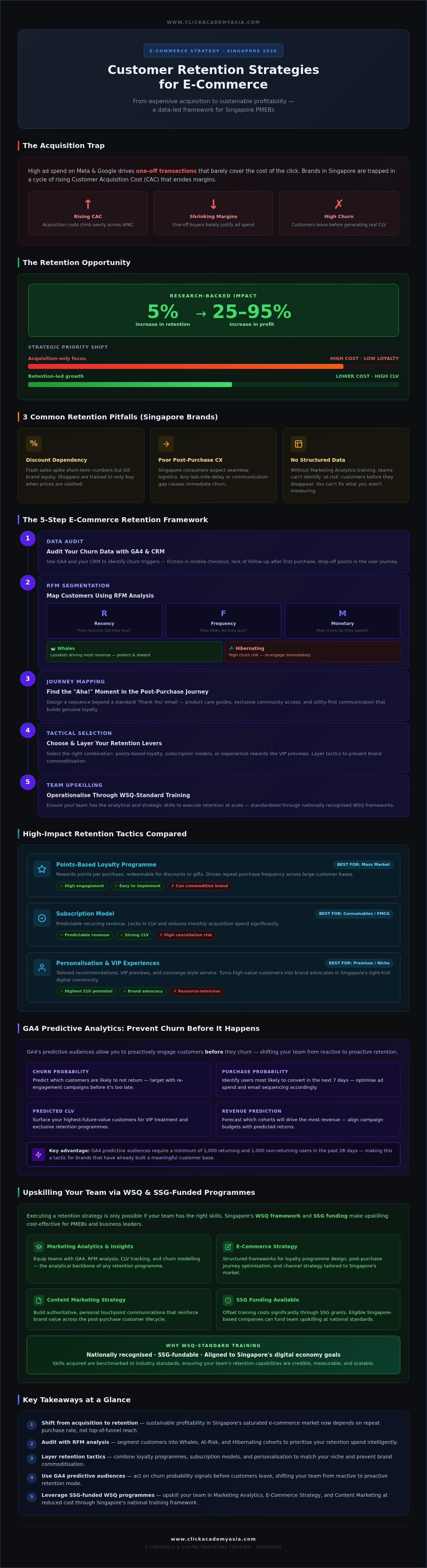
Sustainable profitability now hinges on your ability to keep the customers you've already paid to acquire. Repeat purchase rate has emerged as the most critical metric for 2026 because it validates the health of your brand beyond the initial hook. Implementing robust customer retention strategies for e-commerce isn't just a defensive move; it's a primary growth engine. Research shows that even a modest 5% increase in retention can lead to a 25% to 95% increase in profit [External Link: local industry study].
The Economics of Retention in Singapore
Understanding Customer Lifetime Value (CLV) is essential for any professional looking to future-proof their business. In the Singaporean retail sector, high-value customers don't just buy more; they act as brand advocates in a tight-knit digital community. PMEBs must pivot from transactional marketing to intentional relationship-building. This shift requires a structured approach, which is why many leaders are turning to the WSQ framework to standardise retention excellence across their teams. By aligning with these national standards through ClickAcademy Asia, businesses ensure their staff possess the analytical skills needed to track and improve CLV consistently.
Common Retention Pitfalls for Local Brands
Many local brands fall into the trap of over-relying on one-off discounts. While a 'flash sale' might spike short-term numbers, it often kills brand equity and trains shoppers to only buy when prices are slashed. Another common friction point is the post-purchase experience. In Singapore, where consumers expect seamless logistics, any delay or lack of communication in the 'last mile' can cause immediate churn. Finally, many organisations suffer from a lack of structured data. Without the right training in Marketing Analytics & Insights, teams struggle to identify 'at-risk' customers before they disappear for good. You can't fix what you aren't measuring.
How to Design a 5-Step E-commerce Retention Framework
Executing effective customer retention strategies for e-commerce requires more than just installing a loyalty plugin. It demands a structured, data-led approach that aligns your team's technical skills with your business goals. In Singapore, where competition is fierce, a haphazard approach leads to wasted budget and high churn. This 5-step framework provides the roadmap needed to build a sustainable growth engine.
Step 1 & 2: Data-Driven Auditing and RFM Mapping
Success begins with understanding your existing data. Use GA4 and your CRM to perform an RFM analysis, which categorises customers based on Recency, Frequency, and Monetary value. This process helps you identify your 'Whales'—the loyalists who drive the most revenue—versus 'Hibernating' customers who are at high risk of leaving. Setting realistic retention KPIs for the Singapore market involves looking at local repeat purchase rates rather than global benchmarks. By using [Internal Link: Marketing Analytics with GA4] techniques, your team can pinpoint exact churn triggers, such as friction points in the mobile checkout or a lack of follow-up after the first purchase.
Step 3 & 4: Journey Mapping and Tactical Selection
Once the data is clear, map the post-purchase journey to identify the 'Aha!' moment where customers truly see your brand's value. Move beyond the standard 'Thank You' email by designing a sequence that provides genuine utility, such as product care guides or exclusive community access. When selecting retention levers, compare points-based loyalty programmes against experiential rewards like VIP previews or concierge services. Integrating [Internal Link: WSQ Content Marketing Strategy] into your communication ensures that every touchpoint feels personal and authoritative. This strategic layering prevents your brand from becoming just another noise in a crowded inbox.
The final step is operationalising these insights through team upskilling. A strategy is only as good as the people executing it, and in 2026, this means having a workforce that is comfortable with predictive analytics and CRM automation. If you're ready to move from theory to practical application, you can equip your team with the right tools through the E-commerce Strategy & Operations programme. This ensures your retention framework isn't just a document but a living part of your daily operations. By leveraging WSQ-standard training, you ensure your staff can navigate the complexities of the Singaporean digital ecosystem with confidence.
Comparing High-Impact Retention Tactics: Loyalty vs. Subscription vs. Personalisation
Choosing the right customer retention strategies for e-commerce depends heavily on your product category and purchase frequency. While a tiered loyalty programme might excel for fashion retailers in Singapore, a subscription model often yields better results for health and wellness brands. The goal is to match the tactic to the natural buying cycle of your audience to ensure the highest possible return on investment.
Hyper-personalisation has moved beyond simple name tags in emails. In 2026, successful brands use zero-party data—information that customers intentionally share through quizzes or preference centres—to predict the next purchase. This proactive approach reduces churn by presenting the right offer before the customer even realises they need to restock. It's about building a relationship that feels intuitive rather than intrusive.
Loyalty Programmes and Reward Structures
Singaporean consumers are sophisticated shoppers who respond exceptionally well to 'stackable' rewards. This involves allowing users to combine loyalty points with seasonal promotions or bank-specific discounts. Local brands are increasingly using digital wallet integrations to bridge the gap between online stores and physical retail spaces. This omnichannel approach ensures that retention efforts are consistent across every touchpoint.
You must avoid the 'coupon-only' trap in your loyalty design. If your programme only offers discounts, you're essentially devaluing your brand and training customers to wait for a sale. Instead, focus on experiential rewards such as:
Early access to new product launches or limited editions.
VIP invitations to brand events or masterclasses.
Concierge support for high-tier members to resolve issues faster.
Subscription and Personalisation Engines
For household essentials or beauty products, moving from a 'one-time buyer' to a 'subscriber' is the ultimate retention goal. It removes the friction of reordering and creates a predictable revenue stream for the business. To make this transition feel natural, you need to leverage AI for product recommendations without sounding robotic. The messaging should reflect a deep understanding of the customer's specific needs and past behaviour.
Success in this area requires a deep dive into user intent. Mastering [Internal Link: Advanced Keyword Research Strategies] allows your team to understand the evolving search patterns of your existing customers. By identifying what they search for after their initial purchase, you can create content and offers that keep them engaged within your ecosystem. This level of strategic execution is a hallmark of the WSQ-certified training provided at ClickAcademy Asia, where PMEBs learn to turn raw data into actionable retention tactics.
Leveraging GA4 and Predictive Analytics to Prevent Churn
Data is often treated as a rear-view mirror in Singaporean e-commerce. You look at what happened last month, but by then, the customer has already left. Predictive analytics changes the game by allowing you to look through the windscreen instead. By using GA4's predictive audiences, you can identify segments 'likely to churn' within the next seven days. This foresight is the backbone of modern customer retention strategies for e-commerce, enabling you to intervene before the relationship goes cold.
Tracking custom events is equally vital. Don't just track sales; track how often users interact with your loyalty programme or preference centre. If a formerly active member hasn't checked their points balance in 60 days, that's a clear signal. The 'Time Between Purchases' metric acts as a lead indicator for your business health. If your average repeat purchase cycle is 30 days and a customer hits day 45 without an order, they are entering the danger zone. Bridging the gap between this raw data and your creative strategy is where the real magic happens.
Predictive Analytics for Marketing Managers
Effective marketing management requires more than just glancing at a dashboard. You need to read GA4 retention reports to identify the specific 'Churn Point' in your sales cycle. This is the exact moment when the probability of a second purchase drops significantly. Understanding these nuances is a core module in our [Internal Link: Marketing Analytics with GA4] pillar. It's about moving from descriptive analytics to prescriptive action, ensuring your team knows exactly what the numbers are telling them about customer loyalty in Singapore.
Turning Insights into Actionable Campaigns
Once you've identified at-risk segments, you can automate win-back campaigns based on specific data triggers. Don't send the same generic 'we miss you' email to everyone. Test different offers; perhaps a free gift for your high-value 'Whales' and a small incentive for your 'Price-Sensitive' segment. In Singapore, you must ensure all data-driven efforts remain compliant with PDPA regulations. Respecting privacy while delivering value is a delicate balance that builds long-term trust. If you want to master these technical skills, you can enrol in our Marketing Analytics & Insights course to lead your team with data-driven confidence.
Upskilling Your Team: Implementing Retention Strategies through WSQ Programmes
Even the most sophisticated customer retention strategies for e-commerce will fail if your team lacks the technical proficiency to manage them. Strategic execution is a talent problem as much as it is a tool problem. In Singapore, PMEBs must be equipped with the latest skills in CRM automation and data storytelling to stay competitive. The WSQ Digital Marketing Strategy & Planning framework provides a nationally recognised standard for these competencies, ensuring your workforce is future-ready.
One of the biggest advantages for local businesses is the availability of SkillsFuture Singapore (SSG) funding. You can utilise these grants to reduce training costs by up to 70-90% [External Link: SSG website]. This makes high-level professional development accessible for both SMEs and large corporations. At ClickAcademy Asia, we offer practical workshops led by regional experts who bring real-world experience into the classroom, ensuring that theory is always backed by practical application.
Maximising SkillsFuture Credit and SSG Grants
HR leaders can follow a straightforward process to claim these training subsidies. For corporate enrollment, businesses can often claim higher grant amounts compared to individual sign-ups, depending on the company's size and the employee's profile. Our guide on [Internal Link: Mastering the 2026 Landscape: WSQ Digital Marketing Courses in Singapore] simplifies this landscape, helping you navigate the application portals with ease. Investing in your team's ability to execute customer retention strategies for e-commerce ensures that your marketing budget is spent on sustainable growth rather than just filling a leaky bucket.
Building a Culture of Continuous Learning
A successful retention strategy must be an inter-departmental skill. It isn't just the responsibility of the marketing team; Sales and Operations must also understand how their specific touchpoints affect the customer lifecycle. The long-term ROI of investing in PMEB professional development is clear: lower staff turnover and a more agile business model. Continuous learning is the only way to remain relevant in the rapidly evolving Singaporean digital ecosystem. Equip your team with the skills to dominate 2026 by choosing WSQ-funded training tracks that deliver practical mastery and measurable results.
Future-Proofing Your Growth in the Singaporean Market
Transitioning from a reliance on expensive acquisition to a model of sustainable profitability requires a strategic shift in both mindset and skill. You've seen how auditing churn through GA4 and implementing segmented loyalty programmes can turn a one-time buyer into a lifelong advocate. Investing in robust customer retention strategies for e-commerce is no longer optional; it's the foundation of a resilient business in 2026.
Success depends on your team's ability to translate these complex data points into actionable marketing campaigns. Our WSQ-certified and SSG-funded programmes are taught by industry practitioners who focus on practical, hands-on workshops rather than just theory. This ensures your PMEB workforce is ready to lead with confidence and precision.
Upskill your team with our WSQ-funded E-commerce Strategy courses today and secure your brand's place at the forefront of the digital ecosystem. You have the tools and the roadmap; now it's time to execute with excellence.
Frequently Asked Questions
What is a good customer retention rate for e-commerce in Singapore?
A healthy benchmark for e-commerce in Singapore typically falls between 20% and 30%, though this varies significantly by industry. Fashion and electronics often see lower repeat rates compared to fast-moving consumer goods or beauty products. You should focus on your own historical data to set realistic goals. Improving this metric by just a small margin can significantly impact your bottom line without increasing your advertising spend.
How do I calculate the churn rate for my online store?
You calculate churn rate by dividing the number of customers lost during a specific period by the total number of customers you had at the start. For example, if you began the month with 1,000 customers and lost 50, your churn rate is 5%. It's a vital metric for tracking the health of your online store. Regular monitoring ensures your customer retention strategies for e-commerce are effectively reducing churn.
Are there specific SSG-funded courses for customer retention?
Yes, ClickAcademy Asia provides several WSQ-certified courses that are eligible for SSG funding. Our E-commerce Strategy & Operations and Marketing Analytics & Insights modules are specifically designed to help PMEBs master the technical aspects of loyalty. These programmes allow you to upskill your team while offsetting a significant portion of the training costs through government subsidies. This ensures your staff can implement advanced frameworks with confidence.
Can GA4 really help with predicting customer churn?
GA4 features powerful predictive metrics that identify users who are likely to churn within the next seven days. By analysing past behaviour and purchase patterns, the platform creates "Predictive Audiences" that you can target with specific win-back campaigns. This proactive approach allows you to intervene before a customer leaves your ecosystem. It turns raw data into a strategic asset for preventing revenue loss in the competitive Singaporean market.
What is the difference between a loyalty programme and a retention strategy?
A loyalty programme is a specific tactic, such as a points-based system, while customer retention strategies for e-commerce represent the broader strategic framework. The strategy includes data analysis, journey mapping, and various levers like personalisation or subscriptions. While a loyalty programme can be a part of your retention efforts, the strategy itself ensures all these elements work together. It focuses on the entire post-purchase lifecycle rather than just rewards.
Is it better to focus on acquisition or retention for a new e-commerce brand?
While a new brand must focus on acquisition to build a customer base, you should integrate retention tactics from the very beginning. Relying solely on acquisition is unsustainable due to high costs on platforms like Meta and Google. Building a retention framework early ensures that the customers you pay to acquire actually return. This balanced approach creates a foundation for long-term profitability and higher Customer Lifetime Value in Singapore.
How long does it take to see results from a new retention framework?
Most brands start seeing measurable improvements within three to six months of implementing a new retention framework. This period allows for sufficient data collection, audience segmentation, and A/B testing of different tactics. Retention is a long-term play that requires consistent optimisation rather than a one-off fix. You'll notice the impact through higher repeat purchase rates and a gradual decrease in your blended Customer Acquisition Cost.
How do I use SkillsFuture credits for ClickAcademy Asia courses?
You can use your SkillsFuture credits for any WSQ-certified course at ClickAcademy Asia by selecting the course on the MySkillsFuture portal. For corporate enrollments, HR decision-makers can claim SSG grants to offset training fees for their employees. Our team provides guidance on the application process to ensure you maximise available subsidies. This makes it easier for Singaporean businesses to invest in continuous learning and professional development for their staff.


Comments