
User Acquisition Strategies for FINTECH: A 2026 Implementation Guide for SINGAPORE Professionals
- ClickAcademy Asia

- Jul 14
- 12 min read
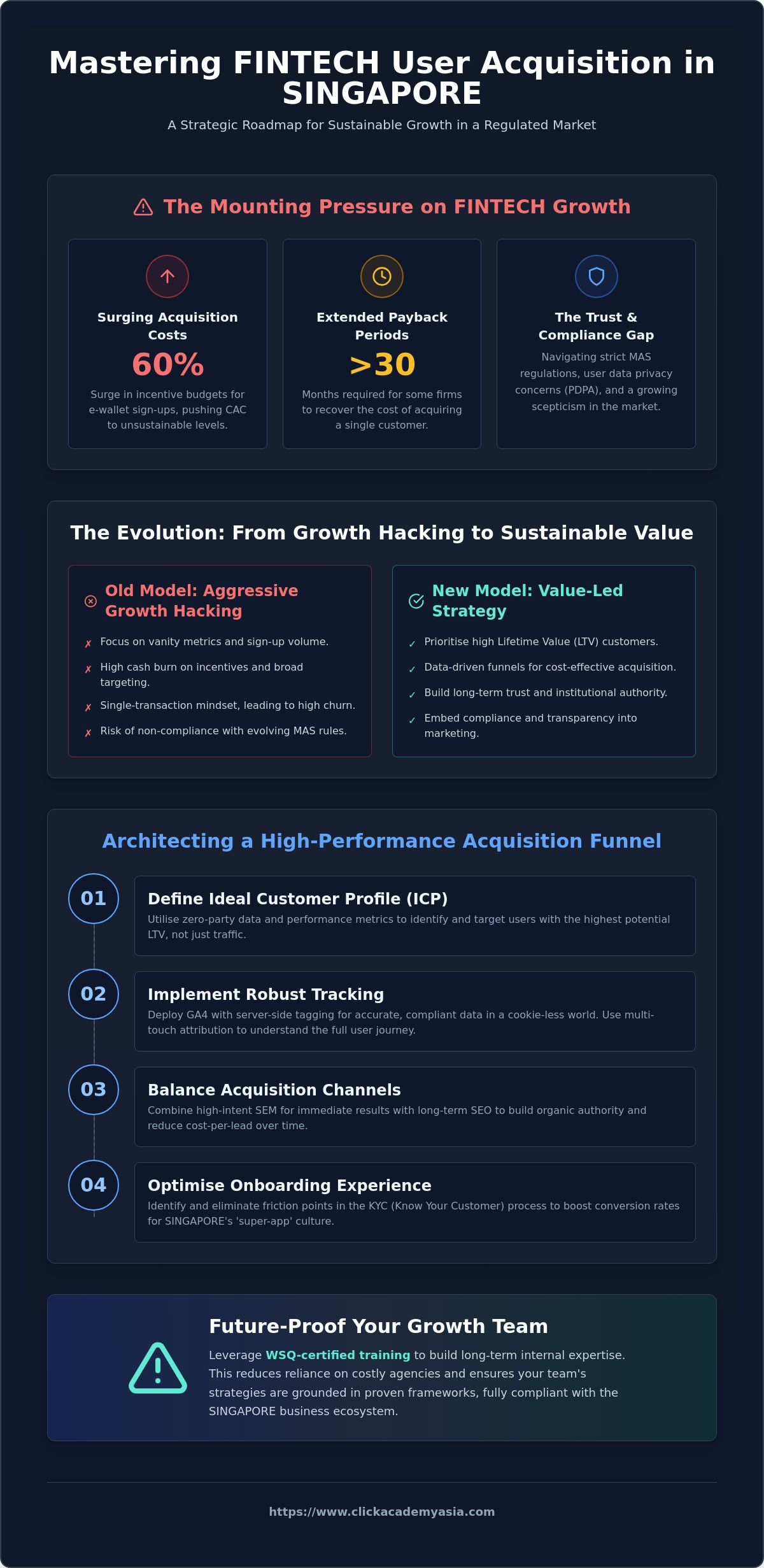
Did you know that incentive budgets for e-wallet sign-ups in SINGAPORE recently surged by up to 60%, pushing payback periods for some firms beyond 30 months? It's a sobering reality for many PMEBs. You're likely feeling the mounting pressure of rising Customer Acquisition Costs (CAC) while struggling to build lasting trust and navigate complex MAS regulations in a saturated market. Finding sustainable user acquisition strategies for fintech is no longer just about outspending the competition; it's about outthinking them with precision and compliance.
We're here to help you bridge that gap and regain control of your growth trajectory. You'll discover how to architect high-growth FINTECH acquisition funnels using data-driven insights and WSQ-certified strategic frameworks that prioritise long-term Lifetime Value (LTV). This guide provides a clear roadmap to reduce your CAC through sharper targeting and ensures your team is aligned on advanced digital strategies. We'll break down the exact steps to optimise your marketing mix and leverage the SINGAPORE ecosystem for measurable, scalable success.
Table of Contents
The Evolution of User Acquisition Strategies for FINTECH in SINGAPORE
Growth in the financial sector has moved far beyond the era of simple customer sign-ups and vanity metrics. Effective user acquisition strategies for fintech now demand a multi-stage trust-building process rather than a single, isolated transaction. As the evolution of financial technology continues to accelerate across the APAC region, PMEBs must recognise that acquisition is merely the beginning of a long-term relationship. In 2026, the industry has shifted away from aggressive "growth hacking" toward sustainable, value-led strategies that align with the high standards of transparency expected in the SINGAPORE market.
The Monetary Authority of SINGAPORE (MAS) plays a pivotal role in this shift by enforcing strict guidelines on marketing transparency and user protection. These regulations ensure that platforms don't just attract users, but do so with integrity. Navigating these complexities requires a team that isn't just tech-savvy but is also deeply versed in local regulatory frameworks. This is why having a WSQ-certified marketing team has become a strategic necessity for firms that want to scale without compromising their reputation or legal standing.
To better understand how these acquisition dynamics play out in the digital space, watch this helpful video:
Addressing the Trust Deficit in 2026
Today's users are significantly more sceptical of digital finance platforms than they were just a few years ago. This scepticism is largely driven by concerns over data privacy and the impact of evolving PDPA regulations on acquisition tactics. When PMEBs lead with professional credentials and transparent data practices, they build immediate brand authority that competitors often lack. By using user acquisition strategies for fintech that prioritise clear communication and regulatory adherence, you can turn a sceptical prospect into a loyal advocate. Professional certifications for your team signal to the market that your firm values expertise and ethical standards above all else.
Integrating SSG-Supported Upskilling into Growth Strategy
Building a high-performance marketing team doesn't need to be a massive financial burden for your organisation. In SINGAPORE, SSG funding significantly reduces the cost of training, allowing firms to upskill their staff in advanced digital methodologies through ClickAcademy Asia. Teams trained within the WSQ framework possess a standardised, high-level competence that provides a distinct competitive advantage. This structured approach ensures your growth tactics are grounded in proven frameworks that have been vetted for the local business ecosystem. Continuous learning directly impacts a firm's bottom line by lowering the high costs associated with inefficient acquisition models and high customer churn.
Architecting a Data-Driven Acquisition Funnel for High-Value Leads
Wasting your marketing budget on users who drop off before completing KYC is a common frustration for growth managers. To build effective user acquisition strategies for fintech, you must move beyond basic demographics and architect a funnel rooted in deep data. Start by defining your ideal customer profile (ICP) through zero-party data and historical performance metrics. This ensures you aren't just buying traffic, but attracting individuals likely to thrive within Singapore's FinTech ecosystem.
Next, establish a robust tracking infrastructure using Google Analytics 4 (GA4) paired with server-side tagging. This combination provides more accurate data in a cookie-less environment while maintaining strict compliance. Since the FINTECH buyer journey is rarely linear, implement multi-touch attribution to credit every touchpoint correctly. Use predictive analytics to identify segments with the highest potential Lifetime Value (LTV). Finally, rigorously A/B test your landing pages to ensure every dollar spent on acquisition is maximised.
Leveraging GA4 for FINTECH Insights
Standard tracking isn't enough for high-stakes financial products. You need to track specific milestones like 'KYC completion' or 'first deposit' to understand exactly where friction occurs. Use custom dimensions to segment high-net-worth individuals based on their interaction patterns and product interests. Mastering these tools is significantly easier when you upskill your team in marketing analytics to ensure data integrity across all channels.
Predictive Analytics and Lead Scoring
Lead scoring allows your team to prioritise users based on their specific financial behaviour and engagement levels. By applying machine learning models, you can even predict user churn before it happens, allowing for proactive retention efforts. This proactive approach turns raw data into a strategic asset for long-term growth. Audit your current data tech stack with this quick checklist:
Server-side tracking: Is your tracking set up to bypass ad-blockers and improve page speed?
Unified view: Do you have a single source of truth for the customer across web and app platforms?
CRM integration: Are your CRM and analytics tools sharing data in real-time?
Attribution accuracy: Does your model reflect the actual path to conversion rather than just the last click?
By following these steps, PMEBs in SINGAPORE can transform their acquisition efforts from a guessing game into a precise, scalable engine. Data-driven decision-making reduces wasted spend and ensures your team focuses on the users who matter most.
Comparing Paid and Organic Channels for FINTECH Growth
Balancing your marketing budget between immediate results and long-term stability is a constant challenge for SINGAPORE PMEBs. While paid ads offer instant visibility, relying solely on them creates a dangerous dependency on rising platform costs. Effective user acquisition strategies for fintech require a dual-track approach that leverages the speed of SEM and the compounding value of SEO. This hybrid model ensures you capture high-intent searchers while simultaneously building the institutional authority necessary to thrive in a competitive market. By diversifying your channels, you protect your growth engine from sudden algorithm shifts or price hikes in the advertising space.
High-Intent Search via SEM and Google Ads
Search Engine Marketing (SEM) remains the most effective way to intercept users at the exact moment they seek financial solutions. When bidding on high-value keywords, it's essential to manage your CPC by focusing on quality scores and landing page relevance. Your ad copy must strike a delicate balance between creating a sense of urgency and maintaining strict compliance with Fintech Regulatory Strategies in Singapore. PMEBs who master advanced SEM strategies can significantly reduce wasted spend by targeting long-tail queries that indicate specific financial needs. This precision allows you to acquire users who are already deep in the decision-making funnel.
Paid Social has also evolved into a critical acquisition tool for different FINTECH niches. LinkedIn is indispensable for wealth management and B2B solutions, whereas TikTok has become a primary discovery engine for younger demographics seeking seamless payment apps. The key is to tailor your creative assets to the specific platform while ensuring your brand voice remains professional and authoritative across all touchpoints.
The Power of Organic Authority through SEO
Organic search is the most sustainable acquisition channel because it builds cumulative trust without a direct cost-per-click. For FINTECH, this means adhering strictly to Google's E-E-A-T (Experience, Expertise, Authoritativeness, Trustworthiness) guidelines. Your content must demonstrate deep financial knowledge and provide genuine value to readers who are increasingly sceptical of digital platforms. Technical SEO is equally critical; complex web architectures must be optimised for speed and security to satisfy both users and search engines. A well-executed SEO strategy lowers your overall CAC by providing a steady stream of qualified leads who already trust your brand's expertise before they even sign up.
E-E-A-T compliance: Use author bios and citations to prove financial expertise.
Technical health: Ensure your site handles secure data transmissions efficiently.
Content depth: Create comprehensive guides that answer complex user queries.
Local relevance: Optimise for SINGAPORE-specific financial terms and regulations.
Integrating these organic efforts with your paid campaigns creates a powerful synergy. When users see your brand in both the sponsored and organic results, their trust in your platform increases exponentially. This holistic approach is the blueprint for scaling a FINTECH firm in the 2026 landscape.
How to Optimise Conversion Rates Through User Experience and Personalisation
SINGAPORE users live in a "super-app" culture where efficiency is the baseline expectation. If your platform doesn't meet this standard of seamlessness, even the most sophisticated user acquisition strategies for fintech will fail at the final hurdle. Conversion rate optimisation (CRO) in 2026 has moved beyond simple button colours; it's now about reducing the cognitive load on PMEBs who expect personalised financial journeys. By prioritising a mobile-first design and ensuring high accessibility, you create a high-trust environment that encourages users to commit to your platform.
Removing Friction in the Onboarding Journey
Digital banking and investment apps often lose a significant portion of potential users during the KYC (Know Your Customer) stage. This friction is frequently caused by cumbersome document upload processes or ambiguous instructions that confuse the user. Using Digital Experience Intelligence (DXI) tools allows your team to identify exactly where users hesitate or drop off in real-time. Implementing micro-copy that explains why certain data is needed and using progress bars to signal completion can significantly boost your conversion rates.
To improve your mobile landing page performance immediately, consider these three quick wins:
Optimise visual assets: Compress all brand imagery to ensure rapid loading without sacrificing clarity on retina displays.
Minimise external scripts: Audit your third-party tracking tags and remove any that aren't essential for the immediate conversion goal.
Enable lazy loading: Ensure that only the elements currently in the user's viewport are loaded initially to improve perceived speed.
Scaling Personalisation without Compromising Privacy
The industry-wide shift from third-party cookies to first-party data strategies has changed how we approach personalisation. You must now rely on data collected directly from user interactions to fuel AI-driven product recommendations. This allows you to offer relevant financial products, such as targeted investment portfolios or insurance plans, based on a user's demonstrated history. This level of relevance makes the acquisition feel like a bespoke service rather than a generic sales pitch.
However, PMEBs must balance this with the enhanced user protection requirements introduced in the 2024 amendments to the Payment Services Act (PSA). Ethical personalisation means ensuring your algorithms are transparent and don't inadvertently exclude specific demographics. Managing these complex projects requires a deep understanding of both technology and regulatory ethics. To lead these high-impact growth initiatives, you can enrol in our WSQ Digital Marketing Strategy & Planning programme to master the latest CRO and personalisation frameworks.
By focusing on inclusive design and data-driven empathy, you ensure your platform isn't just another app on a smartphone, but a vital part of your user's financial life. High conversion rates are the natural result of a user experience that feels intuitive, secure, and uniquely tailored to the individual's needs.
Future-Proofing Your FINTECH Growth Team with WSQ-Certified Training
Outsourcing your growth to external agencies might seem like a convenient solution, but it often leads to a disconnect between brand values and technical execution. In the sensitive world of digital finance, your internal team must possess the strategic depth to manage complex compliance and data requirements. Effective user acquisition strategies for fintech require a level of institutional knowledge that external partners simply cannot replicate. By building internal expertise, you ensure that your growth tactics remain agile and deeply aligned with your long-term business objectives.
The WSQ Digital Marketing Strategy & Planning programme is specifically designed to bridge this competency gap. It moves beyond theoretical concepts, providing PMEBs with a structured framework to architect and manage high-performance funnels. When your sales and marketing teams undergo corporate group training together, they develop a shared vocabulary and a unified approach to data. This alignment is critical for reducing friction between lead generation and final conversion, ultimately lowering your CAC through better internal synergy.
The ClickAcademy Asia Advantage for FINTECH Leaders
Since 2011, ClickAcademy Asia has been at the forefront of professional development in the APAC region, empowering thousands of PMEBs to master the digital landscape. Our workshops are led by industry practitioners who bring real-world experience into the classroom, ensuring every session is practical and actionable. We focus on "how-to" insights that you can implement immediately within your organisation to see tangible results. You can explore our comprehensive range of WSQ digital marketing courses in SINGAPORE to find the right fit for your team's specific needs.
Action Plan: Moving from Strategy to Execution
Transforming your team into a growth powerhouse requires a deliberate approach. Start by conducting a thorough skills audit of your current marketing and sales departments to identify where expertise is lacking. Once you've mapped out these gaps, follow these steps to begin your transformation journey:
Identify relevant WSQ modules: Select specific training tracks, such as Marketing Analytics or Search Engine Optimisation, that address your immediate acquisition challenges.
Leverage SSG funding: Minimise your financial outlay by utilising available subsidies, making high-level training accessible for your entire department.
Implement a test-and-learn culture: Encourage your team to apply their new skills through small-scale experiments before scaling successful tactics across the firm.
Continuous upskilling is the most reliable way to future-proof your organisation against the rapid shifts in user acquisition strategies for fintech. By investing in your people today, you create a resilient growth engine capable of navigating the complexities of the 2026 market with confidence and precision.
Mastering the Future of FINTECH Growth in SINGAPORE
Navigating the 2026 landscape requires more than just a marketing budget; it demands a synergy of technical precision and regulatory trust. You've seen how shifting toward sustainable, value-led user acquisition strategies for fintech can lower your CAC while building long-term institutional authority. By architecting data-driven funnels and optimising for the unique "super-app" culture in SINGAPORE, you position your firm as a leader in a crowded market. The combination of high-intent search strategies and frictionless onboarding is the blueprint for sustainable growth.
The most successful organisations are those that stop outsourcing their core growth and start investing in their people. As an Official Google Partner that has reached over 30 countries since 2011, ClickAcademy Asia is committed to helping you bridge the skills gap through WSQ-certified modules. Equip your team with advanced acquisition skills by exploring our WSQ-funded training tracks today.
Take the next step in your professional journey and build the internal expertise needed to dominate the digital finance sector. Your path to scalable, compliant growth starts with a commitment to continuous upskilling and strategic leadership. We are here to support your team as you transform these insights into measurable business impact.
Frequently Asked Questions
What are the most cost-effective user acquisition strategies for FINTECH startups in SINGAPORE?
Focusing on content marketing and community building is the most sustainable way to grow without a massive ad budget. Organic user acquisition strategies for fintech that leverage E-E-A-T principles allow startups to compete by building authority rather than just buying clicks. Partnering with local ecosystem players and using referral programmes can also drive high-quality leads at a lower cost than broad digital advertising.
How can I reduce the Customer Acquisition Cost (CAC) for my digital payment app?
You should prioritise optimising the onboarding funnel to prevent drop-offs during the KYC process. High friction during registration is a primary driver of high CAC in the digital payment space. By using DXI tools to identify bottlenecks and implementing micro-copy to guide users through security checks, you can significantly increase conversion rates from app install to active user.
Is SSG funding available for digital marketing courses in 2026?
Yes, SSG funding remains a cornerstone of the professional development landscape in 2026. Eligible SINGAPORE citizens and Permanent Residents can access subsidies for WSQ-certified modules at ClickAcademy Asia. These grants are designed to reduce the financial barrier for organisations looking to upskill their teams in advanced growth methodologies and data analytics.
How do MAS regulations affect my FINTECH marketing strategy?
MAS regulations require absolute transparency and accuracy in all promotional materials to protect consumers. Your marketing must avoid misleading claims and clearly state the risks associated with financial products. This oversight ensures that user acquisition strategies for fintech are built on a foundation of integrity, which is essential for maintaining your licence and reputation in SINGAPORE.
What is the role of GA4 in FINTECH user acquisition?
GA4 provides the event-based tracking necessary to understand the non-linear path to conversion in modern finance. It allows PMEBs to track specific milestones, such as 'KYC completion' or 'first transaction', rather than just basic page views. This granular data helps you identify which channels are driving high-value users versus those just generating vanity metrics that don't convert.
Why is trust more important than features for FINTECH users in 2026?
Users in 2026 prioritise security and regulatory reliability over a long list of niche functionalities. With the rise of digital fraud, showing that your platform is compliant and secure builds the immediate authority needed to win over a sceptical audience. Features are easily replicated by competitors, but a reputation for trust is a sustainable competitive advantage that drives long-term retention.
Can I use SkillsFuture Credit for advanced digital marketing certifications?
Yes, you can typically use your SkillsFuture Credit to offset the out-of-pocket expenses for WSQ-certified programmes. This applies to various specialised tracks, including SEO, SEM, and Digital Advertising. It's an excellent way for PMEBs to future-proof their skills and stay ahead of industry shifts without a heavy personal financial burden.
How long does it take to see results from a FINTECH SEO strategy?
You should expect to see measurable improvements in organic traffic and lead quality within four to six months of consistent implementation. SEO is a long-term investment that builds institutional authority and compounds over time. While paid ads provide instant results, a robust organic presence eventually leads to a significantly lower blended CAC and more stable growth.


Comments