
Tech Sales Domination: Mastering the Art of Selling Software & Hardware Solutions

Updated: Jun 4
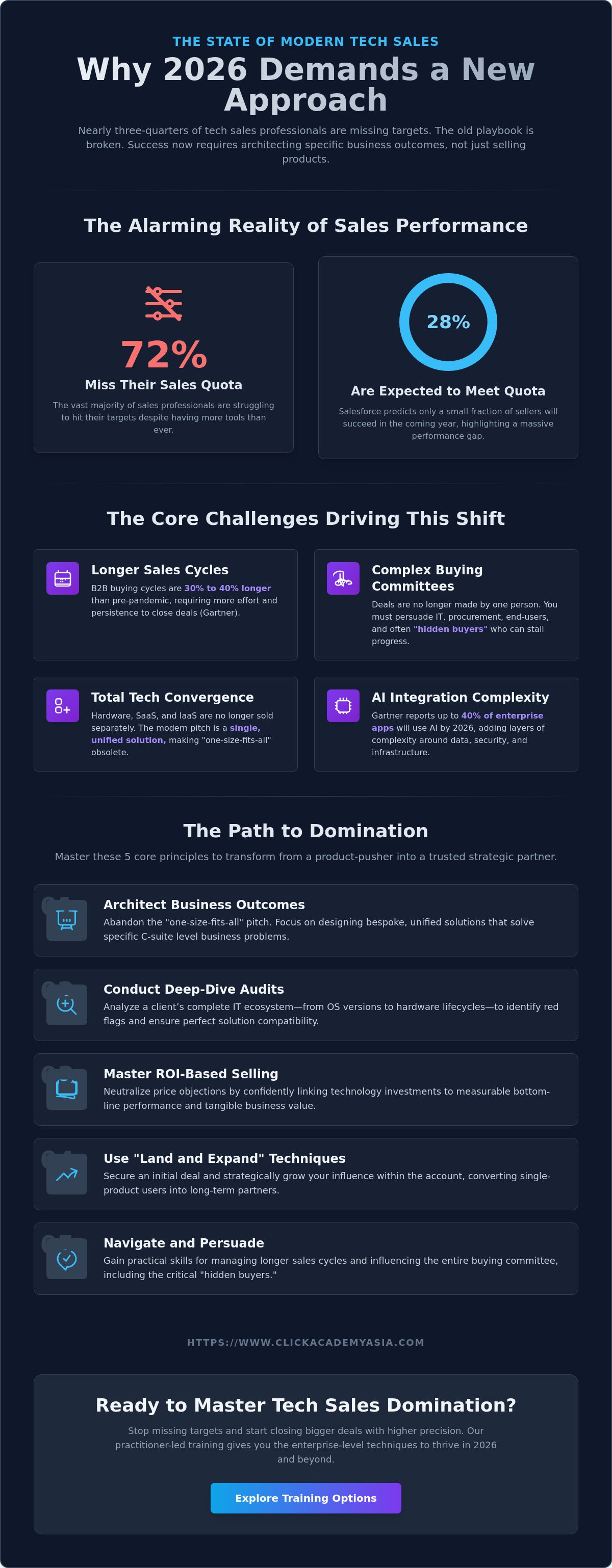
Why are nearly three quarters of tech sales professionals missing their targets despite having more tools than ever? Salesforce reported that only 28% of sellers were anticipated to meet their quota in 2025. This gap exists because selling in 2026 isn't about the tool; it's about architecting a specific business outcome. To lead in this environment, you must adopt the principles of Tech Sales Domination: Mastering the Art of Selling Software & Hardware Solutions.
You've likely felt the frustration of a deal stalling just as you reach the finish line. It's an exhausting reality, especially when Gartner reports that B2B buying cycles are now 30% to 40% longer than they were before the pandemic. You're working harder, but "hidden buyers" and technical objections keep moving the goalposts while you struggle to justify premium pricing.
This guide will show you how to cut through the noise, translate complex jargon into clear business value, and handle price objections with confidence. We'll explore how to analyse infrastructure and use ROI-based selling to transform from a product-pusher into a trusted strategic partner. By mastering these enterprise-level techniques, you'll shorten your sales cycles and close deals with much higher precision.
As you work toward becoming a strategic partner, you may also want to discover Insoft Services to stay updated on the latest technical tracks and certifications that drive enterprise innovation.
Key Takeaways
Learn why a "one-size-fits-all" pitch fails in 2026 and how to pivot your strategy toward architecting specific business outcomes for enterprise clients.
Discover how to conduct a deep-dive audit of a client’s IT ecosystem to ensure your software and hardware solutions are compatible with their existing infrastructure.
Master the core principles of Tech Sales Domination: Mastering the Art of Selling Software & Hardware Solutions to neutralise price objections by linking technology to bottom-line performance.
Develop "Land and Expand" techniques that allow you to grow your influence within an account and convert single-product users into long-term strategic partners.
Gain practical insights into navigating longer sales cycles and persuading the "hidden buyers" who often stall complex B2B technology deals.
Table of Contents
The Evolution of B2B Tech Sales: Why 2026 Demands a New Approach
The B2B technology market has moved far beyond simply shifting units of hardware. In 2026, we are seeing a total convergence where hardware, Software as a Service (SaaS), and Infrastructure as a Service (IaaS) are sold as a single, unified solution. This shift means the old "one-size-fits-all" pitch is effectively dead. Modern enterprise IT environments are far too complex for a generic script; they require a bespoke approach that addresses specific pain points like AI integration and data privacy. Navigating these complexities often requires partnering with IT experts like Insoft Services, who specialize in managed services and professional training for modern infrastructures.
When your sales strategy involves complex hardware components manufactured in the region, you can discover Buying Office Asia to provide your clients with expert on-the-ground sourcing and procurement support.
To better understand how this landscape is changing, watch this helpful video:
To thrive, you must step into the role of a consultant who can bridge the gap between technical IT requirements and C-suite business goals. This involves a deep understanding of Sales Process Engineering, ensuring your approach is systematic and outcome-focused. Mastering these shifts is at the heart of Tech Sales Domination: Mastering the Art of Selling Software & Hardware Solutions. You'll need to address the reality that up to 40% of enterprise applications will incorporate AI agents by 2026, according to Gartner. This adds a layer of complexity to every conversation regarding data security and hybrid infrastructure.
Understanding the Complex Tech Sales Cycle
The journey from a cold lead to a signed contract has become significantly more intricate. It starts with a discovery phase that must go beyond surface-level needs to uncover the technical feedback required for a viable implementation. You aren't just selling to one person; you're managing a committee. IT directors care about security and uptime, procurement focuses on contract terms, and end-users worry about the daily workflow. This level of stakeholder alignment is critical when selling integrated systems, such as those provided by Home-A-Genius, where networking and security must meet the needs of both technical teams and end-users. A successful deal requires aligning these competing interests through every stage of the cycle, from initial discovery to post-implementation support.
Software vs Hardware: Different Sides of the Same Coin
While hardware is tangible and software is intangible, they are increasingly inseparable in the modern marketplace. Selling hardware often involves discussing long-term maintenance and physical reliability, whereas software focuses on scalability and rapid updates. The most successful professionals bundle these into modular offerings. This allows a client in Singapore to start with a core infrastructure and add software modules as their business grows. It's about designing a solution that is flexible enough to adapt to the next decade of digital transformation. If you want to future-proof your career, visit ClickAcademy Asia to explore our practitioner-led training options.
Analysing Client Infrastructure and Technology Requirements
You can't sell a high-performance solution if you don't understand the foundation it sits on. A deep-dive audit isn't just about listing servers; it's about identifying legacy systems that might conflict with new deployments. Use a structured checklist to document current Operating System (OS) versions, network bandwidth, and hardware lifecycles. This level of detail ensures you won't promise a software update that the client's current physical infrastructure simply cannot support.
Ensuring the reliability of physical components is a key part of the consultative process. For those looking to optimize their regional supply chain, you can visit Buying Office Asia to learn about professional on-the-ground procurement and sourcing support in Asia.
Assessing compatibility is a critical step in the sales process. If your software requires high-performance GPUs but the client is running five-year-old workstations in Singapore, the deal is doomed before it starts. This is where Tech Sales Domination: Mastering the Art of Selling Software & Hardware Solutions provides the framework to spot these red flags early. You'll learn to ask the right technical questions to avoid post-sale implementation disasters.
To further mitigate risk and ensure consistent delivery, many tech firms are turning to international quality management standards. Consulting with Align Quality can help your organization implement these systems, providing a clear signal of reliability to your enterprise clients.
Map every technical requirement back to a specific business goal. If an IT director wants better latency, find out if that's to improve customer checkout speeds or internal data processing. Using Harvard negotiation techniques, you can pivot these technical needs into value-based discussions that resonate with the C-suite. This approach turns a technical "nice-to-have" into a business "must-have."
Designing Customised Technology Offerings
Move away from off-the-shelf packages. Enterprise clients expect bespoke architecture that fits their specific workflow. Balance this with standardisation to keep support costs manageable for both parties. Include clear Service Level Agreements (SLAs) in your pitch to define uptime and response times. This turns a technical necessity into a competitive advantage. If you're looking to refine these consultative skills, you might find our practitioner-led sales training helpful.
Future-Proofing the Client Solution
Anticipate where the industry is heading over the next five years. A solution that works today but can't handle AI-driven workloads by 2028 is a poor investment for your client. Build scalability into your initial proposal so the client can add capacity without a total overhaul. This foresight builds trust and facilitates easier upsells later. Modular technology is a system composed of separate, interchangeable components that can be independently upgraded or replaced to meet changing business demands.
This modular approach is equally effective in specialized technology sectors; you can visit Home-A-Genius to see how integrated networking and automation components are designed for scalability and long-term reliability.
To ensure a thorough assessment, focus on these areas:
Legacy integration: Check if new software can communicate with existing databases.
Hardware limits: Verify that physical components meet the minimum specs for the new stack.
Security standards: Ensure the solution complies with local data protection regulations. To gain a deeper understanding of these requirements, you can explore Cyber Security Career Path with Square Skills.
User adoption: Identify if the current workforce has the technical skills to use the new tools.
Negotiation Mastery: Handling Price Objections for Premium Solutions
When a prospect tells you "the price is too high," they're rarely talking about their actual budget. It's almost always a sign that the perceived value hasn't yet outweighed the perceived risk of the purchase. In the competitive 2026 market, you can't rely on generic discounts to close a deal. You must correlate technology adoption directly with bottom-line business performance to make the price irrelevant to the decision-maker.
Developing the ability to communicate value effectively is a continuous journey, and resources like Just Go Sell can help sales professionals sharpen their techniques and improve their overall selling skills.
Adapting your message to the specific sector is vital for success. A bank in Singapore prioritises security and compliance, while a retail chain cares about transaction speed and customer data. Use customised use cases to show exactly how your solution solves their unique problems before the contract is even drafted. This high-level consultative approach is a core pillar of Tech Sales Domination: Mastering the Art of Selling Software & Hardware Solutions.
To handle premium price objections effectively, try these practical steps:
Identify the hidden objection: Ask open-ended questions to see if the issue is budget, risk, or a simple lack of perceived value.
Quantify the impact: Translate technical features into man-hour savings or direct revenue growth.
Showcase peer success: Use a use case from a similar industry to prove the solution delivers results in their specific context.
Offer a modular start: If the total cost is a barrier, suggest a phased implementation to prove value early.
The ROI Framework for Tech Sales
You need to move beyond "faster" or "better" and start talking about specific efficiency gains. Calculate how many man-hours your software saves or how much hardware maintenance costs it eliminates. Don't ignore the "cost of inaction" either. If a prospect's current system causes 10 hours of downtime a month, that's a measurable loss you can use to create urgency. Forrester reports that 86% of B2B purchases stall; your job is to use hard data to keep the momentum going. Once the deal is done, keep tracking these metrics to build a library of case studies for future prospects.
Navigating Enterprise Procurement Processes
Large-scale deals often hit a wall in the procurement phase. These teams are trained to scrutinise every line item for risk and cost. To bypass these hurdles, you must build internal champions; people within the client's organisation who actively want your solution to succeed because it solves their daily frustrations. They will help you navigate the legal and financial red tape. Remember that tech sales are rarely isolated events. A comprehensive digital solution often includes elements like Search Engine Optimisation (SEO) to ensure the new infrastructure actually drives business growth. This holistic view helps procurement see the purchase as a revenue generator rather than just a line-item expense.
Strategic Account Management and Relationship Expansion
"Land and expand" is the definitive strategy for long-term growth in the technology sector. It involves securing an initial foothold within one department and systematically growing your presence across the entire organisation. To achieve Tech Sales Domination: Mastering the Art of Selling Software & Hardware Solutions, you must move beyond being a vendor and become an indispensable part of the client's tech stack. This transition requires a shift in mindset from "closing" to "cultivating."
Managing your account loads is equally vital. High-potential clients shouldn't compete for your time with low-value accounts. Use performance-based processes to categorise your portfolio. This ensures your most valuable partners receive the proactive attention they need to remain loyal. By focusing on these high-impact relationships and utilizing specialized consultancy from Insoft Services, you can convert single-product users into long-term multi-solution partners who trust your guidance.
Building the Relationship Expansion Plan
Identify untapped business units that could benefit from your solutions. If the HR department in Singapore is successfully using your software, the finance team might be your next logical step. Leverage your initial implementation successes to pitch higher-tier hardware or advanced software modules. Regular business reviews are the best venue for this. These aren't just social calls; they're formal opportunities to align your technology roadmap with the client's five-year business goals.
Monitoring Sales Performance and Client Trends
Keep a close eye on metrics that signal account health. Implementation satisfaction isn't a one-time score; it's a moving target. Watch for these common red flags:
Decreasing frequency of software logins or hardware usage.
Key internal champions leaving the organisation.
Unusually high numbers of technical support tickets.
A lack of interest in attending roadmap update sessions.
These signals often suggest a competitor has gained an ear within the organisation. To provide more value, suggest broader training like WSQ Digital Marketing Strategy & Planning. This helps the client's team get more out of their digital tools and solidifies your role as a strategic partner. If you're ready to lead these high-level accounts, view our sales leadership courses to get started.
Mastering Tech Sales Domination with ClickAcademy Asia
Theory alone won't help you close a multi-million dollar enterprise deal in Singapore's competitive tech hub. This is why the Tech Sales Domination: Mastering the Art of Selling Software & Hardware Solutions - https://www.clickacademyasia.com/course/tech-sales-domination programme prioritises a practitioner-led approach. Unlike traditional academic courses that rely on outdated textbooks, our training is delivered by industry veterans who are currently active in the field. They bring real-world experience from the front lines of B2B sales, ensuring you learn strategies that actually work in the 2026 marketplace.
The course carries the WSQ certification, which is a powerful asset in the Singaporean job market. Employers recognise WSQ as a mark of practical competency and professional excellence. By earning this certification, you prove that you possess the specific skills required to manage complex sales cycles and architect high-value technology solutions. It's about future-proofing your career with credentials that carry weight across the entire region.
In addition to sales-focused credentials, staying current with technical certification tracks through global providers like Insoft Services can further validate your expertise when architecting solutions for the most demanding enterprise clients.
Financial barriers shouldn't stop you from reaching the next level of your career. Singapore Citizens aged 40 and above can access a 70% subsidy from SSG, reducing the payable amount to just S$429 including GST. For those aged 21 to 39 and Permanent Residents, a 50% subsidy is available, bringing the cost to S$649. You can also use your SkillsFuture Credits or NTUC UTAP support to further offset these fees. Eligible companies can even claim 90% of out-of-pocket expenses through the SkillsFuture Enterprise Credit (SFEC).
Who Should Enrol in This Course?
This programme is specifically designed for senior sales managers and account executives who want to refine their consultative approach. It's also the ideal roadmap for professionals looking to transition from other sectors into the high-growth tech industry. To ensure everyone in the room can contribute to high-level discussions, we require a minimum of one month of work experience as a starting point. This prerequisite ensures that the cohort shares a foundational understanding of professional environments, making the peer-to-peer learning much more impactful.
Your Path to Mastery Starts Here
Your journey begins with mastering infrastructure analysis and ends with creating strategic action plans that win enterprise-level contracts. You'll learn to navigate the nuances of both hardware and software sales, as we've discussed in previous sections. Beyond the classroom, you'll join the ClickAcademy Asia alumni network, connecting you with a community of digital leaders and potential strategic partners. This network provides ongoing support and industry insights long after the final module is complete.
Don't let your sales targets remain out of reach. Take the definitive step toward professional excellence and start your journey toward becoming a strategic tech advisor. Enrol in the Tech Sales Domination course today and transform your approach to the modern B2B market.
Elevate Your Career in the 2026 Tech Landscape
The 2026 B2B market moves at a relentless pace. You've learned that success now depends on your ability to bridge the gap between complex technical infrastructure and high-level business goals. By mastering the "land and expand" strategy and using hard ROI data to dismantle price objections, you position yourself as a strategic partner rather than just another vendor. These skills are no longer optional; they're the foundation of any high-performing sales career in Singapore.
Taking the next step requires more than just reading; it requires practical, hands-on application. Our Tech Sales Domination: Mastering the Art of Selling Software & Hardware Solutions - https://www.clickacademyasia.com/course/tech-sales-domination programme provides the exact roadmap you need to lead high-value enterprise deals. This practitioner-led training is delivered by industry experts and is already trusted by professionals in over 30 countries globally.
Because the course is WSQ-certified and SSG-funded, it's a highly accessible way to future-proof your skills and accelerate your professional growth. Don't let your sales targets stay out of reach. Master the art of tech sales—secure your spot in our next intake. You have the tools; now it's time to lead the market with absolute confidence.
Frequently Asked Questions
Is the Tech Sales Domination course eligible for SkillsFuture credits?
Yes, Singapore Citizens aged 25 and above can use their SkillsFuture Credits to offset the payable fees. This is on top of the SSG subsidies that cover up to 70% of the course fee for citizens aged 40 and above, or 50% for those aged 21 to 39 and Permanent Residents. It makes the Tech Sales Domination: Mastering the Art of Selling Software & Hardware Solutions programme highly accessible for individual learners.
What are the prerequisites for joining the Tech Sales programme?
The primary requirement is a minimum of one month of professional work experience. You don't need a background in computer science or engineering to succeed. We've designed the curriculum to help professionals from any industry learn how to analyse technical requirements and translate them into business value for the C-suite.
How long does the Tech Sales Domination course take to complete?
The programme is delivered as an intensive, practitioner-led training experience designed for busy professionals. It focuses on rapid skill acquisition through structured modules that cover everything from infrastructure audits to closing enterprise deals. This format ensures you can apply your new skills to your current sales pipeline almost immediately.
Can this course help me transition from retail sales to B2B software sales?
Yes, this course is specifically built to help professionals pivot into the high-stakes world of technology sales. We teach you how to move away from transactional selling and adopt a consultative approach. You'll learn to handle the longer sales cycles and complex decision-making units that define the B2B software and hardware markets.
Will I receive a WSQ certificate upon completion?
Yes, all successful participants receive a nationally recognised WSQ certificate. This certification is a valuable asset in the Singaporean job market, proving to employers that you've met rigorous standards in sales competency. It's a clear marker of your ability to manage complex technology solutions at an enterprise level.
Are there any subsidies available for corporate group training?
Yes, company-sponsored training is heavily subsidised to encourage workforce upskilling. Eligible organisations can receive up to 70% funding for their employees' course fees. Furthermore, companies can claim 90% of their out-of-pocket expenses through the SkillsFuture Enterprise Credit (SFEC), significantly reducing the net cost of the training.
What is the difference between this course and general sales training?
General training often focuses on basic persuasion; this programme focuses on technical solution architecture and ROI-based selling. We address the specific challenges of 2026, such as AI integration and hybrid cloud infrastructure. You won't just learn to sell; you'll learn to conduct deep-dive audits and design bespoke technology offerings that solve real business problems.
How does ClickAcademy Asia support post-training career growth?
We provide all graduates with access to our extensive alumni network, which is a hub for digital expertise across Asia. This community allows you to connect with other professionals and stay updated on the latest technology trends. Many of our students also progress into specialised areas like Sales Leadership or Digital Transformation for Leaders to further their career trajectory.


Comments