
Singapore Online Retail: 2026 Loyalty Program Guide

Your online store's survival in 2026 depends less on your acquisition budget and more on the depth of your customer's wallet share. Most retail leaders in Singapore are feeling the squeeze of rising acquisition costs and a market that feels increasingly crowded. You've likely realised that basic points systems aren't enough, which is why investing in customer loyalty strategy training has become a critical priority for local PMEBs. It's frustrating to watch marketing spend climb while Customer Lifetime Value remains stagnant.
This guide provides a definitive roadmap to mastering loyalty mechanics that actually drive ROI. We'll show you exactly how to design a high-performing programme that keeps shoppers coming back. You'll discover how to move beyond reactive discounting and start building proactive retention strategies that scale.
Beyond strategy, we'll navigate the practical side of upskilling your workforce. You'll learn how to leverage WSQ-certified training and SSG grants to offset costs while building a future-proof team. Let's explore the step-by-step process of turning one-time buyers into lifelong brand advocates in the local ecosystem.
Table of Contents
The Strategic Shift: Why Customer Loyalty Strategy Training is Non-Negotiable in Singapore
Decoding the Framework: Loyalty Program Design for Online Retail and Beyond
Choosing Your Model: Comparing Points, Tiers, and Subscription-Based Systems
How to Implement a Data-Driven Loyalty Strategy: A Practical Step-by-Step Guide
Future-Proofing Your Team: WSQ-Certified Training and SSG Funding in Singapore
The Strategic Shift: Why Customer Loyalty Strategy Training is Non-Negotiable in Singapore
The Singapore retail environment in 2026 has matured beyond the era of simple transactional discounts. Shoppers are fatigued by endless "12.12" sales that offer little beyond a temporary price cut. To thrive, brands must pivot toward sophisticated, value-driven engagement. This is where customer loyalty strategy training becomes essential for marketing teams, as it equips them to move from reactive coupon-pushing to proactive relationship management.
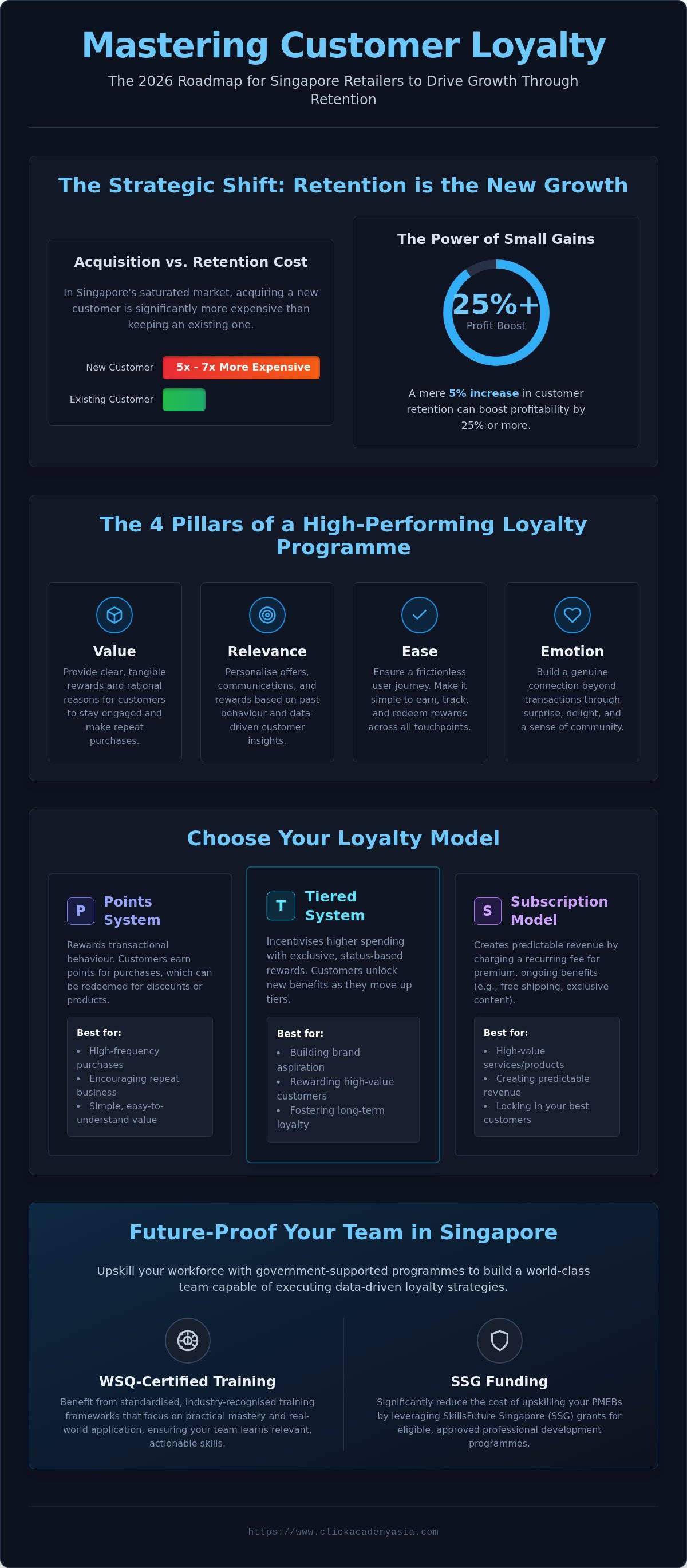
High Customer Acquisition Cost (CAC) remains a significant barrier to profitability in our saturated market. It's often reported by industry analysts that acquiring a new customer in the APAC region can be five to seven times more expensive than retaining an existing one. When your team understands how to optimise retention, they transform your marketing spend from a sunk cost into a long-term investment. Data-driven decision making allows you to identify which segments are worth the most effort and investment.
The Economic Case for Retention in 2026
Retailers in Singapore are increasingly focusing on Customer Lifetime Value (CLV) as their primary metric for success. In the context of online retail ROI, CLV represents the total net profit a business can expect from a single customer account throughout the entire relationship. Improving this figure by just 5% can lead to substantial profit increases, according to various local retail studies. Trained staff are better equipped to analyse these benchmarks and adjust loyalty mechanics in real-time.
A workforce that has undergone formal customer loyalty strategy training can better interpret complex data sets. They don't just see a purchase; they see a pattern of behaviour that can be nurtured. This level of insight is what separates market leaders from those struggling with high churn rates. Practical mastery in analytics ensures your loyalty programme remains agile and relevant to changing consumer habits.
Addressing the PMEB Skills Gap
Many local marketing departments fall into the trap of chasing "quick wins" through aggressive discounting. While these might boost short-term numbers, they often erode brand equity and attract price-sensitive churners who won't return. Moving toward a sustainable model requires a foundation of formal digital strategy training. PMEBs need to understand the psychological drivers of loyalty, not just the technical setup of a points plugin.
The WSQ framework plays a vital role in standardising this expertise across the Singaporean workforce. By aligning with WSQ-certified programmes, businesses ensure their teams are learning from a curriculum grounded in real-world application. This structured approach helps bridge the gap between theoretical knowledge and the tactical execution required in a competitive economy. It turns your staff into strategic advisors who can navigate the complexities of 2026 retail with confidence.
Decoding the Framework: Loyalty Program Design for Online Retail and Beyond
Effective loyalty program design serves as a blueprint for consistent engagement. It moves beyond "buy one get one free" tactics to create an ecosystem where every interaction reinforces the brand's value proposition. In Singapore's digital-first economy, this requires a blend of technical precision and psychological insight. You must design for the long term, ensuring your rewards structure evolves alongside your customers' needs.
The four pillars of successful retail loyalty are Value, Relevance, Ease, and Emotion. Value provides the rational reason to stay, while Relevance ensures offers match individual shopper preferences based on past data. Ease refers to a frictionless user journey across all digital touchpoints. Mastering these pillars through customer loyalty strategy training allows PMEBs to build resilient brands that withstand market volatility.
Service recovery is often an overlooked mechanism in loyalty building. When a delivery fails or a product is faulty, your response can actually increase loyalty more than a perfect transaction would. A structured recovery programme turns dissatisfied customers into vocal advocates by proving the brand prioritises the relationship over the single sale. It's about building trust through accountability and swift action.
Behavioral Psychology in Loyalty Design
The "endowed progress effect" is a powerful tool for initial engagement. By giving users a head start, such as pre-filling the first two slots on a digital stamp card, you significantly increase the likelihood they'll complete the goal. Gamification further drives interaction by introducing elements of achievement or social proof that keep your online brand top-of-mind. These psychological nudges ensure your programme feels like a journey rather than a chore.
We're seeing a significant shift from purely rational rewards to emotional brand advocacy. Customers in 2026 want to feel like they belong to a community or support a mission. Brands such as GREENDO illustrate this by building a dedicated community around health and fitness for women, moving beyond simple product sales. Moving your strategy toward these emotional triggers requires a deep understanding of consumer psychology. This level of insight is a core component of modern digital marketing education, helping you move past simple transactional mechanics.
Your loyalty strategy must integrate seamlessly with your existing CRM and marketing automation tools. Essential API integrations ensure that points and rewards are updated in real-time across your website, mobile app, and point-of-sale systems. This technical cohesion provides the unified experience that modern Singaporean shoppers expect. Without this integration, your data remains siloed and your marketing stays reactive.
Data privacy is paramount, especially with strict PDPA compliance requirements in Singapore. Your system must handle personal information securely while providing total transparency on how data is used for rewards. A CRM centralises customer data to track key loyalty metrics like purchase frequency and churn risk, enabling more precise targeting. Ensuring your team is trained in these technical frameworks is vital for scaling your operations safely.
Choosing Your Model: Comparing Points, Tiers, and Subscription-Based Systems
Selecting the right loyalty framework isn't just a technical choice; it's a strategic move that defines your brand's relationship with its audience. In the Singaporean market, where competition for attention is fierce, your model must align with your product margins and purchase frequency. Customer loyalty strategy training helps decision-makers evaluate these models through a data-driven lens rather than following generic industry trends.
Points-based systems remain a staple for high-frequency, low-margin retail, such as groceries or daily essentials. They're intuitive for the user and easy to implement. However, tiered loyalty approaches are often more effective for prioritising high-value customers. By offering escalating benefits, you create an aspirational journey that keeps your most profitable segments engaged for longer.
Paid membership or subscription models are gaining traction as a way to build a "moat" around an online store. These systems provide immediate value, like free shipping or exclusive discounts, in exchange for an upfront fee. Hybrid models are also emerging in 2026, combining the reliability of points with the prestige of experiential rewards to cover all customer motivations.
Points vs. Tiers: Which Fits Your Brand?
Small retailers often find points-based models more manageable due to lower administrative overhead. Large retailers, conversely, benefit from tiers because they allow for sophisticated segmentation and targeted marketing. It's vital to calculate the "burn rate" of your points, which is the speed at which they're redeemed, to ensure your programme remains profitable. Successful Singaporean models often use tiers to reward their top 10% of spenders with perks that go beyond simple discounts, focusing resources where they generate the highest ROI.
The Rise of Experiential Rewards
Modern Singaporean consumers are increasingly valuing access and exclusivity over mere price cuts. Designing non-monetary perks like early access to new collections, VIP events, or personalised styling sessions creates a deeper emotional bond. These rewards differentiate your brand in a way that competitors can't easily replicate through discounting alone. Measuring the impact of these rewards requires looking at brand sentiment and social advocacy. This shift toward emotion-based loyalty is a key pillar of advanced customer loyalty strategy training, ensuring your team can manage the complexities of modern consumer expectations.
How to Implement a Data-Driven Loyalty Strategy: A Practical Step-by-Step Guide
Implementation is where high-level vision meets operational reality. Many Singaporean retailers struggle because they invest in loyalty software before defining a clear roadmap. Building a data-driven system requires a structured approach that aligns with your specific business goals. Enrolling your team in customer loyalty strategy training provides the tactical framework needed to execute these steps without wasting budget on trial and error.
Follow this five-step process to ensure your programme is built on a foundation of profitability and customer insight:
Step 1: Audit and Segment. Use RFM (Recency, Frequency, Monetary) analysis to categorise your existing database. Identify your top 20% of spenders and understand their unique purchase triggers.
Step 2: Define Core Objectives. Decide if your primary goal is to increase Average Order Value (AOV), reduce churn, or drive high-frequency visits. Your rewards must directly incentivise these specific behaviours.
Step 3: Select Mechanics. Choose mechanics that match your brand identity. Luxury brands might opt for exclusive access, while fast-moving consumer goods often benefit from points-based systems.
Step 4: Launch a Pilot. Roll out the programme to a small group of "super-users" first. Use this phase to iron out technical bugs and gather initial qualitative feedback.
Step 5: Iteratively Optimise. Use GA4 and customer feedback to refine your offers. A successful programme is never static; it evolves based on real-time performance data.
Setting Measurable Loyalty KPIs
Measuring ROI is often the most challenging part for PMEBs in the retail sector. You should track redemption rates and participation frequency rather than just focusing on total sign-ups. High sign-up numbers mean little if those customers never return to claim their rewards. To master the data behind these metrics, you can upskill your team through our WSQ Marketing Analytics & Insights course to ensure your programme remains profitable.
Defining a Net Promoter Score (NPS) target specifically for your loyalty members is also vital. This helps you gauge if the programme is actually building brand advocacy or just providing temporary discounts. Consistent monitoring allows you to pivot your strategy before churn rates begin to climb.
The Launch and Communication Plan
An omnichannel strategy is essential for a successful launch in the Singapore market. You must promote your programme across social media, email, and SMS to ensure maximum visibility. Your front-line staff need to be trained as brand ambassadors who can clearly explain the value proposition to shoppers in real-time. The ideal launch sequence begins with a teaser campaign for existing customers, followed by a 48-hour "early access" window for your highest-spending tier before the general public roll-out.
This phased approach creates a sense of exclusivity and rewards your most loyal fans first. It also allows your team to manage the initial influx of enquiries more effectively. Professional customer loyalty strategy training ensures your staff have the communication skills to handle this roll-out with confidence and professionalism.
Future-Proofing Your Team: WSQ-Certified Training and SSG Funding in Singapore
A robust strategy is only as effective as the team executing it. While many marketers rely on fragmented tutorials or 'self-taught' methods, these often lack the structural cohesion required for enterprise-level success. In Singapore's 2026 retail landscape, formal customer loyalty strategy training provides a standardised language of excellence that self-study simply can't match. It ensures your department moves in unison toward clearly defined ROI targets rather than working in silos.
ClickAcademy Asia has been a premier destination for specialised education since 2011, focusing on practical mastery over abstract theory. Our programmes are specifically designed to bridge the gap between high-level loyalty design and daily retail operations. By learning from industry mentors who have managed real-world challenges, your team gains tactical insights that aren't available in generic online courses. This regional leadership helps your brand stay ahead of shifting consumer behaviours across the APAC territory.
Maximising SkillsFuture and SSG Grants
Financial barriers shouldn't hinder your team's growth in a competitive economy. Most PMEBs and corporate groups in Singapore can access significant subsidies through the SSG framework, which often covers a substantial portion of course fees. These grants make high-level upskilling highly accessible, allowing you to invest in [Internal Link: ClickAcademy Asia Sales/Marketing courses] without straining your annual marketing budget. WSQ-certified credentials aren't just a badge; they're a signal of professional competence that accelerates career progression and organisational capability.
Navigating the funding landscape can seem daunting, but the long-term value far outweighs the initial administrative effort. HR decision-makers who prioritise these frameworks often see higher staff retention rates and a more agile workforce. By aligning your training needs with government-supported tracks, you demonstrate a commitment to your employees' future-ready skills. This strategic investment pays dividends through improved loyalty programme performance and reduced operational friction.
Customised Training for Corporate Teams
Every retail business faces unique hurdles, from specific technical silos to niche customer segments that require a different touch. We offer bespoke workshops that address these pain points directly, ensuring the curriculum solves your actual business problems rather than theoretical ones. This tailored approach allows your staff to apply new skills immediately to your existing loyalty framework. It's time to move beyond the status quo and empower your team to lead with a ClickAcademy Asia digital strategy track.
Building a culture of continuous learning is no longer optional; it's a requirement for maintaining a competitive edge. When your team sees upskilling as a core part of their role, they remain proactive in identifying new growth opportunities. This mindset shift, supported by ongoing customer loyalty strategy training, is what separates market leaders from those who are merely reacting to technological changes. Invest in your people today to secure your brand's position in the Singaporean market of tomorrow.
Summary of Actionable Points
Audit and Segment: Use customer data to identify your most profitable segments before designing rewards.
Select the Right Model: Choose between points, tiers, or subscriptions based on your specific retail margins.
Prioritise Emotion: Incorporate experiential rewards like VIP access to build long-term brand advocacy.
Leverage Government Support: Use SSG funding and SkillsFuture credits to offset the cost of professional upskilling.
Invest in Certification: Ensure your team has the customer loyalty strategy training required to manage complex digital frameworks.
Ready to transform your retention rates? Equip your team with the skills they need to dominate the 2026 retail market through our WSQ-funded training tracks. Contact ClickAcademy Asia today to explore how our certified programmes can drive your business growth.
Master Your Retention Strategy for 2026
Success in Singapore's retail market requires shifting from generic discounts to sophisticated, data-driven loyalty models. You've seen how auditing customer segments and choosing the right mechanic, whether points, tiers, or hybrid, can insulate your brand against rising acquisition costs. A well-designed programme doesn't just reward transactions; it builds an emotional moat around your online store that competitors can't easily breach.
Executing this vision requires a team equipped with specialised customer loyalty strategy training. ClickAcademy Asia has spent over 10 years empowering Singaporean PMEBs through WSQ-certified modules that are eligible for SSG funding. You'll learn from expert mentors with deep APAC market experience who focus on practical mastery rather than just theory. This ensures your staff can navigate the technical and psychological complexities of modern consumer behaviour with confidence.
Equip your team with WSQ-funded loyalty and digital strategy training at ClickAcademy Asia. The future of retail belongs to those who build lasting relationships. Start future-proofing your workforce today to secure your brand's growth for the years ahead.
Frequently Asked Questions
What is the most effective loyalty program design for online retail in 2026?
The most effective design for 2026 is a hybrid model that balances transactional points with high-value experiential rewards. This approach addresses both the emotional and rational drivers of Singaporean consumers. Success depends on using real-time data to ensure offers remain relevant and personalised to individual shopper behaviours. By integrating these mechanics into your existing digital ecosystem, you create a frictionless experience that encourages repeat purchases and builds long-term brand advocacy.
How much does customer loyalty strategy training cost in Singapore?
Professional customer loyalty strategy training fees are typically structured per participant for public workshops or through bespoke corporate group rates. While exact costs depend on the programme duration, significant subsidies are available through the SSG framework. Singaporean citizens and Permanent Residents can often access funding that covers a substantial portion of the tuition. This makes high-level executive education financially viable for both individuals and local retail organisations looking to upskill.
Can I use SkillsFuture Credit for loyalty program design courses?
Yes, individual Singaporeans can utilise their SkillsFuture Credit to pay for the out-of-pocket expenses of WSQ-certified courses. This credit applies to the co-payment amount remaining after SSG subsidies have been deducted. Using these credits for strategic marketing education allows PMEBs to upskill without significant personal financial investment. It's an excellent way to gain future-ready skills in loyalty design while taking advantage of government support for continuous learning in a competitive economy.
What is the difference between WSQ-certified training and a standard workshop?
WSQ-certified training adheres to a rigorous national framework developed by SSG to ensure practical competency and industry relevance. Unlike standard workshops, WSQ programmes involve formal assessments that validate your mastery of specific skills. These credentials are widely recognised by employers across Singapore and provide a clear pathway for career progression. Additionally, WSQ-accredited modules are the primary vehicle for accessing government training grants and SkillsFuture subsidies for corporate teams.
How do I measure the ROI of a new customer loyalty programme?
Measuring ROI involves tracking the shift in Customer Lifetime Value (CLV) and comparing it against your acquisition spend. You should monitor specific KPIs such as redemption rates, participation frequency, and the reduction in churn. Utilising advanced tools like GA4 allows you to attribute revenue directly to loyalty programme interactions. A successful strategy will show a clear correlation between programme engagement and an increase in total net profit generated per customer account.
What are the key components of a WSQ Customer Loyalty L2 course?
A strategic WSQ course in this field focuses on the end-to-end process of reward system design and implementation. Key components include customer segmentation using data analytics, the selection of appropriate loyalty models, and the creation of omnichannel communication plans. Participants also learn how to navigate PDPA compliance and technical API integrations. These modules are designed to turn tactical marketing staff into strategic leaders who can drive measurable outcomes in the retail sector.
Is SSG funding available for corporate group training in marketing?
SSG funding is available for corporate group training, providing a cost-effective way for businesses to upskill their workforce. Companies can claim subsidies for customer loyalty strategy training when enrolling employees in WSQ-certified programmes. This support reduces the financial burden on HR budgets while ensuring the team receives high-quality education from industry mentors. It's a strategic investment that helps local retailers maintain a competitive edge in a saturated and rapidly evolving digital market.
How long does it take to see results from a redesigned loyalty strategy?
You can expect to see early indicators of success, such as increased sign-up rates and initial redemptions, within the first three months. However, the full impact on retention and CLV usually becomes apparent after six months of consistent operation. This timeline allows for iterative optimisation based on customer feedback and real-time performance data. Patience is essential, as building genuine brand loyalty is a long-term strategic goal rather than a quick tactical win.


Comments