
Marketing Budget Allocation Models for 2026: A Strategic Guide for Singapore Professionals
- ClickAcademy Asia

- Jun 30
- 12 min read
Updated: Jul 10
Your CEO likely cares very little about your latest social media engagement metrics; they care about how those numbers influence the P&L statement. In SINGAPORE, where competition for capital is fierce, failing to speak the language of finance often leads to slashed budgets and missed opportunities. You've likely felt the frustration of trying to justify a bold new campaign to a leadership team that only sees marketing as a cost centre rather than a revenue driver within the local business ecosystem.
Mastering the right marketing budget allocation models is the only way to bridge this gap and secure your seat at the strategic table. This guide provides a clear framework to help you align your spend with corporate objectives and drive measurable ROI in 2026. You'll learn how to navigate the shift from channel-based spending to integrated, AI-driven strategies that satisfy both your creative vision and the CFO's requirements. We will also examine how to influence the P&L directly, ensuring your 2026 initiatives are backed by data and financial logic.
Table of Contents
Aligning Marketing Budget Allocation Models with Business Goals in Singapore
Many marketers view budget season as a tedious exercise in filling out cells on a spreadsheet. However, true marketing budget allocation is a strategic distribution of resources designed to fuel specific business outcomes, rather than a simple accounting task. While professional services firms in SINGAPORE typically allocate between 5% and 10% of their revenue to marketing, the efficacy of that spend depends entirely on how well it aligns with your company's broader financial health. Your budget shouldn't just be a list of expenses; it's a roadmap for growth that must be defensible to the CFO.
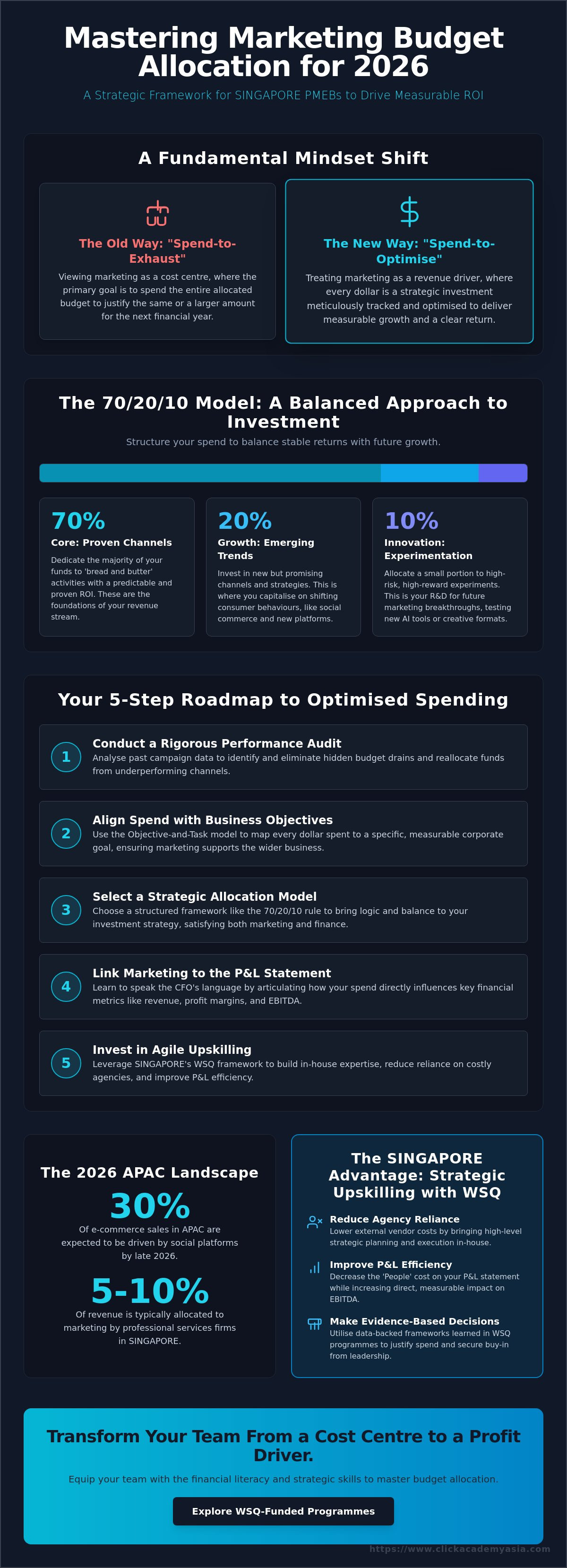
As we look toward 2026, the local business ecosystem demands a fundamental shift from a "spend-to-exhaust" mentality to a "spend-to-optimise" approach. Simply burning through a quarterly allocation to justify next year's request is a relic of the past that leads to wasted capital. Marketing budget allocation models are frameworks that categorise spend based on risk, channel, or objective, providing the structure needed to ensure every dollar works harder for your ROI. By adopting these frameworks, you move from reactive spending to proactive investment management.
For B2B organisations needing expert guidance to oversee this transition, check out Budget Boosters for senior marketing leadership that aligns spend with strategic business outcomes.
To better understand how these frameworks drive tangible results, watch this step-by-step guide on effective resource distribution:
Why Your 2026 Budget Needs a Strategic Anchor
Consumer behaviours across APAC are shifting at a pace that renders static budgets obsolete, with platforms like TikTok and Instagram expected to drive 30% of e-commerce sales by late 2026. If you're repeating last year's allocation simply because it's comfortable, you're succumbing to "budget inertia." This trap prevents you from capitalising on emerging trends like AI-driven search or social commerce. You must distinguish between "Operational Spend," which maintains current performance, and "Strategic Spend," which targets new market segments and long-term brand equity. An agile model allows you to pivot resources when a specific channel outperforms expectations, rather than being locked into a rigid, outdated plan.
The Role of WSQ and SSG in Modern Budgeting
In SINGAPORE, savvy PMEBs recognise that upskilling isn't just a personal benefit; it's a savvy budgetary tactic. By leveraging WSQ-certified training, your professional development becomes a line item that essentially pays for itself through substantial government subsidies. When you build internal expertise through a WSQ Digital Marketing Strategy & Planning programme, you gain the following advantages:
Reduced Agency Reliance: Bringing high-level strategy in-house lowers your external vendor costs.
Improved P&L Efficiency: Lowering the "People" cost on your P&L statement while increasing direct impact on EBITDA.
Evidence-Based Decisions: Using data-backed frameworks to justify spend to non-marketing leadership.
You can check the latest SSG funding eligibility criteria to see how these frameworks can offset your training costs. Positioning ClickAcademy Asia as your premier destination for specialised education ensures your team stays ahead of the technological curve while remaining fiscally responsible. Mastering these marketing budget allocation models is the first step toward transforming your department from a cost centre into a recognised profit driver.
Core Marketing Budget Allocation Models: From 70/20/10 to Zero-Based Budgeting
Selecting the right framework is essential for any PMEB tasked with managing high-stakes investments. Among the most resilient marketing budget allocation models is the 70/20/10 rule. This strategy suggests dedicating 70% of your funds to "bread and butter" channels with proven ROI, 20% to emerging trends like social commerce, and 10% to pure experimentation. This balance ensures your core revenue remains stable while you explore the future of the APAC digital landscape.
For established firms in SINGAPORE, the Percentage of Revenue model remains a common benchmark. National averages typically hover between 7% and 10% of total revenue. While this provides a safe baseline, it can be overly rigid for high-growth sectors. Developing this level of financial foresight is a core component of strategic planning, where we bridge the gap between creative execution and fiscal responsibility.
Objective-and-Task budgeting offers a more precise, bottom-up alternative. Instead of looking at historical spend, you define specific 2026 outcomes and calculate the exact resources required to achieve them. This model is highly defensible to leadership because it ties every dollar to a specific KPI. However, it requires a deep understanding of your conversion funnels and acquisition costs.
Zero-Based Budgeting (ZBB) is particularly vital for 2026. It requires you to justify every single dollar from scratch, effectively eliminating "zombie" campaigns that linger in spreadsheets without delivering value. By forcing a fresh look at every line item, ZBB ensures your resources are always aligned with current market realities rather than past habits.
Choosing the Right Model for Your Growth Stage
Your choice of marketing budget allocation models should reflect your company's maturity. Market leaders often employ the Competitive Parity model to match rival spending and maintain dominance. Conversely, scale-ups often prefer a Percentage of Growth model, which aggressively reinvests profits to capture market share. Many APAC leaders now utilise a Hybrid Model, combining the safety of 70/20/10 with the precision of Objective-and-Task. Always maintain a Reserve Fund of 10-15% to allow for mid-year pivots when new opportunities or threats emerge.
Factoring in the 2026 Tech Stack
AI-driven analytics tools now demand a larger share of the "Tools" allocation. As traditional tracking methods decline, your infrastructure must pivot toward robust first-party data collection. This shift requires significant investment in CRM integration and customer data platforms. Successful 2026 budgets allocate at least 5% to data governance and privacy compliance to avoid regulatory friction. This proactive spend protects your brand reputation while ensuring your data remains a high-value asset for future AI-driven optimisations.
How to Read a P&L Statement to Inform Your Budget Allocation
Many marketers treat the Profit and Loss (P&L) statement like a black box that only concerns the finance department. This is a significant strategic error. To master marketing budget allocation models, you must understand how your spend flows through the company's financial arteries. Your budget isn't just a separate pool of money; it's a significant component of Operating Expenses (OPEX) that directly influences the company's bottom line.
When you invest in digital ads or SEO, that cost sits squarely in the OPEX category. This figure directly impacts EBITDA, or Earnings Before Interest, Taxes, Depreciation, and Amortisation. If your marketing spend grows faster than your revenue, your EBITDA margin shrinks, which often triggers budget cuts from the CFO. You must also distinguish between Gross Profit and Net Profit. While marketing primarily drives the "Top Line" or Total Revenue, your efficiency determines how much of that revenue survives to become Net Profit after all expenses are paid.
Finding your footprint in a standard corporate P&L is simpler than it looks. Follow these steps to identify your impact:
Locate "Advertising and Promotion" (A&P): This usually contains your direct media spend and agency fees.
Check "Selling and Distribution Expenses": Some companies bundle event costs or sales commissions here.
Identify "Technology and Software": Look for your CRM and marketing automation subscriptions in this section.
Analyse "Staff Costs": This includes the salaries and benefits of your internal marketing team.
Marketing as an Investment, Not an Expense
Stop describing marketing as a cost to be managed. Instead, frame it as an investment in revenue growth. Link your "Top Line" revenue growth directly to your chosen marketing budget allocation models to show cause and effect. Use Customer Acquisition Cost (CAC) to demonstrate your efficiency. If your CAC is lower than your Customer Lifetime Value (CLV), your allocation strategy is working. When presenting to leadership, use terms like "Contribution Margin" to show how much profit each marketing dollar generates after variable costs are covered.
The Impact of Training Subsidies on the P&L
Professional development is often the first item cut during lean times, yet this is counter-productive for long-term growth. In SINGAPORE, SSG-funded courses like WSQ Digital Marketing Strategy & Planning appear on the P&L as a significantly reduced net expense. Because SSG provides up to 70-90% funding for eligible SINGAPOREANS, the "People" cost remains manageable while team productivity increases. Upskilling your current team is nearly always more cost-effective than hiring new talent, which involves high recruitment fees and onboarding lag. Use this monthly P&L review checklist to stay aligned:
Compare A&P spend against monthly revenue growth.
Analyse CAC trends relative to the previous quarter.
Identify unutilised SSG training grants for your team.
Review marketing OPEX as a percentage of total revenue.
5 Steps to Optimising Your 2026 Marketing Spend
Efficiency in 2026 isn't about spending less; it's about ensuring every dollar is an active participant in your growth strategy. Many PMEBs in SINGAPORE struggle with bloated budgets because they fail to trim the fat before adding new initiatives. To truly master marketing budget allocation models, you must follow a disciplined, five step process that prioritises performance over habit.
Audit Historical Performance: Start by identifying "hidden budget drains." Look for overlapping tool subscriptions or automated ad campaigns that haven't been reviewed in months.
Define 2026 Objectives: Use the SMART framework to set specific goals. Map these directly to the Objective-and-Task model to ensure your request is grounded in tangible needs.
Map the Funnel: Sales cycles in APAC are becoming more complex. Allocate your spend across Awareness, Consideration, and Conversion based on your actual 2026 sales cycle lengths.
Implement Multi-Touch Attribution: Move beyond "Last Click" metrics. Ensure your budget reflects the true contribution of every touchpoint in the customer journey.
Establish Reallocation Triggers: Don't wait for a quarterly review to make changes. Set quantified rules that dictate when to pull spend from underperforming channels.
Auditing Your Current Allocation
Identifying "zombie" channels is the quickest way to find extra capital. These are platforms that consume budget and manpower without delivering a measurable pipeline. You should also scrutinise agency markups and hidden logistics costs, particularly in event marketing, which often hide significant inefficiencies. To refine this audit process, consider mastering Marketing Analytics with GA4 to gain a granular view of your data. This level of insight allows you to cut waste with surgical precision, freeing up funds for higher performing marketing budget allocation models.
Setting Reallocation Triggers
Agility is your greatest asset in a fluctuating market. Define specific "Stop-Loss" thresholds to protect your bottom line. For instance, if your Customer Acquisition Cost (CAC) exceeds 30% of your Lifetime Value (LTV) for two consecutive months, that channel requires an immediate pause or pivot. This "Agile Reallocation" process allows you to move funds from Paid Search to Content if organic trends suddenly spike. When these shifts occur, use a "Budget Pivot Memo" to clearly explain the financial logic to stakeholders, ensuring continued buy-in for your strategic decisions.
Take control of your data and drive better ROI by exploring our WSQ Marketing Analytics & Insights programme today.
Upskilling for Strategic Budget Management with ClickAcademy Asia
Mastering marketing budget allocation models requires more than just reading a guide; it demands a shift in professional identity. To influence a CFO, you must transition from being a creative lead to a strategic business partner who understands the financial mechanics of the organisation. ClickAcademy Asia serves as the premier mentor for PMEBs in SINGAPORE, bridging the gap between high-level marketing execution and the rigours of financial accountability.
The WSQ Digital Marketing Strategy & Planning programme is specifically designed to provide you with this level of mastery. Unlike theoretical academic degrees that often lag behind the industry, our curriculum focuses on the practical application of knowledge. You will learn to construct defensible budgets that align with the 2026 technological landscape, ensuring your spend is always tied to measurable ROI and business health.
Holding a WSQ-accredited or Google-certified qualification provides immediate authority during intense budget negotiations. It signals to your leadership team that your proposed marketing budget allocation models are based on globally recognised standards and local best practices. This professional prestige is a vital asset when you are competing for limited corporate resources in a high-pressure APAC environment.
Why Training is Your Best Budgetary Investment
Hiring expensive external consultants to fix a broken budget is often a reactive, high-cost solution. By contrast, investing in your team’s internal capabilities protects the bottom line over the long term. A skilled team that can manage its own analytics and strategy reduces agency reliance and lowers the "People" cost on your P&L statement. ClickAcademy Asia also offers corporate group training, allowing entire marketing departments to align their strategies and adopt a unified, future-ready approach to spend management.
Maximising Your SkillsFuture Credit in 2026
In 2026, SINGAPOREAN professionals have access to unparalleled support through SSG funding frameworks. You can significantly offset the cost of your strategic education by utilising these grants, which often cover up to 70% of course fees for eligible citizens and Permanent Residents. For those aged 40 and above, the SkillsFuture Mid-Career Enhanced Subsidy may cover up to 90% of the programme cost, making this the most cost-effective way to future-proof your career.
Securing your spot in our WSQ-certified tracks is a straightforward process designed for busy professionals. Our workshops are grounded in real-world experience, providing you with "quick wins" you can implement the very next day. Empower your team with the financial and strategic skills needed to dominate 2026 by exploring our WSQ-funded courses today.
Lead Your Organisation Toward Financial Excellence
Mastering your department's financial destiny is the most effective way to transition from a cost centre to a strategic growth partner. You now have the tools to move beyond arbitrary spending by aligning your efforts with P&L realities and EBITDA goals. By consistently applying these marketing budget allocation models, you'll ensure every dollar invested in 2026 is defensible, data-driven, and designed for maximum impact within the SINGAPORE business ecosystem.
Don't let your team fall behind as the technological landscape shifts. ClickAcademy Asia has provided executive education excellence in SINGAPORE for over 11 years and remains an official Google Global Partner. Our WSQ-certified and SSG-funded programmes offer the practical skills needed to navigate complex financial frameworks and drive measurable ROI.
Equip your team with strategic budget mastery through our WSQ-funded Digital Marketing Strategy courses and secure your organisation's competitive edge. The future of marketing is financial; it's time to lead the charge with confidence.
Frequently Asked Questions
What is the most common marketing budget allocation model?
The Percentage of Revenue model remains the most frequent choice for businesses because it's simple to calculate and scales naturally with company growth. It involves setting aside a fixed portion of gross or projected sales for marketing activities. While common, many APAC leaders are moving toward more agile marketing budget allocation models that allow for mid-year shifts based on real-time performance data and market volatility.
How much of my revenue should be allocated to marketing in SINGAPORE?
Your allocation should reflect your business size and industry benchmarks within the local ecosystem. Micro businesses in SINGAPORE typically invest between $500 and $3,000 per month, while medium-sized enterprises with 51 to 200 employees often spend between $10,000 and $30,000 monthly. If you're in a high-growth phase or a competitive sector like SaaS, your spend might reach the higher end of these brackets to capture market share.
How does the 70/20/10 rule apply to digital marketing in 2026?
In 2026, your 70% "core" spend should focus on high-intent channels like SEO and Search Generative Experiences that provide stable lead flow. The 20% "emerging" portion is best used for social commerce on platforms like TikTok or Instagram, which are expected to drive a third of regional e-commerce sales. The final 10% should be reserved for experimental AI tools and niche community platforms that offer high potential for future ROI.
Can I use SkillsFuture Credit for marketing strategy courses?
Yes, SINGAPOREANS can utilise their SkillsFuture Credit to offset the out-of-pocket costs for WSQ-certified programmes at ClickAcademy Asia. These credits work in tandem with SSG funding, which covers a significant portion of the course fees for eligible PMEBs. It's a highly effective way to gain advanced strategic skills without placing a heavy burden on your personal or corporate professional development budget.
What is the difference between Zero-Based Budgeting and historical budgeting?
Historical budgeting simply adjusts last year's figures based on inflation or minor goal changes, which often leads to "budget inertia." In contrast, Zero-Based Budgeting is one of the more rigorous marketing budget allocation models that requires you to justify every single dollar from a zero base each year. This method is superior for 2026 because it forces you to eliminate underperforming "zombie" campaigns and reallocate funds to high-growth areas.
How do I justify a marketing budget increase to my CFO?
You must frame your request using financial metrics that impact the P&L statement, such as the Contribution Margin or the ratio of Customer Lifetime Value to Acquisition Cost. Avoid focusing purely on "vanity metrics" like likes or impressions. Show the CFO exactly how the additional funds will drive EBITDA growth or improve operational efficiency, making it clear that marketing is a revenue-generating investment rather than an optional expense.
What are the hidden costs in a marketing budget I should look out for?
Hidden costs often lurk in unutilised software seats, agency production markups, and the rising price of data privacy compliance. In 2026, you should also account for the infrastructure costs of first-party data collection and the legal liabilities associated with influencer marketing. Failing to include these line items can lead to significant budget overruns and friction with your finance department during end-of-year audits.
How often should I reallocate my marketing budget?
While you should establish a firm annual framework, you don't have to wait for a quarterly review to make tactical shifts. Successful PMEBs perform monthly audits to identify high-performing campaigns that deserve more fuel. If a specific channel's performance drops below your established "Stop-Loss" threshold, you should be prepared to reallocate those funds immediately to maintain your overall ROI and hit your year-end targets.


Comments