
Marketing Attribution Guide for Singapore Teams

What if a simpler attribution model could give your team more confidence than a sophisticated one? For Singapore marketers, conflicting channel reports and incomplete tracking can make it hard to see which interactions support a business outcome. Building a marketing attribution model from scratch should begin with a decision, not a complex formula.
It’s understandable to want one definitive account of what drove a conversion. But when data is inconsistent, adding complexity can make results harder to interpret and validate. A useful model starts by clarifying the question, checking the available evidence and being transparent about what the findings can and can’t tell you.
This guide shows you how to choose an approach that fits your business decision and data, prepare and validate information consistently, and use attribution insights responsibly when reviewing marketing investment. You’ll learn how to create a repeatable process your team can explain to stakeholders, without treating any single model as the whole truth. The aim is practical: clearer decisions grounded in evidence your team can trust.
Table of Contents
Why build a marketing attribution model from scratch for a Singapore team?
How to build a marketing attribution model from scratch: a five-step workflow
Which attribution model should you choose: rule-based or data-driven?
How to validate attribution results and avoid misleading conclusions
Build attribution capability with practical marketing analytics skills in Singapore
Why build a marketing attribution model from scratch for a Singapore team?
A Singapore marketing team may see search ads generating clicks, social campaigns driving engagement and email contributing to enquiries, yet still face a basic question: which interactions helped produce the conversion? Each channel report describes its own activity, but may not show the full recorded journey. Building a marketing attribution model from scratch gives the team a structured way to examine that journey and allocate conversion credit using clear, stated rules.
Attribution modelling assigns credit for a conversion across recorded marketing touchpoints. For example, a prospective customer might click a paid search advert, later visit through an organic search result, then return via an email link before submitting an enquiry. A model can distribute credit across those recorded interactions, but it describes the observed path. It doesn’t, by itself, prove that any interaction caused the conversion. For a foundational overview, professionals often turn to comprehensive training resources such as those provided by ClickAcademy Asia.
Start with the decision, then choose the model and data. That order keeps the work focused: the team can define what it needs to learn, identify the relevant journey records and avoid building a complicated system that cannot support a real decision.
Which marketing decision should the model help answer?
First, distinguish the decision you’re making. Channel evaluation asks how recorded conversions are credited across channels; campaign optimisation looks at which campaigns appear along converting journeys; budget planning uses those insights to inform investment choices. These questions may draw on overlapping data, but they aren’t interchangeable. Write down the decision in one sentence before selecting a model.
Name the conversion: specify the event, such as a completed purchase or submitted enquiry.
Connect it to an outcome: clarify what the conversion represents for the business, rather than treating every tracked event as equally valuable.
Set boundaries: choose selected channels or one conversion journey for the initial analysis.
A defined scope makes the work easier to inspect. If the team is studying enquiries, for instance, it can focus on the recorded interactions leading to an enquiry instead of trying to account for every marketing touchpoint at once.
What attribution can, and cannot, tell your team
A model allocates credit according to its rules or the patterns in its observed data. That allocation can help the team compare journeys consistently, but it isn’t the same as measuring incremental impact: a channel receiving credit hasn’t necessarily caused a conversion that would otherwise not have happened.
Interpret the result alongside other performance evidence, not as a standalone verdict. Gaps matter, too. If a journey includes an untracked interaction, or the same person’s activity can’t be connected across records, part of the path may be invisible. The model can only describe the data it receives.
Before proceeding, agree on the decision, conversion event and scope with the people who will use the findings. This gives analysts and stakeholders a shared basis for interpreting credit and makes the limits of the evidence clear from the outset.
How to build a marketing attribution model from scratch: a five-step workflow
Keep the first version small enough to review by hand. A Singapore team could begin with one conversion journey and a few selected channels, using the records it can access rather than waiting for every system to be perfectly connected. The aim is a repeatable method the team can inspect, explain and improve.
A minimum viable attribution model is a scoped, documented method for allocating conversion credit across the touchpoints you can reliably observe.
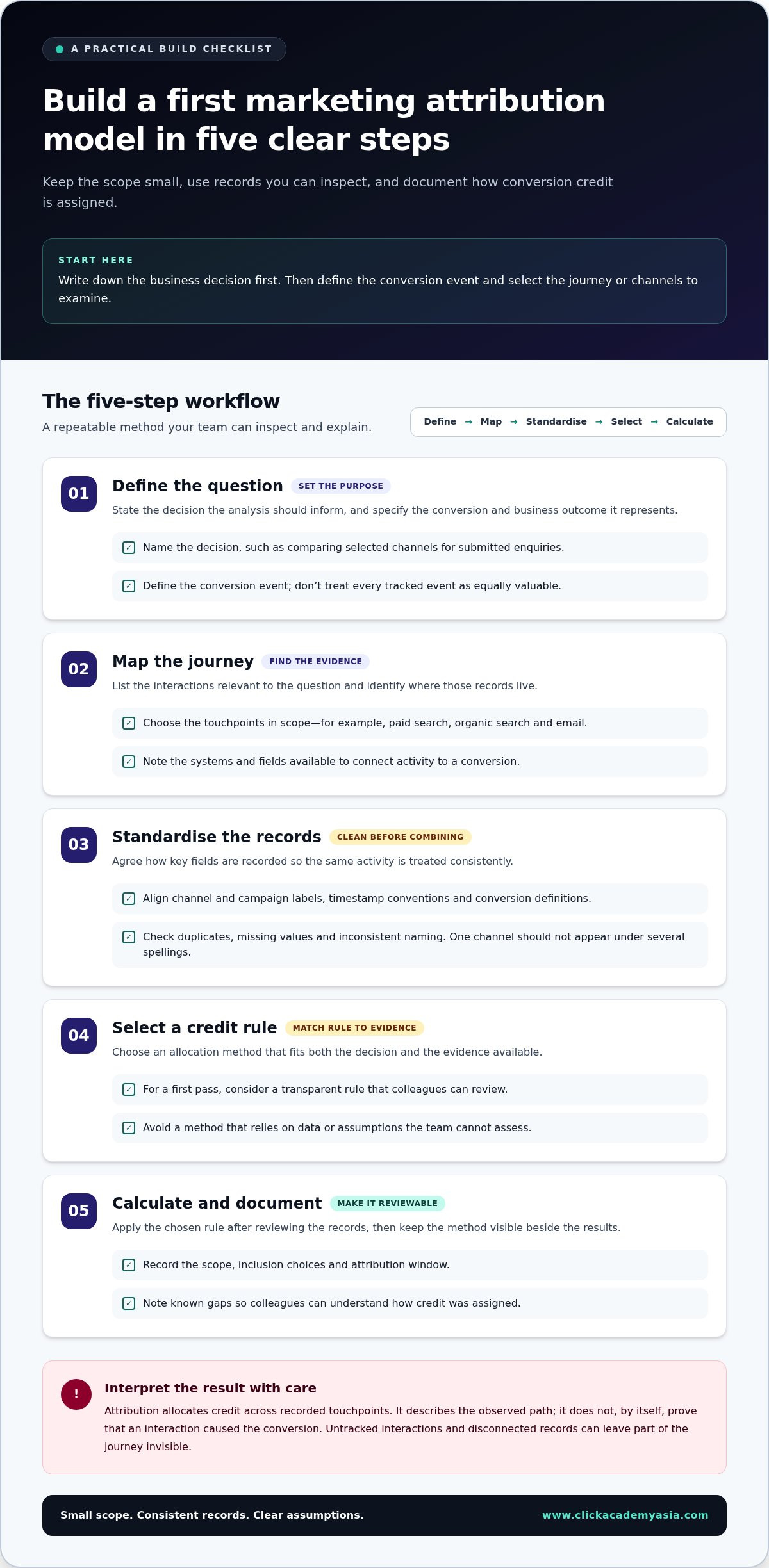
Define the question. State the decision the analysis should inform, such as comparing selected channels for submitted enquiries. Name the conversion event and the business outcome it represents. This determines which records matter.
Map the journey. List the interactions relevant to that question, such as paid search, organic search and email. Note the systems that record them and the fields available to connect activity to a conversion.
Standardise the records. Agree on channel and campaign labels, timestamp conventions and conversion definitions. Check for duplicates, missing values and inconsistent naming before combining records. A label such as “paid social” shouldn’t appear under several spellings in the same analysis.
Select a rule. Choose a credit-allocation method that fits the question and available evidence. For a first pass, a transparent rule may be easier to review than a method that depends on data or assumptions the team cannot assess. Choosing the Right Attribution Model outlines factors to consider when matching a model to business goals and data.
Calculate and document. Apply the rule only after reviewing the underlying records. Record the scope, inclusion choices, attribution window and known gaps beside the results, so colleagues can understand how the credit was assigned.
Map touchpoints, conversion events and data sources
Build a simple field inventory before joining data. Depending on the conversion and available records, useful fields may include interaction type, channel, campaign label, timestamp, conversion event and an identifier that can connect interactions. The required systems and fields vary: an analytics platform, advertising account and CRM may use different labels, timestamps or identifiers. Note these differences rather than assuming the records align.
For example, an advertising platform may record an ad interaction, analytics may show a website session, and a CRM may store the submitted enquiry. If the campaign name or identifier differs between records, the journey may not join cleanly. Flag unmatched entries for review rather than silently treating the available records as a complete path.
Set a consistent measurement window and calculation rule
Choose an attribution window that reflects the journey under review and the timing visible in your records. Document why it fits; don’t select a window simply because it is a default setting. Also write down how direct visits, repeat interactions and unassigned traffic will be handled, so the team applies the same rules to every journey.
Hypothetical example: one enquiry follows recorded paid social, organic search and email interactions. If the team applies an equal-credit rule, each receives one-third of the credit. This illustrates the calculation, not proof that each touchpoint caused the enquiry. A short, documented workflow gives the team a practical basis for testing and refining its approach. Teams looking to strengthen their measurement and interpretation skills can explore practical marketing analytics learning.
Which attribution model should you choose: rule-based or data-driven?
The right model depends on the decision, the journey you can observe and the quality of your data. A team reviewing which channel first introduced customers may need a different view from one examining the final interaction before conversion. When building a marketing attribution model from scratch, start with a method your team can explain and compare against its actual records.
Model complexity should grow only when the evidence and decision need it. No approach is universally correct, and assigned credit isn’t proof that a touchpoint caused a conversion.
Last-click
Credit logic: Gives all credit to the final recorded touchpoint before conversion. Useful for: Reviewing the last interaction in a defined journey. Limitation: Earlier interactions receive no credit.
First-click
Credit logic: Gives all credit to the first recorded touchpoint. Useful for: Examining which channels introduce people to the journey. Limitation: Later interactions are disregarded.
Linear
Credit logic: Distributes credit equally across recorded touchpoints. Useful for: Giving a straightforward overview when several interactions matter to the analysis. Limitation: Equal shares assume each interaction deserves the same credit.
Position-based
Credit logic: Assigns larger shares to selected positions, often the first and last, with the remainder spread across other interactions. Useful for: Emphasising introduction and closing touchpoints. Limitation: The chosen weights are assumptions, not measured causal impact.
Data-driven
Credit logic: Uses observed data patterns to estimate how interactions relate to conversion credit. Useful for: Teams with suitable, consistent journey data and a clear need for a more tailored view. Limitation: Results can be difficult to interpret or validate if inputs are incomplete or the method is poorly understood.
When is a rule-based model a sensible starting point?
Rule-based models apply explicit, transparent rules to recorded conversion journeys. First-click and last-click answer different questions: one highlights the recorded introduction, the other the final recorded interaction. Linear and position-based approaches offer alternatives, but each embeds an allocation assumption. Choose the rule that best fits the decision, then state that assumption plainly when sharing results.
When should a team consider data-driven approaches?
Consider a data-driven method only when the available inputs are consistent enough to support it and the team can explain how it will be assessed. Markov Chain approaches examine sequences and the effect of removing a touchpoint; Shapley Value approaches allocate contribution across combinations of interactions. These are options, not defaults. Before progressing, document data requirements, interpretability and validation needs.
Use journey complexity and channel mix to guide the choice, but let trustworthy evidence set the limit. A transparent baseline that supports the decision is more useful than sophistication the team cannot confidently interpret.
How to validate attribution results and avoid misleading conclusions
A model can calculate credit consistently and still produce a misleading picture if the underlying records are incomplete or the context has changed. Treat validation as a regular operating step, not a one-off check before the first report. This is especially important when building a marketing attribution model from scratch, because early decisions about tracking and definitions shape the conclusions the team can draw later.
Which data-quality checks should happen before interpretation?
Before reviewing channel credit, check whether the inputs describe journeys consistently. Use a checklist each time the model is refreshed:
Check completeness: confirm that the channels and campaigns in scope appear in the records, and look for missing events or unexplained unassigned traffic.
Review tagging: compare campaign labels and source conventions across analytics, advertising and CRM records. Identify inconsistent names that could split one campaign into several entries.
Find duplicates: check for repeated interactions or conversion records that could inflate activity or conversion counts.
Confirm conversion definitions: make sure the event being counted still represents the intended business outcome, rather than a different or intermediate action.
Assess the measurement window: check whether it captures the relevant observed journey. If journeys regularly begin before the window or continue after it, the model may omit useful interactions.
Record issues rather than quietly correcting them without explanation. A material tracking gap can change the interpretation of channel credit, so resolve it or clearly mark the affected results before recommending investment changes.
How should teams communicate attribution limitations?
Label results as allocated credit under a stated model, not as a definitive causal verdict. Put the model rule, measurement window, scope, conversion definition and known data limitations beside the findings. Stakeholders can then see what the analysis includes and avoid treating a precise-looking chart as proof of impact.
Next, compare the output with observed journey patterns and other available performance evidence. If a channel’s assigned credit changes sharply, check whether the underlying journeys show a similar shift and whether other reporting supports that interpretation. Investigate discrepancies rather than selecting whichever report best supports a preferred budget decision.
Context matters, too. Seasonality may alter demand, a tracking change may affect what gets recorded, and a newly launched channel may not yet have a comparable history. Note these factors when reviewing results, and avoid attributing every change in credit to improved or weakened channel performance.
Lift tests can complement attribution by helping assess incremental impact in a test context. They aren’t interchangeable: attribution allocates credit across recorded touchpoints, while a lift test is designed to evaluate the difference associated with an intervention. Use each to answer the question it is suited to, and don’t present one as a substitute for the other.
Keep a versioned review record with the review date, assumptions, limitations, data issues and any changes to definitions or tracking. Set the next review point as part of your team’s measurement routine, so conclusions remain connected to the conditions under which they were produced. To strengthen your team’s marketing analytics and interpretation skills, explore practical marketing analytics training.
Build attribution capability with practical marketing analytics skills in Singapore
A useful attribution process depends on more than a formula. Your team needs the confidence to define what it is measuring, understand how the data is structured and explain what the results mean for a business decision. These capabilities help marketers interpret findings with care, without presenting model outputs as certainty.
Three skills support that work:
Analytics literacy: understand what marketing data records, how to read performance reports and where the evidence has limits.
Measurement planning: turn a business question into a clear conversion definition, tracking requirements and scope.
Interpretation: explain what the results suggest, what they don’t establish and what further evidence could help.
These skills are useful across campaign reviews and planning, not only when building a marketing attribution model from scratch. They can also help teams discuss measurement consistently with colleagues across marketing, sales and leadership.
Connect measurement skills to a team’s marketing decisions
Professional learning can help marketers develop a stronger foundation for asking focused questions and interpreting analytics in context. Practitioner-led learning connects concepts to professional situations, while teams remain responsible for adapting their approach to their own systems and evidence. For related learning, explore marketing analytics and GA4 training.
ClickAcademy Asia is a Singapore-based professional training provider. Its relevant offerings include WSQ Marketing Analytics & Insights and Google Analytics (GA4) Training. These are learning options for strengthening analytics capability, not a ready-made attribution model or a promise of a specific modelling outcome.
Explore relevant WSQ learning and next steps
Attribution also calls for strategic thinking: teams need to connect measurement choices with marketing priorities. WSQ Digital Marketing Strategy & Planning is another relevant professional learning option for developing that broader perspective. Consider the capability your team needs most, then use it to guide the next step in strengthening measurement practice.
Equip your team with practical marketing skills through relevant WSQ learning and professional training. Explore professional marketing training or contact ClickAcademy Asia at TeamSG@clickacademyasia.com or by WhatsApp or phone on 9388 8755.
Put your next attribution decision into practice
Start with one decision your team needs to make. Define the conversion, choose a manageable scope, check the records and document how you’ll interpret the results. These practical steps give your team a clear starting point for building a marketing attribution model from scratch.
Developing measurement confidence also takes ongoing analytics and strategic planning skills. ClickAcademy Asia offers WSQ-funded learning tracks, including WSQ Marketing Analytics & Insights and WSQ Digital Marketing Strategy & Planning. Eligible Singaporeans and PRs can claim up to 70% subsidy on qualifying courses. Eligibility requirements are age 21 years and above; Level 2 basic computer literacy; GCE N, O, or A Level, NITEC, or a diploma plus 2 years work experience; English proficiency of GCSE N/O pass, WPLN Level 5, IELTS 5.5, or TOEFL iBT 46-59; learners must bring a personal laptop.
Equip your team with practical skills to interpret marketing data and make more informed decisions. Explore WSQ-funded marketing training tracks and take the next step with confidence. For more information, email TeamSG@clickacademyasia.com or call or WhatsApp 9388 8755.
Frequently Asked Questions
Can I build a marketing attribution model without a data warehouse?
Yes, you can start without a data warehouse if the relevant records are accessible and manageable in a simpler format. For example, a team might export campaign and conversion data from its analytics platform and CRM, then compare a small set of journeys in a spreadsheet. Keep access controlled, retain source records and document any manual matching. Move to more structured data infrastructure only when volume or repeatability makes the current process difficult to manage.
What data do I need to build a marketing attribution model?
You need records that connect marketing interactions with a defined conversion. Depending on your setup, useful fields may include a campaign or channel label, interaction timestamp, conversion timestamp, conversion type and a consistent identifier for linking records. For example, an enquiry analysis might combine campaign-tagged sessions with CRM enquiry records. Start by checking which fields are actually captured, then note where identifiers or labels cannot be matched.
How do I choose an attribution window?
Choose a window that fits the observed time between an initial interaction and the conversion you’re analysing. Review available journey records to see how long conversions typically take, and consider whether the buying process differs by product or audience. Apply the selected window consistently, then check whether changing it materially alters the model’s output. Document the rationale so future reviews can distinguish a genuine performance shift from a changed measurement setting.
Does an attribution model prove which channel caused a sale?
No. An attribution model assigns credit within the recorded journeys; it doesn’t establish that a channel caused a sale or that the sale would not have happened otherwise. To investigate incremental effect, a team could consider a suitable controlled test, such as comparing outcomes for exposed and holdout groups where the design supports it. Treat attribution and causal testing as different evidence, and avoid making causal claims from credit allocation alone.
Can I include offline conversions in a marketing attribution model?
Yes, if offline conversion records can be connected to relevant marketing interactions with a suitable, consistently used identifier. For example, a CRM record of a completed sale may be matched to an earlier campaign journey if the records share a usable reference. First define which offline outcome counts, such as a qualified sale rather than an initial conversation. Record unmatched conversions separately, so they aren’t mistakenly treated as having no marketing influence.
How often should a marketing attribution model be reviewed?
Set a regular review rhythm that fits how often your campaigns, tracking and conversion definitions change. Review sooner after a major website measurement change, CRM migration, new channel launch or shift in the business outcome being measured. Keep a dated record of each review and compare results with the prior version only when their definitions and scope are sufficiently consistent. This makes changes easier to interpret without implying that every movement reflects channel performance.
Is a data-driven attribution model always better than last-click?
No. A data-driven approach may offer a more tailored allocation, but it also relies on suitable inputs and results the team can interpret. Last-click is simpler and may suit a narrow question about the final recorded interaction, though it leaves earlier touchpoints out of its credit. Choose based on the decision, evidence and validation capacity. A more complex model isn’t automatically more useful if stakeholders can’t explain or test its output.



Comments