
Market Sizing and Total Addressable Market Analysis: A Strategic Guide for SINGAPORE Professionals in 2026
- ClickAcademy Asia

- 2 minutes ago
- 11 min read
How many of your 2026 growth projections are based on solid data versus a gut feeling or over-inflated global averages that don't apply to the local context? For professionals in SINGAPORE, relying on generic figures often leads to failed launches and intense stakeholder scepticism. Mastering market sizing and total addressable market analysis is no longer just a task for the finance department; it's a vital survival skill for any PMEB looking to secure budget and drive real revenue in the APAC region.
You've likely felt the pressure to present big numbers to impress the board, only to struggle when asked to justify those figures with granular regional data. This guide will empower you with a defensible framework to quantify business opportunities accurately using TAM, SAM, and SOM models. We'll show you how to source reliable APAC data, align your marketing spend with actual revenue potential, and leverage WSQ-aligned strategic frameworks to future-proof your 2026 planning. By the end, you'll have the clarity needed to prioritise the right growth segments and secure stakeholder buy-in with confidence using methods backed by SSG standards.
Table of Contents
The Strategic Importance of Market Sizing and Total Addressable Market Analysis in SINGAPORE
Market sizing is the numerical estimation of a commercial sector's potential, providing a clear ceiling for your business ambitions. For professionals in SINGAPORE, conducting a rigorous market sizing and total addressable market analysis is the absolute foundation of any robust 2026 digital marketing programme. As we look toward 2026, the integration of AI and shifting consumer behaviours in APAC means that old data is often obsolete. Without this analysis, companies often fall victim to 'market blindness', wasting precious budget on narrow segments with limited growth. In a regional hub like ours, leadership requires precise APAC market quantification to ensure every dollar spent contributes to a scalable objective.
To better understand this concept, watch this helpful video:
Why PMEBs Must Master Market Quantification
Decision-makers don't want guesses; they want evidence. Market sizing bridges the critical gap between raw data points and the high-level executive decision-making needed to steer an organisation. When you can articulate a clear Total Addressable Market (TAM), you move from being a tactical executor to a strategic partner. In the SINGAPORE workforce, PMEBs who master market intelligence are the ones who secure corporate budget approvals with ease. With 2026 budgets under closer scrutiny, the ability to justify spend through quantified potential is a vital skill for career advancement. Data literacy is no longer optional for those aiming for senior leadership roles in the local ecosystem.
Market Sizing as a Risk Mitigation Tool
Strategic growth is as much about what you avoid as what you pursue. TAM analysis serves as a powerful risk mitigation tool, preventing your team from over-investing in saturated or rapidly declining niches. Entering the wider APAC region without sizing the opportunity often leads to expensive pivots or failed launches. For instance, assuming the SINGAPORE market mirrors the scale of neighbouring Indonesia can lead to massive misallocations of marketing spend. By quantifying the landscape beforehand, you ensure your strategy is grounded in reality rather than optimism. This practical approach to strategy is exactly what we cover in our WSQ Digital Marketing Strategy & Planning course, helping you build frameworks that work in the real world.
Decoding the Framework: TAM, SAM, and SOM Explained
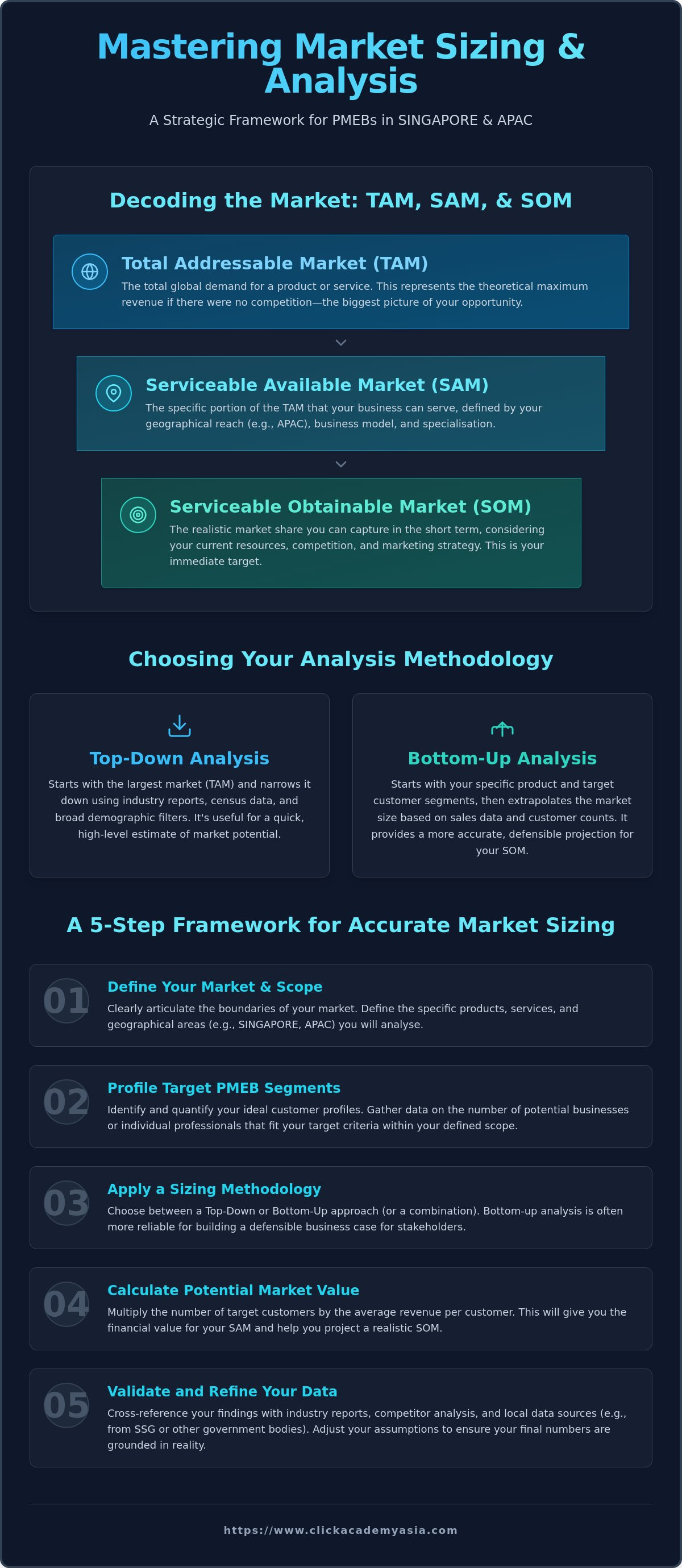
Understanding the layers of market sizing and total addressable market analysis requires a mental model often compared to a set of Russian Dolls. Each metric sits inside the other, narrowing your focus from a broad global vision to a concrete, actionable plan. This framework ensures that your strategic objectives remain grounded in reality while acknowledging the full scale of the opportunity available to your firm. By stripping away the layers, you can identify exactly where your resources will yield the highest returns.
Total Addressable Market (TAM): This represents the absolute global demand for your product or service if competition didn't exist. It's the theoretical maximum revenue your business could generate.
Serviceable Available Market (SAM): This is the specific portion of the TAM that fits your current business model, geography, and regulatory reach. For many SINGAPORE firms, this often equates to the wider APAC region.
Serviceable Obtainable Market (SOM): This is the realistic market share you can capture in the short term, accounting for existing competition and resource constraints.
Visualising the Market Opportunity Funnel
Imagine a hypothetical SINGAPORE-based AI start-up offering automated payroll solutions. Their TAM would be the global payroll software market, a massive figure that looks great on a pitch deck but lacks immediate utility. However, due to different tax laws and language requirements, their SAM might be limited to English-speaking APAC territories like Australia, Malaysia, and Hong Kong. Their SOM would then be the specific percentage of SMEs in those regions they plan to convert within the next 12 months. Geography and regulatory barriers are the primary filters in SAM calculations, making it essential to analyse your target landscape with precision before allocating budget.
The Role of Digital Channels in Expanding SAM
Digital transformation has fundamentally changed how we calculate SAM. While physical borders once strictly limited a firm's reach, robust SEO and SEM strategies now allow SINGAPORE businesses to effectively increase their serviceable market without a physical presence in every country. By targeting high-intent keywords across APAC, you can bridge the gap between a local operation and a regional powerhouse. This is particularly relevant for category creators where historical data is scarce. In such cases, you should apply 'Value Theory' to estimate market size based on the specific value your innovation provides compared to existing, less efficient alternatives. Ultimately, SOM remains the most critical metric for immediate ROI because it represents the revenue you can actually bank this year.
Top-Down vs. Bottom-Up: Choosing Your Analysis Methodology
Selecting the right methodology for your market sizing and total addressable market analysis depends on your business maturity and the data at your disposal. The Top-Down approach begins with broad industry reports and filters them down to your specific niche. It's exceptionally fast and useful for early-stage validation when you need to prove a concept to stakeholders quickly. However, it often suffers from "optimism bias," as secondary reports may not account for the specific regulatory hurdles or cultural nuances unique to the APAC region.
Conversely, the Bottom-Up approach is built from the ground up using your own primary data. It's more labour-intensive but offers a level of accuracy that Top-Down models simply can't match. For established SINGAPORE firms, this method is the gold standard for 2026 strategic planning because it's based on proven customer behaviour rather than third-party projections. If you're a category creator introducing a completely new solution, you'll likely need a third option: Value Theory. This involves estimating the market size based on the specific economic value your innovation creates for the end-user.
The Bottom-Up Advantage for Digital Marketers
Digital leaders have a distinct advantage when it comes to bottom-up analysis. Your internal data from GA4 or CRM systems provides a superior foundation for market sizing because it reflects real-world interactions. To calculate this, use the straightforward formula: (Total Number of Potential Customers) x (Average Contract Value) = Market Size. For instance, if there are 280,000 SMEs in SINGAPORE with a revenue above S$100,000 as of 2026, and your average annual fee is S$5,000, your potential local market is S$1.4 billion. If you're looking to sharpen your data extraction skills, consider reading our guide on [Internal Link: https://www.clickacademyasia.com/post/marketing-analytics-with-ga4-a-strategic-guide-for-2026-professionals].
Leveraging Value Theory for Disruptive Solutions
How do you size a market that doesn't exist yet? This is the challenge for innovative SINGAPORE startups and tech firms launching disruptive solutions in 2026. Value Theory allows you to quantify the market by looking at the "willingness to pay" of your target PMEB audience. Instead of looking at what people currently spend on old solutions, you analyse the cost of the problem you're solving. If your new AI tool saves a firm S$50,000 in annual labour costs, you can price your service based on a fraction of that saved value. This approach is essential for future-proofing business models, as it prioritises the tangible impact on the customer's bottom line over historical spending patterns.
A 5-Step Framework for Market Sizing in the APAC Region
Executing a precise market sizing and total addressable market analysis requires a structured approach that balances high-level vision with ground-level data. In the SINGAPORE business ecosystem, where competition is fierce and data is abundant, following a repeatable framework ensures your projections remain defensible during executive reviews. This 5-step process is designed to help PMEBs move from broad assumptions to a granular, actionable SOM.
Step 1: Define your target customer profile. Start by identifying the specific PMEB segments that derive the most value from your solution. Be precise about industry, company size, and job functions.
Step 2: Aggregate secondary data. Use reputable sources to find the total number of potential users. You can find essential benchmarks in this [External Link: local statistic/industry study] to ground your initial TAM figures.
Step 3: Conduct primary research. Validate your assumptions by engaging directly with the local SINGAPORE market. Surveys or focus groups help determine if your estimated 'willingness to pay' matches reality.
Step 4: Apply your methodology. Use the Top-Down or Bottom-Up models discussed earlier to calculate your TAM and SAM. Ensure you account for the 560,000 active business entities currently operating in SINGAPORE as of 2026.
Step 5: Factor in constraints. Determine your SOM by looking at your actual marketing budget, sales capacity, and the competitive intensity of the APAC landscape.
Finding Reliable Data in SINGAPORE
Reliable market analysis depends entirely on the quality of your inputs. SINGAPORE professionals have access to world-class data portals like SingStat and the Department of Statistics, which provide granular insights into workforce demographics and business spend. It is vital to cross-reference these government figures with industry-specific reports to avoid the 'over-inflation' trap common in pitch decks. Many PMEBs find that attending WSQ training provides them with access to expert-led case studies and proprietary data sets that aren't available to the general public. This structured learning environment helps you master the art of data-driven strategy with confidence.
Refining Your SOM for 2026 Realities
As we navigate 2026, consumer behaviours in APAC are shifting toward hyper-personalisation and AI-driven interactions. These trends directly affect your capture rates and must be factored into your final SOM. Digital advertising efficiency is no longer just about reach; it's about how effectively your SEO and SEM strategies convert high-intent users within your SAM. Before finalising your numbers, use this sanity-check checklist: Is your SOM larger than your total marketing budget? Does your projected capture rate exceed historical APAC norms for your industry? Are you accounting for the S$2.4 billion annual digital marketing spend currently seen in the local market? Answering these questions ensures your 2026 growth plan is both ambitious and achievable.
Upskilling for Strategic Leadership: Mastering Market Intelligence with WSQ
Mastering the technicalities of market sizing and total addressable market analysis is the first step toward becoming a truly strategic leader. In a competitive hub like SINGAPORE, the ability to quantify future opportunities is what separates tactical managers from visionary executives. By integrating these analytical skills into your professional toolkit, you align your career trajectory with the high-value needs of the modern economy. The 'WSQ Digital Marketing Strategy & Planning' course is specifically designed to bridge this gap, turning theoretical knowledge into actionable business intelligence that drives growth.
Learning from practitioners who live and breathe the APAC business landscape ensures your education is grounded in real-world application. These mentors provide the context that global textbooks often miss, such as local regulatory shifts or specific regional consumer nuances. Continuous learning is no longer a luxury; it is the ultimate competitive advantage for 2026 professionals. Leaders who can accurately size a market and defend their projections will always be in high demand across the local business ecosystem.
The Path to WSQ Certification
Our curriculum moves beyond academic theory to focus on the practical application of strategy. You will work through modules that specifically cover market analysis, competitor mapping, and revenue forecasting. This project-based approach ensures you leave the programme with a defensible strategy you can implement immediately within your organisation. Because these courses are WSQ-certified, they meet the highest standards of industry relevance and quality assurance. You can explore the next steps for your professional development by viewing our [Internal Link: https://www.clickacademyasia.com/].
Maximising Your SkillsFuture Credit for Strategy
Professional upskilling in SINGAPORE is supported by a robust ecosystem of financial assistance. For many PMEBs, SSG funding covers a significant portion of course fees, making elite strategic training highly accessible. If you are planning your development for the latter half of the year, keep in mind that the redesigned SFEC with a new S$10,000 credit launches on 1 December 2026. This investment in your strategic capabilities offers a substantial long-term ROI as you lead your team through the 2.0% to 4.0% GDP growth forecasted for the year. Mastering market sizing empowers you to move from simple execution to high-level strategy, ensuring your place at the decision-making table.
Drive High-Level Growth Through Data-Driven Strategy
Mastering market sizing and total addressable market analysis is the definitive way to transition from a tactical executor to a high-level strategic leader. By now, you should have the clarity to replace "ballpark" figures with a defensible framework that aligns your marketing spend with actual revenue potential. Whether you utilise a bottom-up approach or apply value theory for disruptive innovations, your growth plans will finally stand up to the most rigorous stakeholder scrutiny. This data-driven precision is the hallmark of a future-ready professional in SINGAPORE.
Your next step is to institutionalise these skills within your organisation. Our training is delivered by APAC industry experts and backed by strategic partnerships with global leaders like Google. Through our WSQ-certified and SSG-funded modules, you can gain the practical mastery needed to navigate complex market dynamics with confidence. You don't need to navigate these changes alone when you have access to a curriculum grounded in real-world application.
Equip your team with strategic market analysis skills by exploring our WSQ-funded Digital Marketing Strategy & Planning tracks at ClickAcademy Asia.
The future of SINGAPORE'S digital economy belongs to those who can quantify opportunity and execute with precision. We look forward to supporting your journey toward strategic excellence.
Frequently Asked Questions
What is the difference between TAM and SAM in market sizing?
TAM represents the maximum global revenue opportunity for a product, while SAM is the specific portion of that market your business can realistically reach. For a SINGAPORE firm, SAM is often defined by geographical limits like the APAC region or specific regulatory boundaries. While TAM helps you understand the long-term vision, SAM is the metric you use to build your immediate operational strategy.
How do I find reliable market data for the SINGAPORE and APAC regions?
You can find reliable data through government portals like SingStat and the Department of Statistics, which provide granular insights into the SINGAPORE economy. For wider APAC trends, industry-specific reports and proprietary data sets provided during WSQ training sessions are invaluable. Cross-referencing these sources ensures your market sizing and total addressable market analysis remains grounded in verifiable facts rather than optimistic projections.
Why is bottom-up market sizing considered more accurate than top-down?
Bottom-up sizing is considered more accurate because it relies on your own primary data, such as actual customer counts and average contract values. Top-down methods often use broad industry reports that might include irrelevant segments or over-inflated global figures. By building your model from the ground up, you account for the specific conversion rates and pricing power unique to your business in the local market.
Can market sizing be used for small businesses or is it only for startups?
Market sizing is a vital tool for small businesses and SMEs, not just high-growth startups or global corporations. It helps small business owners avoid over-investing in narrow segments that lack the volume to sustain growth. By quantifying the landscape, SMEs can prioritise high-value niches and ensure their limited marketing budget is directed toward the most profitable opportunities within their reach.
How often should a company refresh its total addressable market analysis?
A company should refresh its market sizing and total addressable market analysis at least once a year to account for shifting economic conditions. In 2026, rapid advancements in AI and changing consumer behaviours in APAC mean that data from even 18 months ago may be obsolete. A refresh is also necessary whenever you launch a new product or enter a new geographical territory within the region.
What role does SEO play in increasing a company's SOM?
SEO increases your Serviceable Obtainable Market (SOM) by capturing a larger share of high-intent users who are already searching for your solutions within your SAM. By ranking for specific strategic keywords, you effectively divert traffic away from competitors and toward your own offerings. This organic visibility is one of the most cost-effective ways to increase your market penetration without exponentially increasing your advertising spend.
Are there government subsidies available for market strategy training in SINGAPORE?
Yes, the SINGAPORE government provides significant support through SSG funding for WSQ-certified programmes. Eligible PMEBs and companies can utilise SkillsFuture credits and other subsidies to offset the cost of strategic training. These grants make high-level education in market intelligence and digital strategy accessible, ensuring the local workforce remains competitive in the evolving APAC landscape.



Comments