
How to Explain SEO to Your Boss: A Strategic Guide for SINGAPORE Professionals
- ClickAcademy Asia

- 22 hours ago
- 11 min read
SEO isn't a free marketing channel, and continuing to frame it as "free traffic" is likely the reason your budget requests keep getting rejected. If you're a PMEB in SINGAPORE, you've probably felt the pressure of a leadership team demanding instant results while viewing organic growth as a mysterious black box. It's exhausting to justify long-term strategies when your stakeholders are focused solely on immediate ROI and bottom-line figures.
This guide will teach you exactly how to explain seo to your boss by translating technical metrics into the language of business value. You'll learn how to pivot away from jargon like "crawling" or "backlinks" and instead present SEO as a vital tool for capturing sustainable market share. We will outline how to secure approval for essential tools and WSQ programmes, ensuring your team has the expertise to navigate the latest Google core updates and maintain a competitive edge in the local ecosystem.
Table of Contents
The Translation Gap: Why Your Boss Does Not "Get" SEO
Most PMEBs in SINGAPORE face a common hurdle when discussing digital strategy: they speak a different language than their leadership. You might be tracking metadata and site speed, but your boss is focused on the quarterly bottom line. This disconnect is the primary reason budget requests for optimisation often stall. While technical specialists focus on inputs like rankings, executives are laser-focused on outputs like revenue and market share.
Local leaders are often more skeptical of long-term digital plays because the SINGAPORE business culture prizes efficiency and tangible, immediate returns. SEO often feels like a "black box" where investment disappears without the instant gratification provided by SEM. To bridge this gap, you must stop acting like a technical executor and start positioning yourself as a strategic business partner who understands the company's broader objectives.
To better understand the fundamentals of this discipline before presenting it to leadership, watch this helpful video:
The Problem with Technical Jargon
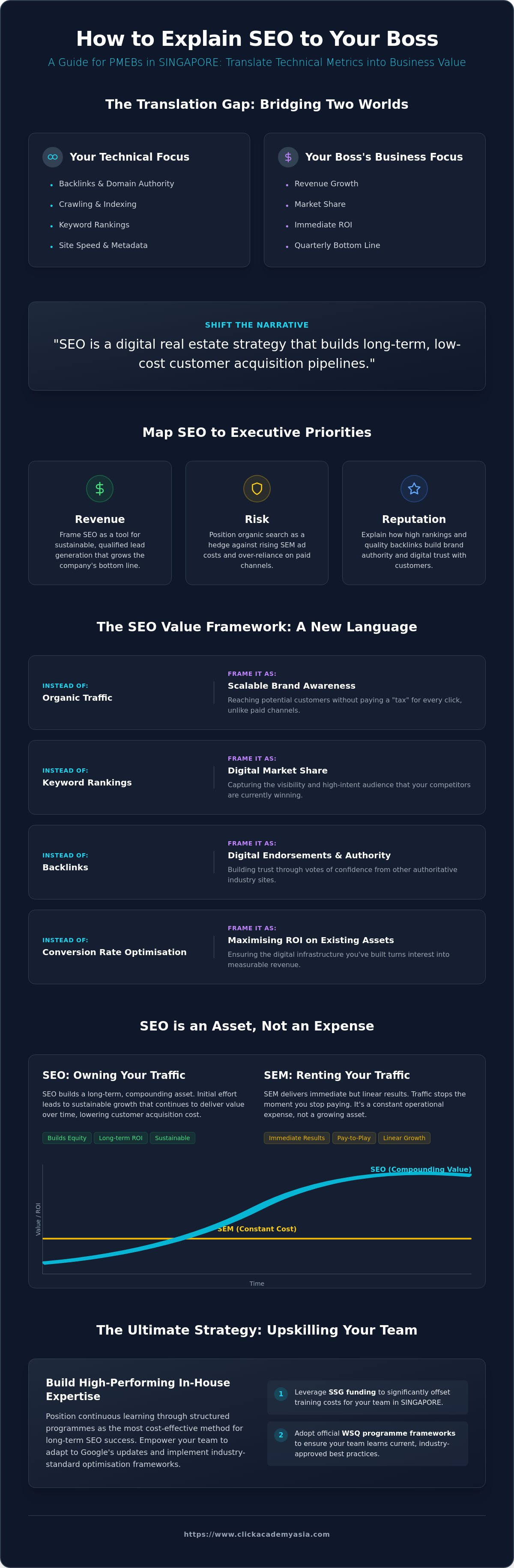
Dropping terms like "Canonical Tags," "LSI keywords," or "Domain Authority" during a boardroom pitch is a quick way to lose your audience. To an executive, this jargon sounds like you're hiding behind complexity to excuse a lack of immediate results. When you're learning how to explain seo to your boss, simplicity is your greatest asset. If you need a single sentence to define the practice for a CEO, use this: "SEO is a digital real estate strategy that builds long-term, low-cost customer acquisition pipelines."
Shifting the Narrative to Business Outcomes
Every leader, regardless of their industry in SINGAPORE, cares about three core pillars: Revenue, Risk, and Reputation. Your task is to map your SEO efforts directly to these Key Performance Indicators (KPIs). High rankings aren't just vanity metrics; they represent captured market share that your competitors are currently enjoying. By framing organic search as a way to mitigate the risk of rising ad costs, you demonstrate empathy for your boss's specific pressures.
Transitioning from a tactical mindset to a strategic one often requires a structured framework. Professionals looking to lead these high-level conversations can benefit from formal training, such as the WSQ Digital Marketing Strategy & Planning programme, which provides the tools to align digital tactics with corporate goals. Understanding these strategic links ensures that your next pitch is met with approval rather than confusion.
The SEO Value Framework: Translating Metrics into Executive KPIs
To succeed in your pitch, you must bridge the gap between technical execution and commercial reality. Every metric you present should serve as a proxy for a business outcome that resonates with leadership. When you are mastering how to explain seo to your boss, your goal is to demonstrate that organic search is a strategic asset, not just a marketing expense. Use this framework to translate your data into a language your PMEB stakeholders understand:
Organic Traffic: This represents scalable brand awareness. Unlike paid channels, it allows the company to reach potential customers without paying a "Pay-to-Play" tax for every single click.
Keyword Rankings: Frame this as digital market share. Dominating the search results for high-value terms in SINGAPORE means you are capturing the visibility your competitors are currently fighting for.
Backlinks: These are digital endorsements. They function as a vote of confidence from other authoritative sites, strengthening your brand's reputation and digital authority.
Conversion Rate Optimisation: This is about maximising the ROI of every existing visitor. It ensures that the digital infrastructure you've built is actually turning interest into revenue.
From "Traffic" to "Qualified Lead Generation"
Bosses often dismiss traffic as a vanity metric. You must explain that SEO captures users with high intent at the exact moment they are looking for a solution. This is fundamentally different from "Interruption Marketing," such as social media ads, where you're trying to divert attention from other activities. SEO leads are often more efficient because the user has already identified a need. Aligning these efforts with your sales funnel is a critical skill, and your team can refine this through a WSQ Content Marketing Strategy programme to ensure every piece of content drives a commercial action.
The "Compounding Interest" Analogy
One of the most effective ways to illustrate the value of SEO is through a financial lens. Explain that SEO is like a pension fund, while SEM is like a high-interest credit card. SEM provides instant results, but the moment you stop "feeding the machine" with ad spend, your visibility vanishes. SEO, however, builds equity over time. The content you optimise today will continue to attract customers six months or two years from now. This leads to a declining Cost-per-Acquisition (CPA) over time, as the initial investment yields long-term, sustainable growth that doesn't disappear when the budget is paused.
Addressing the Three Most Common Executive Objections
Anticipating resistance is a vital part of your strategy. Even with a clear value framework, your leadership team will likely raise concerns about timelines, existing ad spend, or the perceived high cost of implementation. Knowing how to explain seo to your boss requires having data-backed counters ready for these standard pushbacks. By reframing these objections as strategic choices rather than hurdles, you position yourself as a proactive problem solver.
Countering the "Time" Argument
The most frequent objection is that organic growth takes too long. You should explain this as the "Momentum Phase." Just like Research and Development (R&D) or opening a new physical branch in SINGAPORE, SEO requires an initial investment in infrastructure before the results begin to compound. To maintain executive patience, you must provide "Quick Wins" within the first 30 days. These can include technical fixes like improving site speed or optimising existing high-intent pages to show immediate movement in search visibility.
SEO vs. SEM: The Strategic Synergy
If your boss argues that Google Ads already covers your search presence, focus on the synergy between the two. SEO isn't a replacement for SEM; it's an accelerant. By improving your on-page relevance and site structure, you naturally enhance your Quality Score. This directly lowers your cost-per-click, making your paid campaigns more efficient. Furthermore, owning both the paid and organic positions creates a "Search Engine Dominance" effect that captures more market share while pushing competitors further down the page. [External Link: Search Engine Land study on SEO/PPC synergy]
The Cost Objection and the SINGAPORE Advantage
Many leaders hesitate at the cost of monthly agency retainers or expensive enterprise tools. In SINGAPORE, monthly SEO retainers for mid-level growth can range from SGD 1,500 to SGD 3,000. You can mitigate this by proposing an internal upskilling strategy. Instead of outsourcing everything, suggest training your current team through a WSQ Search Engine Optimization (SEO) programme. By leveraging SSG funding, which can cover up to 50% of the training costs for eligible SMEs, you transform a recurring external expense into a permanent internal asset. This approach ensures your team uses industry-standard frameworks while keeping the budget manageable.
Building Your SEO Business Case: A 5-Step Pitch Template
Securing executive buy-in requires more than just a good argument; it needs a structured business case that addresses the specific commercial realities of the SINGAPORE market. When you are determining how to explain seo to your boss, following a repeatable template ensures you cover every financial and strategic angle. This five-step approach transforms your request from a vague marketing wish into a calculated business investment that aligns with corporate growth.
Step 1 & 2: The Competitive Reality Check
Start by identifying which competitors are siphoning traffic that should belong to your brand. Use competitive intelligence tools to show the "digital market share" you are currently conceding to others in your industry. Translate this lost traffic into a tangible revenue figure by applying your company's average order value (AOV) and conversion rates. This creates a sense of urgency through the "Cost of Inaction." Every day we delay SEO, our competitors entrench their positions, making it more expensive for us to displace them later.
Step 3: Propose a "Pilot Programme" to lower risk. Instead of asking for a massive annual budget, suggest a 90-day pilot focused on a specific product line or service category. This reduces the perceived risk for leadership while allowing you to demonstrate early indicators of success, such as improved keyword impressions or technical health scores, before scaling the initiative company-wide.
Step 4: The Financial "Closer" for SINGAPORE Bosses
In the local ecosystem, the strongest closer is often the availability of government support. Introduce the WSQ Search Engine Optimization (SEO) framework as your implementation roadmap. Explain how SSG funding significantly reduces the cost of upskilling your current team, turning a potentially expensive agency retainer into a highly subsidised internal capability. Emphasise that professional certification ensures the brand follows white-hat practices, reducing the risk of costly penalties from search engine algorithm updates that could damage your digital reputation.
Step 5: Define Clear Milestones. Your boss needs to know how success will be measured beyond just rankings. Set specific KPIs for each phase of the programme, such as a 20% increase in organic impressions within the first three months or a measurable reduction in customer acquisition costs by the six-month mark. Clear milestones build trust and provide a logical roadmap for future budget expansions as the programme delivers results.
Ready to build your internal capability? Explore our WSQ Digital Marketing courses to equip your team with the skills to execute this strategy effectively.
Upskilling as the Ultimate SEO Implementation Strategy
Securing executive approval is only half the battle; the real challenge lies in effective execution. Many organisations in SINGAPORE struggle with "DIY SEO" because they lack a structured framework to turn technical advice into consistent results. Relying on fragmented tutorials often leads to inconsistent performance and wasted resources. Developing an in-house "SEO Champion" ensures your strategy is led by someone who understands your brand’s nuances better than any external agency could.
Professional training provides the bridge between theory and practical mastery. Workshop-based learning allows your team to secure "Quick Wins" by applying optimisation techniques to your live website during the programme itself. This immediate application helps maintain the momentum you built during your initial pitch to leadership. By positioning ClickAcademy Asia as your strategic training partner, you ensure your team adopts industry-standard frameworks that are recognised across the APAC region.
The Value of WSQ Certification for PMEBs
WSQ modules are specifically designed for practical, real-world application rather than abstract academic concepts. These courses are led by industry practitioners who have navigated the unique challenges of the SINGAPORE digital landscape. This prestige adds a layer of credibility to your internal marketing efforts, reassuring leadership that your strategy is grounded in proven methodologies. You can explore our WSQ Search Engine Optimization (SEO) course to see how we empower professionals to take full control of their organic visibility.
Future-Proofing the Marketing Team
SEO knowledge has evolved into a foundational skill for every modern Marketing Manager. Investing in these capabilities doesn't just improve your search rankings; it significantly enhances employee retention by showing a clear commitment to professional growth. When your team understands the mechanics of search, they become more agile and data-driven in all their marketing decisions. Mastering how to explain seo to your boss is the first step toward building a high-performing team that can sustain long-term growth.
To recap your strategic roadmap:
Translate technical jargon into business KPIs like revenue and market share.
Benchmark the competition to illustrate the tangible opportunity cost of inaction.
Leverage SSG funding to make professional upskilling cost-effective for your organisation.
Focus on the compounding value of SEO compared to the recurring costs of SEM.
Ready to equip your team with the expertise to dominate the search results? Explore how our WSQ Digital Marketing Strategy & Planning track can empower your organisation to achieve sustainable digital excellence.
Lead the Digital Conversation in Your Boardroom
Mastering how to explain seo to your boss is about more than defending a marketing budget; it's about demonstrating a commitment to sustainable, long-term market dominance. By shifting from technical jargon to commercial KPIs, you position organic search as a vital pillar of the company's digital real estate. Focus on the compounding ROI of SEO and leverage the local support systems that make upskilling a low-risk, high-reward decision.
Our WSQ-certified training is taught by industry experts who understand the nuances of the APAC market. With up to 70-90% SSG funding available for eligible SINGAPOREANS and PRs, there's never been a better time to transform your team into a powerhouse of organic growth. This investment ensures your organisation uses industry-standard frameworks while future-proofing your internal capabilities.
Equip your team with the strategic SEO skills they need—explore our WSQ-certified programmes today. You have the roadmap and the strategic tools; now it's time to lead your organisation toward a future of digital excellence.
Frequently Asked Questions
How long does it typically take for SEO to show a return on investment?
SEO typically requires six to twelve months to deliver a significant and sustainable ROI. While you can achieve technical "Quick Wins" within the first 90 days, the compounding effects of organic growth take time to mature. This timeline is comparable to other long-term business investments like R&D or physical expansion in SINGAPORE, where initial infrastructure building precedes long-term profitability.
Is SEO still relevant in 2026 with the rise of AI search?
SEO remains vital in 2026, especially after Google's March 2026 Core Update, which prioritised high-quality, people-first content. AI-powered search engines and Generative Engine Optimisation (GEO) rely on these same authority signals to source their answers. If your brand isn't visible in organic results, you'll miss the opportunity to be cited in AI Overviews and personalised Discover feeds.
What is the difference between SEO and SEM in a business context?
The primary difference lies in ownership versus rental of digital space. SEM provides instant visibility through paid ads but stops the moment you cease spending. SEO builds digital equity and sustainable market share that continues to perform even when ad budgets are paused. Using both together often lowers your overall cost-per-acquisition by improving your site's Quality Score.
How much SSG funding can my company get for SEO training in SINGAPORE?
Eligible SINGAPOREANS and PRs can access up to 70-90% SSG funding for WSQ-certified training programmes. This makes upskilling your internal PMEB workforce a highly cost-effective alternative to expensive agency retainers. By leveraging these grants, you turn a recurring marketing expense into a permanent internal asset that stays within the company.
Can we do SEO ourselves or do we need an expensive agency?
Many SINGAPORE companies successfully manage SEO in-house by training a dedicated "SEO Champion" who understands the brand's unique goals. While agencies offer specialised expertise, an internal team often provides better alignment with your long-term business strategy. A hybrid approach, where you upskill your staff through a WSQ programme, typically yields the best balance of cost and control.
What are the most important SEO KPIs my boss will actually care about?
Your boss will prioritise metrics that link directly to the bottom line, such as Revenue from Organic Search and Customer Acquisition Cost (CAC). Digital Market Share and Conversion Rate are also vital because they demonstrate competitive growth. When you're learning how to explain seo to your boss, always pivot away from vanity metrics like "rankings" toward these commercial outcomes.
How do I explain technical SEO issues like "site speed" to a non-technical leader?
Explain technical issues through the lens of User Experience and lost revenue. A slow website isn't just a technical flaw; it's a barrier that causes potential customers to abandon their purchase. Frame site speed as a conversion optimisation tool that prevents your marketing budget from being wasted on a leaky sales funnel that frustrates users.
What is a WSQ-certified SEO course and why does it matter?
A WSQ-certified course is a programme that follows the SkillsFuture Singapore national framework for professional skills and competencies. It matters because it guarantees that the training is practical, industry-relevant, and taught by verified practitioners. For employers, it provides a reliable benchmark of quality while offering significant SSG funding support to offset the cost of professional development.



Comments