
Get Your Team to Think More Strategically in Singapore

If every team meeting is consumed by urgent tasks, the problem may not be a lack of strategy. It may be the gap between big-picture goals and everyday decisions. For leaders in Singapore, learning how to get your team to think more strategically starts with habits that help people pause, weigh evidence and connect their work to longer-term priorities.
When deadlines are tight, it is understandable that teams focus on immediate targets. But strategic thinking does not need to sit apart from the work or remain an abstract leadership exercise. Practical routines can help people make more forward-looking decisions while staying focused on what needs to happen today.
This article shows how to make those routines repeatable: frame discussions around future implications, test assumptions with evidence and clarify how priorities guide day-to-day choices. Structured learning can also strengthen strategic capability over time. In Singapore, WSQ frameworks offer a pathway to develop relevant skills, including through WSQ Digital Marketing Strategy & Planning, while workplace practice helps teams apply those skills to real decisions.
Table of Contents
Why teams in Singapore need to think more strategically
A team can deliver every urgent task on time and still be unprepared for what comes next. Customer needs may shift, new technology may change how work gets done, or an opportunity may require people to redirect their effort. The challenge for teams in Singapore is to meet current commitments without letting today’s workload take up all the attention needed to prepare for future risks and possibilities.
Strategic thinking is the shared practice of connecting context, choices and coordinated action to create longer-term value. The team looks beyond the immediate request, considers what is changing, weighs possible responses and agrees how to act. It is more than producing a plan or setting ambitious goals. A plan records intended actions, while strategic thinking helps a team test whether those actions still make sense as circumstances change.
This distinction matters because strategy is useful only when it influences real decisions. When a new request competes with an existing priority, people need enough context to understand the trade-off. Not every decision needs a lengthy discussion, but the team should be able to explain why it chose one course of action, what it set aside and how the choice supports shared outcomes.
For leaders asking how to get your team to think more strategically, make the reasoning visible. Strategic planning provides an overview of how organisations set direction and translate it into action. Teams also need regular opportunities to interpret their own working context. When technology, customer expectations or organisational priorities shift, the ability to revisit assumptions and adjust together helps teams respond deliberately rather than continue with an outdated approach.
What does strategic thinking look like in a team?
It shows up in everyday conversations. Before committing to a solution, team members ask what has changed, whose needs matter and which outcome the work should support. They explain the reasoning behind a recommendation, connect their responsibilities to shared priorities and consider the knock-on effects for colleagues. Instead of treating each request as equally urgent, they make thoughtful trade-offs and communicate what those choices mean for delivery.
Why strategic thinking gets crowded out by daily work
People often focus on the nearest deadline because urgent tasks are visible, while future risks and opportunities can feel less defined. Fragmented information makes the wider picture harder to see, and unclear priorities leave individuals guessing about what should come first. A top-down strategy can widen the disconnect if employees are expected to carry out decisions without understanding the reasoning or having a way to contribute relevant insight.
This is not a failure of individual ambition. It is a signal that leaders can improve the conditions for better thinking: clarify priorities, share useful context and make room for questions before decisions are final. When people understand the direction and can influence how their work supports it, strategic thinking becomes part of the team’s practice, not an abstract exercise reserved for planning sessions.
How to build strategic thinking through context, choices and action
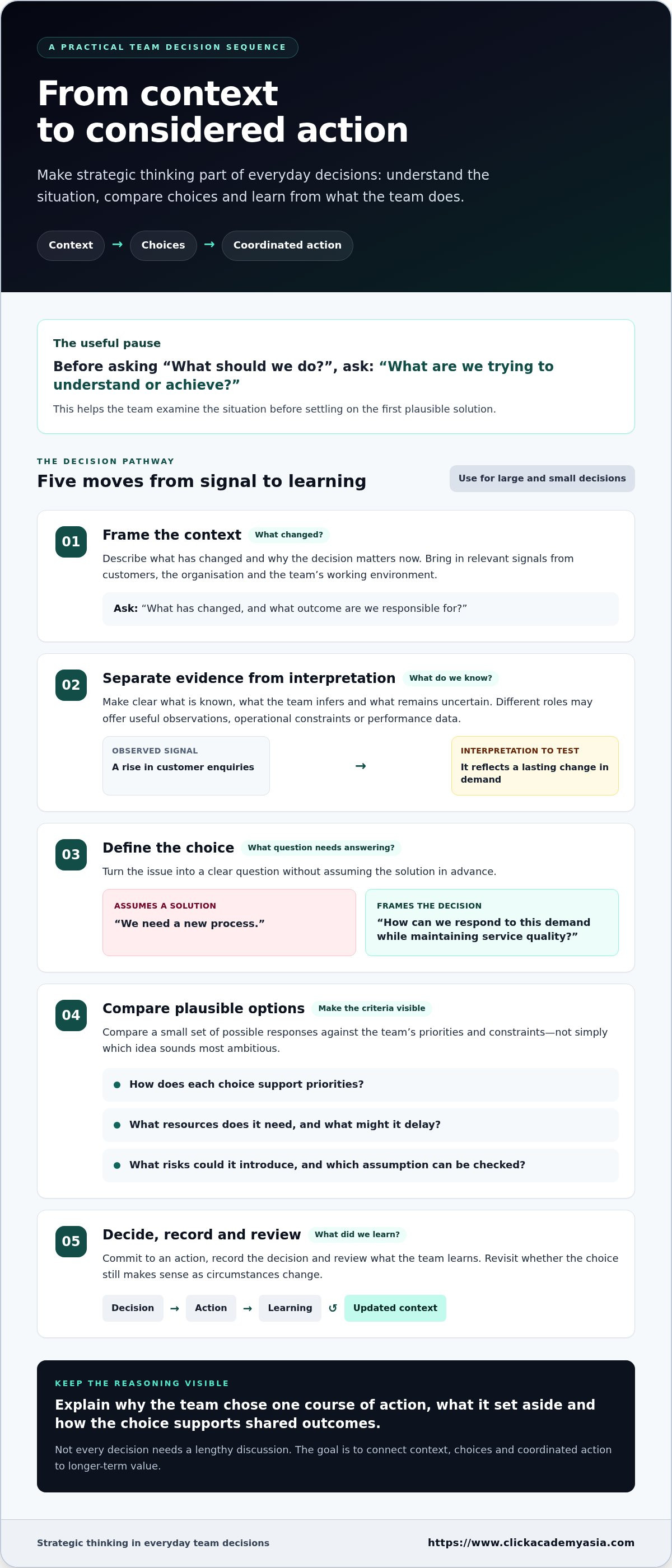
A reliable team decision should not begin with “What should we do?” Start with “What are we trying to understand or achieve?” That pause helps people avoid committing to the first plausible solution before examining the situation. To work out how to get your team to think more strategically, give them a sequence they can use for decisions both large and small.
Strategic thinking becomes repeatable when a team frames the context, defines the choice, compares options, commits to action and reviews what it learns.
Start with context, signals and assumptions
Before proposing solutions, invite the team to describe what has changed and why the decision matters now. Include signals from customers, the organisation and the team’s working environment. Different roles can contribute different perspectives: frontline observations, operational constraints and performance data may each reveal part of the same issue.
Frame the context. Ask, “What has changed, and what outcome are we responsible for?” Keep the discussion focused on information that could affect the decision.
Separate evidence from interpretation. Label what you know, what you infer and what remains uncertain. For example, a rise in customer enquiries is an observed signal. The belief that it reflects a lasting change in demand is an interpretation to test.
Define the choice. Turn the issue into a clear question. “How can we respond to this demand while maintaining service quality?” is more useful than “We need a new process”, which assumes the solution before the problem is understood.
Turn insight into choices, ownership and learning
Once the question is clear, compare a small set of plausible responses. Make the criteria visible so the conversation does not become a contest of preferences. The right option depends on the team’s priorities and constraints, not on which idea sounds most ambitious.
Compare options. Consider how each choice supports priorities, what resources it needs, what it may delay and what risks it could introduce. Note any assumption the team can check.
Decide and record. Capture the chosen action, the reason for it, the person responsible and the intended outcome. This gives everyone a shared reference point and makes the decision easier to revisit.
Set a review point. Agree what signal will show whether the decision is working and when the team will examine it. If results differ from expectations, treat that as useful information and adjust the approach.
Keep the record brief enough to use: one question, the key evidence, the options considered, the decision and its review point. This helps teams act with intent without turning every choice into a lengthy planning exercise. Leaders looking to build this capability can explore practical strategy learning alongside regular team decision reviews.
Strategic thinking versus critical thinking: what should your team practise?
Teams do not need to choose between strategic thinking and critical thinking. Strategic thinking helps them consider direction and future consequences; critical thinking helps them examine whether the evidence and reasoning behind a decision hold up. Used together, they turn broad priorities into choices the team can explain and act on.
Here is a concise comparison:
Purpose: Strategic thinking helps shape direction and identify where to focus. Critical thinking evaluates information and tests the quality of a proposed choice.
Time horizon: Strategic thinking considers longer-term implications alongside current needs. Critical thinking can be applied to immediate decisions as well as future plans.
Questions: Strategic questions include, “What outcome should we prioritise?” Critical questions include, “What evidence supports this option, and what might we be overlooking?”
Typical outputs: Strategic thinking may clarify priorities, opportunities or a direction to pursue. Critical thinking may surface assumptions, risks, evidence gaps or reasons to refine an option.
These are different lenses, not competing methods or a universal framework. A team can use them flexibly, depending on the decision, its potential impact and the information available.
When should a team use strategic thinking?
Use strategic thinking when setting direction, deciding which initiatives deserve attention or responding to a change that could affect future work. The team considers how the issue fits wider organisational priorities and what may happen if it acts, delays or chooses another path. Keep the discussion practical by finishing with a decision, a next step or a question that needs further investigation.
For example, a team deciding whether to automate a recurring reporting task might first ask what it wants to achieve. Is the priority to reduce manual work, improve the usefulness of reports or give staff more time for analysis? Strategic thinking helps the team weigh those aims against broader priorities instead of treating automation as an automatic win.
How critical thinking strengthens strategic decisions
Once the team has a direction to consider, critical thinking helps test it. Members can examine the evidence, identify assumptions, consider risks and check whether the reasoning supports the proposed action. This scrutiny is not about rejecting ideas for the sake of debate. It helps the team make a more informed choice before committing resources.
In the reporting example, the team might check which parts of the process take the most effort, whether the available information is reliable and what risks automation could introduce. That analysis could support the original idea, suggest a smaller trial or reveal that a different improvement is more relevant. The strategic question sets the direction; critical evaluation tests the route.
Building strategic capability is less about teaching everyone to use the same template and more about helping teams switch deliberately between these modes of thought. If you are considering how to get your team to think more strategically, encourage people to define the intended outcome, then invite constructive challenge before deciding what to do next.
How to make strategic thinking part of your team’s weekly work
Strategic thinking does not need a separate off-site or another recurring meeting. Build a short review into a team meeting that already exists, using current priorities and decisions as the starting point. The aim is to spot what needs attention, make deliberate choices and leave with clear next steps, not to create a strategy discussion with no effect on the work.
Use better prompts in existing team meetings
Set aside a focused part of the agenda for questions that help the team look beyond the immediate task list. Ask which priority matters most now, what the team should stop, start or continue, and what new signal could change its view. Invite quieter contributors and cross-functional perspectives before closing a decision. Someone in a different role may see a customer concern, dependency or operational constraint the core group has missed.
Leaders can rotate the prompts to suit the decisions at hand:
Priorities: Which outcome deserves our attention, and what work could be deprioritised to make room?
Signals: What have we noticed from customers, colleagues or results that could affect our current direction?
Assumptions: What evidence would change our view or lead us to reconsider this decision?
Blockers: What is stopping progress, and does it point to a wider issue rather than a one-off delay?
Decisions: What needs to be decided now, and what information is still needed?
These questions keep the conversation grounded in real work. They also make it easier to hear concerns without treating every challenge as resistance to the plan.
Keep strategy connected to execution
A discussion becomes useful when it changes what happens next. Before the meeting ends, capture the agreed action, its owner, the intended outcome and when the team will review progress. Keep the record visible alongside the work so decisions do not disappear into meeting notes.
Review results against the intended outcome, not activity alone. Completing a task or publishing a campaign shows that work happened; it does not, by itself, show whether the intended business result followed. In marketing, connect the measure to the question being asked, such as whether a campaign is attracting relevant visitors or contributing to a defined conversion goal. Marketing Analytics with GA4 can help teams relate measurement to strategic decisions.
Revisit the assumptions behind important choices. Ask what the team expected, what the evidence now suggests and what it would change next time. The right review point depends on the decision and how quickly useful evidence becomes available. To build these habits into practical team capability, explore strategy-focused professional training. These routines are a practical starting point for leaders working out how to get your team to think more strategically through everyday work.
Develop strategic capability with practical learning in Singapore
Team routines help strategic thinking become part of daily work. Structured professional development can add value when a team needs shared concepts, guided practice or support applying new skills to decisions. It is particularly useful when discussions keep circling around the same challenges, or when people understand the organisation’s priorities but are not confident translating them into choices and action.
Before selecting a learning pathway, identify the capability gap. Is the team struggling to interpret evidence, set marketing priorities or connect digital activity to business objectives? A clear need helps leaders choose learning that relates to actual work, rather than treating training as separate from the decisions the team needs to make.
Choose learning that connects strategy to real work
ClickAcademy Asia is a Singapore-based professional training provider offering WSQ Digital Marketing Strategy & Planning and customised corporate training. Its practitioner-led, AI-integrated curriculum connects concepts with practical workplace decisions, and learning can be delivered onsite, online or in a hybrid format. Teams developing digital strategy skills can explore WSQ digital marketing courses in Singapore.
Facilitated practice gives colleagues the chance to work through relevant scenarios, compare reasoning and build a shared approach. They can bring that learning back to team decisions, test it in context and identify where further development would help. WSQ frameworks provide a structured learning pathway. Eligible Singaporeans and PRs may receive up to 70% subsidy on qualifying courses, subject to eligibility. The maximum subsidy should not be assumed for every learner.
Understand eligibility and take the next step
For WSQ Digital Marketing Strategy & Planning, learners must meet these requirements:
Age 21 years and above.
Level 2 basic computer literacy.
GCE N, O, or A Level, NITEC, or diploma plus 2 years work experience.
English proficiency of GCSE N/O pass, WPLN Level 5, IELTS 5.5, or TOEFL iBT 46-59.
Bring a personal laptop.
For course selection assistance, text 9388 8755 to arrange an appointment. A consultant will respond within 1-2 working days. You can also email TeamSG@clickacademyasia.com or contact the team by WhatsApp/phone on 9388 8755.
To develop a shared learning pathway around your team’s capability needs, explore customised corporate training. Pair relevant professional learning with workplace practice to strengthen strategic judgement and apply it to decisions that matter.
Make your next team decision a starting point
The next strategic shift does not need to begin with a major initiative. Choose one upcoming team decision and use it to practise connecting the wider context with a clear choice, sound reasoning and a next step. Then look back at what the team learned. That cycle can help turn strategic thinking into a capability people use, not just a topic discussed at planning time.
If you are considering how to get your team to think more strategically, structured learning can give people a shared foundation to apply in their roles. ClickAcademy Asia has upskilled 30,000+ professionals and trained 6,000+ companies and teams, with 3,000+ 5-star Google reviews.
Equip your team with practical skills that support better decisions and future-ready capability. Explore practical WSQ and corporate training options, then bring the learning into the conversations where priorities are set and work gets done. Take the next step towards helping your team think more strategically by pairing focused learning with everyday practice.
Frequently Asked Questions
What does it mean for a team to think strategically?
It means the team can explain how its choices support the organisation’s direction, even when priorities compete. A useful sign is that people can identify dependencies between their work and another team’s contribution before a deadline is at risk. For example, a launch team might map which decisions depend on customer feedback, technical readiness and operational support, then flag gaps early rather than treating each workstream separately.
How can I encourage my team to think more strategically?
Make it safe to raise a concern before a decision is final. Try a short pre-mortem: ask the team to imagine that a proposed initiative has fallen short, then name plausible reasons why. This can surface risks that people may hesitate to mention in a standard status update. It is a practical first step in how to get your team to think more strategically, especially when a decision involves uncertainty or competing interests.
Can strategic thinking be taught to employees?
Yes. Give employees progressively broader responsibilities, such as asking them to prepare a short decision brief for a project they know well. Have them outline the intended outcome, key dependencies and information they still need, then provide feedback on their reasoning. This builds confidence through a genuine work task and helps managers see where coaching or further learning could make the biggest difference.
What is the difference between strategic thinking and critical thinking?
Strategic thinking helps a team consider direction, while critical thinking helps it scrutinise a particular claim or option. To practise both without turning the distinction into theory, ask a decision owner to state the desired direction, then invite a colleague to act as a constructive challenger. The challenger’s role is to test the logic and identify overlooked implications, not to oppose the proposal automatically.
How often should a team discuss strategy?
Let the significance and reversibility of a decision guide the discussion. A choice that is difficult to undo or could affect several teams deserves more deliberate consideration than a small, easily adjusted action. Teams can also revisit a decision when its underlying conditions change, rather than waiting for a fixed calendar review. This keeps the effort proportionate and avoids discussing strategy for its own sake.
What are the eligibility requirements for ClickAcademy Asia’s qualifying WSQ courses?
Learners must be 21 years and above, have Level 2 basic computer literacy, hold GCE N, O, or A Level, NITEC, or a diploma plus 2 years work experience, and meet English proficiency requirements of GCSE N/O pass, WPLN Level 5, IELTS 5.5, or TOEFL iBT 46-59. Learners must bring a personal laptop. Eligible Singaporeans and PRs may receive up to 70% subsidy on qualifying courses.
How can I get help choosing a course for my team?
Text 9388 8755 to arrange an appointment, and a consultant will respond within 1-2 working days. For corporate training enquiries, email TeamSG@clickacademyasia.com or contact the team by WhatsApp/phone on 9388 8755. ClickAcademy Asia offers customised corporate training and WSQ Digital Marketing Strategy & Planning. To make the discussion useful, outline the capability your team wants to build and the workplace decisions or projects where people should apply that learning.


Comments