
Digital Marketing Strategy for Market Entry: A 2026 Singapore Business Checklist
- ClickAcademy Asia

- 1 day ago
- 12 min read
Did you know that digital ad spend in Singapore is projected to reach S$2.45 billion by the end of 2026? While the capital is flowing, many PMEBs still hesitate to expand across borders because they fear wasting budget on campaigns that miss the mark. You've likely felt that same uncertainty about local cultural nuances or wondered if your team has the technical depth to manage international SEO. It's a valid concern; a poorly executed digital marketing strategy for market entry can lead to significant financial loss and brand damage in unfamiliar territories.
We've designed this guide to transform that hesitation into a structured, high-growth roadmap. You'll master a comprehensive checklist that simplifies international market entry risk assessment, ensuring your expansion is backed by data rather than guesswork. We'll explore how to organise your digital presence to meet local expectations while maintaining the professional excellence your brand stands for. By the end of this article, you'll have the clarity needed to lead your cross-border marketing team with total confidence.
Table of Contents
Why Your Digital Marketing Strategy for Market Entry is Critical in 2026
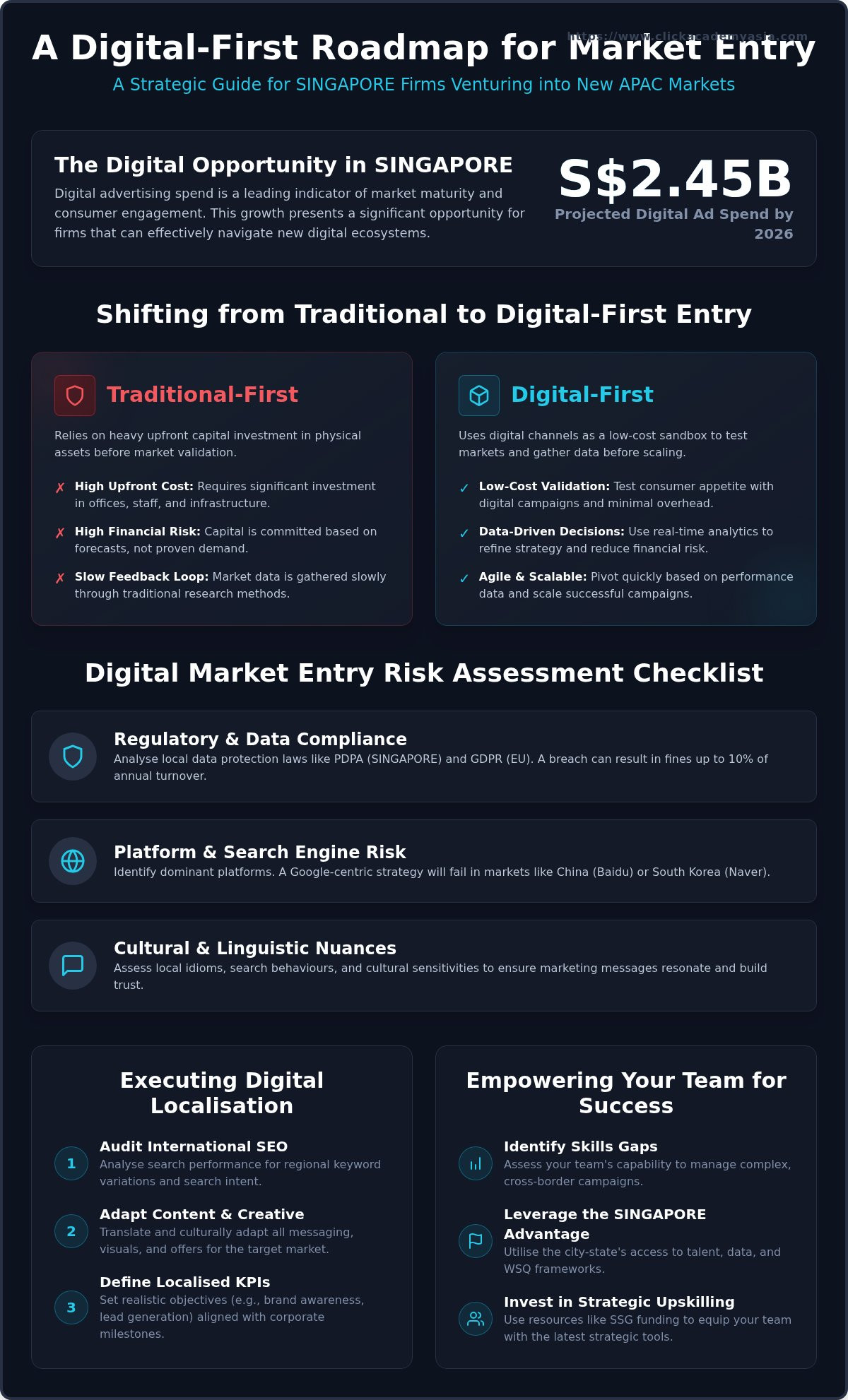
The traditional model of international expansion often required massive upfront investment in physical infrastructure and local office leases. In 2026, this "Traditional-First" approach is being replaced by a more agile, data-driven methodology. Leading firms in SINGAPORE now use a digital marketing strategy for market entry as a low-cost sandbox to test consumer appetite before committing heavy capital. This shift places the marketing lead at the heart of the boardroom, transforming them into the primary strategic driver of cross-border growth and risk mitigation.
To better understand how these digital concepts translate into a winning go-to-market plan, watch this helpful video:
When you utilise digital channels first, you gain access to granular data that physical surveys simply can't provide. You can analyse real-time conversion rates and search intent to refine your market entry strategies before scaling operations. This process allows the marketing lead to provide the board with evidence-based projections, reducing the fear of wasting budget. However, a generic approach will fail. Success in 2026 requires hyper-localisation; your content must reflect the specific cultural nuances, local idioms, and search behaviours of your target territory to build genuine trust with a new audience.
The SINGAPORE Advantage in Global Digital Expansion
SINGAPORE remains the ultimate springboard for penetrating APAC markets. As a regional digital hub, the city-state offers unparalleled access to high-quality data and professional talent. By aligning your team's skills with the WSQ Digital Marketing Strategy & Planning framework available through ClickAcademy Asia, you standardise excellence across your international campaigns. Many PMEBs also leverage SSG funding to offset the costs of this critical upskilling. This ensures your expansion teams are equipped with the latest strategic tools while operating from a world-class business ecosystem.
Defining Your Digital Entry Objectives
You cannot manage what you do not measure. Setting realistic KPIs is essential when entering a new market. Whether you prioritise brand awareness or immediate lead generation, your digital objectives must align with your broader corporate milestones. Start by identifying "low-hanging fruit" through social listening and search volume analysis. This data-driven approach ensures your digital marketing strategy for market entry remains focused on high-ROI activities. It allows you to pivot quickly if the data suggests a different approach, reducing the overall risk of your international venture.
International Market Entry Risk Assessment: The Digital Marketing Checklist
International market entry risk assessment is the process of evaluating digital barriers to entry, including regulatory compliance, platform dominance, and technical infrastructure limitations. While the potential for regional growth is high, ignoring these hurdles can lead to catastrophic budget drain or severe legal penalties. For instance, the maximum financial penalty for a data breach under the Personal Data Protection Act (PDPA) in SINGAPORE is now 10% of an organisation's annual turnover or S$1 million, whichever is higher. If you are entering European markets, GDPR requirements are equally stringent. You must also prepare for the December 31, 2026, deadline to cease using NRIC numbers for authentication in SINGAPORE, as this affects how you collect and store user data across your digital touchpoints.
Platform risk is another critical factor often overlooked by expanding firms. While Google dominates most regions, entering markets like China or South Korea requires a completely different digital marketing strategy for market entry. You cannot simply port a Google Ads campaign to Baidu or Naver and expect results. Each platform has its own algorithm nuances, ad formats, and user intent patterns. Referencing the U.S. International Trade Administration guidance on Singapore can provide a foundational understanding of how these local nuances impact business operations and digital visibility.
Cultural and Content Risk Mitigation
A "Lost in Translation" audit is non-negotiable for any serious expansion. It's not just about language; it's about visual cues and social norms. For example, colours that signify prosperity in one culture might represent mourning in another. You need to analyse local consumer psychology to understand digital buying behaviour. Are users in your target market more likely to convert via a social messaging app or a traditional e-commerce checkout? Aligning your brand messaging with local values ensures you don't inadvertently alienate your new audience. If your team lacks this expertise, consider upskilling through WSQ-certified programmes to build internal strategic competence.
Technical and Infrastructure Evaluation
Your tech stack must be ready for the regional shift. In SINGAPORE, where mobile connection rates hit 166% of the population, a mobile-first approach is the baseline. However, you must assess local internet speeds in your target market to ensure your site doesn't lag. Gaps in multi-region GA4 tracking can lead to fragmented data, making it impossible to calculate true ROI. Consider these technical essentials:
Payment Gateways: Does your site support local favourites like GrabPay, AliPay, or regional credit card providers?
Data Residency: Are you storing user data in compliance with local sovereignty laws to avoid regulatory friction?
AI Integration: With new PDPC rules regarding AI data usage notifications, how is your automated marketing handling personal data?
Addressing these technical hurdles early is a "quick win" that protects your long-term expansion goals and ensures a seamless user experience from day one.
Comparing Digital-First vs. Traditional Entry Modes
PMEBs in SINGAPORE often face a crossroads when deciding between traditional exporting and establishing local subsidiaries. Traditional exporting allows you to test the waters with minimal local commitment, but it often leaves your brand message at the mercy of third-party distributors who may not share your vision. In contrast, setting up a local subsidiary offers total control over your customer experience, though it demands significant capital for legal fees and physical office space. This high-stakes decision requires a balanced analysis of risk versus potential reward.
The rise of digital licensing provides a sophisticated alternative for the 2026 business environment. By licensing your brand or IP to a local digital partner, you can maintain a strong market presence without the burden of physical infrastructure. This approach relies heavily on a robust digital marketing strategy for market entry to ensure your brand's integrity remains intact across borders. For service-based PMEBs, a digital-only entry often yields the highest ROI, as it bypasses the logistics of physical goods and focuses resources on building authority through content and search visibility.
We recommend the 'Phased Digital Entry' model as a proven path to sustainable growth. This model involves three distinct stages designed to protect your capital:
Testing: Run targeted ad campaigns to validate demand and gather data on local consumer preferences.
Scaling: Increase budget on high-performing channels while refining your local content strategy based on real-time feedback.
Establishing: Commit to physical offices or local hiring only once the digital data proves long-term viability and consistent demand.
The Hybrid Approach: Digital Support for Physical Entry
Physical arrival shouldn't be the first time your brand is heard of in a new territory. Smart firms use SEO and SEM to build 'pre-launch' demand months before their doors open. By leveraging local influencers, you bridge the trust gap that often plagues foreign entrants. Integrating O2O (Online-to-Offline) strategies ensures that your digital traffic translates into physical footfall, which is critical for retail expansion in the APAC region. This synergy ensures your physical investment is met with an existing, eager audience.
Choosing the Right Mode for Your Resource Level
Matching your entry mode to your available marketing budget is essential for sustainability. If you have limited capital, digital franchising offers a lower-risk path to growth compared to direct ownership. However, direct ownership provides the highest level of control over your digital marketing strategy for market entry and customer data. To ensure your organic growth keeps pace with your expansion, consider our guide on Strategic SEO Planning: Scaling Your Organic Presence. This helps you align your resource allocation with long-term visibility goals and ensures your team is equipped for the challenge.
Execution Checklist: Localising Your Digital Presence
Executing a digital marketing strategy for market entry requires moving beyond simple translation into the territory of deep cultural resonance. You must adapt your core digital assets to mirror the expectations of your new audience while maintaining brand consistency across borders. Start by auditing your current SEO strategy for international keyword variations; terms that perform well in SINGAPORE often have different search volumes or intent profiles in neighbouring APAC markets. This audit ensures your technical foundation is robust enough to capture local search demand from day one.
Your content calendar needs to be equally agile and culturally aware. A multi-language schedule that respects local holidays, such as Lunar New Year, Songkran, or regional harvest festivals, ensures your brand feels like a local participant rather than a distant outsider. Simultaneously, you must optimise your paid media bids to account for local competition levels and currency fluctuations. This granular level of control prevents budget bleed and ensures your cost-per-click remains sustainable even in volatile economic environments. Successful PMEBs in 2026 use these "quick wins" to establish immediate relevance in new territories.
Search and Social Media Adaptation
Transcreating ad copy is far more effective than simple translation. You aren't just changing words; you're adapting the emotional hook to fit high-intent search terms unique to that specific culture. This process preserves the persuasive power of your original message while making it feel native to the new market. For a deeper dive into these technical nuances, explore our guide to Advanced Keyword Research Strategies: A 2026 Masterclass.
Platform selection is another critical pivot for SINGAPOREAN firms. While Meta might be the cornerstone of your domestic strategy, you may need to shift focus to WeChat in China or Zalo in Vietnam to reach your target audience effectively. Each platform requires a bespoke content approach to drive engagement, as user behaviour on Zalo differs significantly from the scrolling habits seen on Instagram or LinkedIn.
Data-Driven Localisation with GA4
In 2026, GA4 offers sophisticated tools for regional performance analysis that go beyond basic traffic metrics. Setting up sub-properties allows you to isolate data for specific markets, providing a cleaner view of local user journeys without cluttering your primary data stream. You should also track local conversion events that might differ from your home market, such as a 'WhatsApp Inquiry' or 'Line Message' instead of a traditional 'Add to Cart' in regions where conversational commerce is the primary driver of sales. GA4 predictive analytics can anticipate regional churn by identifying patterns in user behaviour that precede a drop in engagement, allowing you to intervene with targeted retention campaigns.
To ensure your team can handle these complex technical setups, you can apply for WSQ-funded training in Marketing Analytics & Insights to turn raw regional data into a powerful competitive advantage.
Upskilling Your Team for Successful Market Entry
Relying solely on external agencies for international growth is a high-stakes gamble that rarely pays off in the long run. While consultants provide valuable temporary support, internal strategic competence is what drives sustainable, long-term expansion. You need leaders who don't just follow a checklist but deeply understand how a digital marketing strategy for market entry integrates with your overarching business goals. Without this internal expertise, your firm risks becoming over-dependent on vendors who may not fully grasp your brand's core values or the specific nuances of your target APAC markets.
Identifying the skills gap within your management team is the first step toward a successful launch. Do your managers understand the technical requirements of international SEO, or how to navigate the complex data residency laws mentioned in our risk assessment section? In SINGAPORE, the government provides significant support to bridge these gaps. By utilising SSG funding and WSQ frameworks, you can standardise your expansion team's output while significantly offsetting the cost of professional development. This ensures your PMEBs are equipped with the latest strategic tools to lead cross-border campaigns with precision.
The WSQ Digital Marketing Strategy & Planning Pathway
This programme is specifically designed to move your team from tactical execution to high-level strategic planning. It teaches your managers how to conduct rigorous international framework assessments and evaluate the ROI of different entry modes before a single dollar is spent on ads. By mastering these skills, your staff can better manage the complexities of 2026's digital environment. For a closer look at the curriculum, explore our guide on Mastering the 2026 Landscape: WSQ Digital Marketing Courses.
Actionable Next Steps for PMEBs
You don't need to overhaul your entire department overnight to see results. Start with these targeted actions to strengthen your digital marketing strategy for market entry:
Conduct a Baseline Audit: Evaluate your current expansion plan against the technical and cultural risks we've identified.
Host a Strategic Workshop: Enrol your key stakeholders in a collaborative session to align on risk thresholds and regional KPIs.
Invest in Practical Mastery: Explore the WSQ Digital Marketing Strategy & Planning course to equip your team with the frameworks needed for 2026.
Taking these steps ensures your team isn't just reacting to market changes but is actively shaping your brand's future in new territories. Continuous learning is the most effective way to future-proof your expansion and ensure your team remains agile in an ever-evolving digital ecosystem.
Lead Your International Expansion with Strategic Precision
Success in cross-border growth isn't about having the largest budget; it's about having the most agile roadmap. By shifting to a digital-first methodology and conducting a rigorous risk assessment, you've already mitigated the most common pitfalls of international expansion. You now understand that a robust digital marketing strategy for market entry requires a sophisticated blend of GA4 data analysis and deep cultural transcreation. This foundation ensures your brand resonates with new audiences while protecting your capital from ineffective campaigns.
The final step is ensuring your internal team has the strategic depth to execute this vision with total confidence. Rather than relying solely on external vendors, you can empower your team for global growth with our WSQ Digital Marketing Strategy & Planning course. This programme features practical, mentor-led workshops and a recognised WSQ certification upon completion. Eligible SINGAPOREANS and PRs can also access up to 70% SSG funding to offset training costs. Take the lead in the APAC region and start building your high-growth future today.
Frequently Asked Questions
What is the most important part of an international market entry risk assessment?
The most critical element is regulatory compliance and platform suitability. You must ensure your data collection aligns with laws like the PDPA in SINGAPORE or GDPR in Europe to avoid heavy financial penalties. Failing to vet local search engines or social platforms can lead to wasted ad spend and legal friction before you even launch your first campaign.
How do I choose between a digital-first and a traditional market entry strategy?
Your choice depends on your resource level and the need for market validation. A digital-first approach serves as a cost-effective sandbox to gather data on consumer intent before committing to physical leases or local hiring. Traditional entry is better suited for established firms that require total control over local logistics and high-touch, physical customer service from day one.
Can small businesses in SINGAPORE use SSG funding for market entry training?
Yes, small businesses can leverage significant government support through SSG funding. Eligible SINGAPOREANS and PRs can receive up to 70% funding for WSQ-certified programmes. This allows your team to master a digital marketing strategy for market entry without the heavy financial burden of high-priced private consultancy fees or unproven training models.
What are the common digital marketing mistakes when entering a new country?
Most firms fail by simply translating content rather than transcreating the emotional hook for a new audience. Ignoring local search behaviours or using the wrong social platforms, such as sticking to Facebook in a market dominated by Zalo or WeChat, are also common errors. These mistakes often result in high bounce rates and a total lack of brand trust.
How does the WSQ framework help with international business expansion?
The WSQ framework provides a standardised, industry-recognised methodology for upskilling your team. It ensures that every member of your expansion project uses the same strategic language and assessment tools. This consistency is vital for maintaining brand integrity while managing complex cross-border campaigns across the APAC region, where local nuances can vary significantly.
Do I need to create a new website for every international market I enter?
You don't always need a new website, but you must localise the user experience. Using sub-directories or sub-domains allows you to maintain domain authority while serving regional content and local currencies. It's essential to integrate local payment gateways and ensure your SEO strategy targets territory-specific keywords to capture the most relevant regional traffic.
What role does GA4 play in monitoring a new market entry?
GA4 is essential for tracking regional conversion events and predicting user churn through advanced data modelling. By setting up sub-properties, you can isolate performance data for each market to see which regional campaigns drive the highest ROI. Its predictive analytics also help you anticipate drops in engagement, allowing for proactive retention strategies before they impact your bottom line.
How long does it typically take to see results from a digital market entry strategy?
You can see immediate traffic through paid SEM, but a comprehensive digital marketing strategy for market entry typically takes three to six months to show organic results. We recommend a phased approach. Spend the first month testing, use the second to refine your content based on data, and scale your spend only once the conversion data proves viability.


Comments