
Content Marketing in Web: A Strategic Guide for Professionals in 2026

Updated: May 22
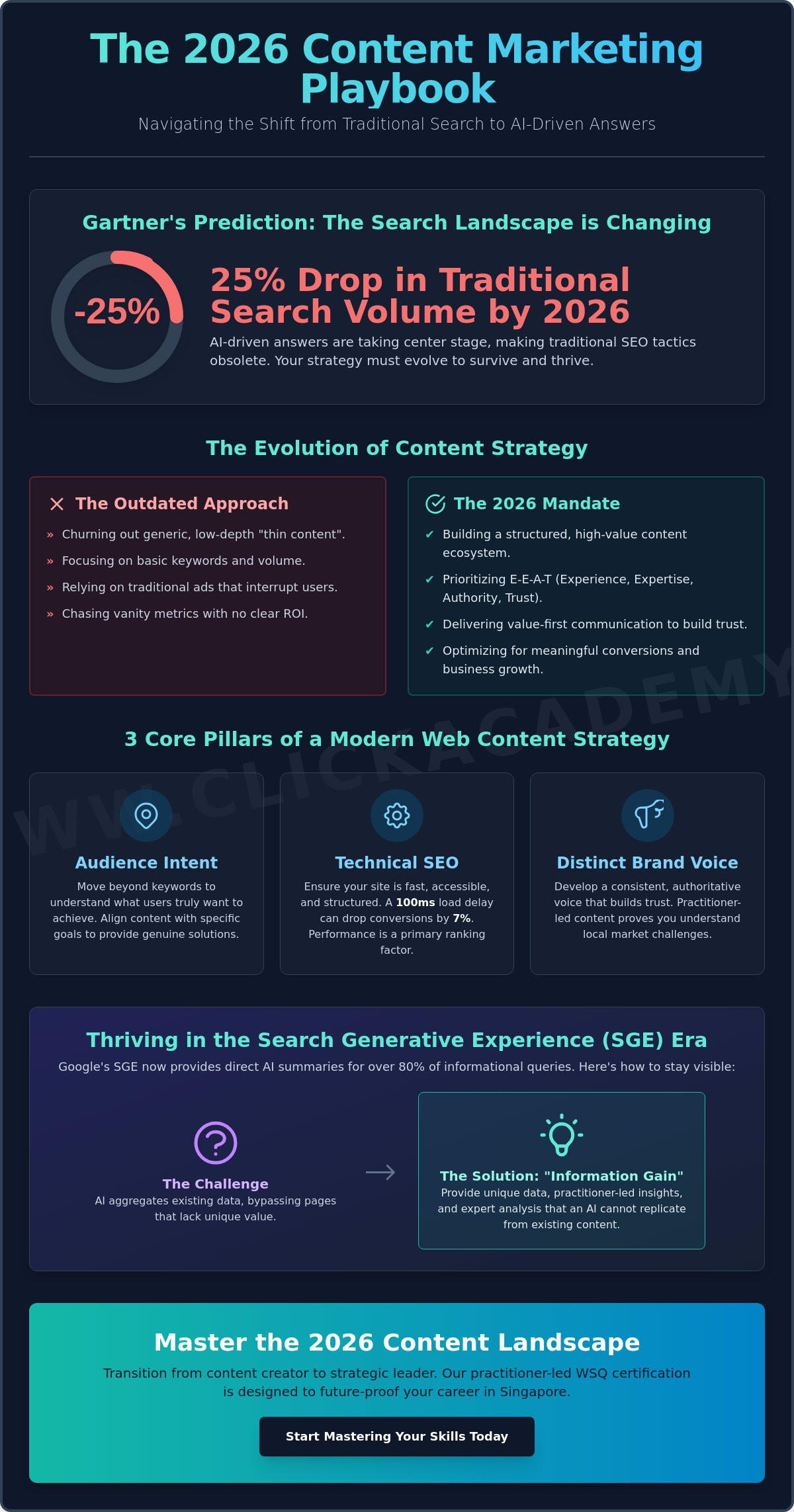
Gartner predicts that by 2026, traditional search engine volume will drop by 25% as AI-driven answers take centre stage. You've likely felt the pressure of this shift already, struggling to cut through the automated noise while evolving your strategy for Content Marketing in Web. It's a daunting task to keep your skills relevant when digital goalposts move every few months, leaving many professionals feeling like their hard-earned expertise is under threat from an influx of synthetic content.
We're here to help you master this new landscape through a lens of sophisticated storytelling and technical precision that future-proofs your career. This practitioner-led guide provides the exact framework needed to align your strategy with 2026 search behaviours, ensuring your brand remains a trusted authority in the Singapore market. By focusing on high-value human connection rather than just volume, you can secure your status as a leading digital expert and mentor within your organisation.
You'll learn how to move beyond basic keywords to build a structured content ecosystem that delivers tangible business growth through high-conversion organic channels. We'll explore the shift from vanity metrics to meaningful conversion optimisation, giving you the tools to prove your impact to stakeholders with absolute confidence.
Key Takeaways
Learn how to transition from traditional advertising to a value-first strategic system that builds long-term audience trust and retention.
Optimise your digital assets for the 2026 landscape by aligning your brand voice with the latest Search Generative Experience (SGE) requirements.
Identify high-ROI content formats and master the strategy of repurposing single pillar pieces into high-impact, multi-channel campaigns.
Master the art of Content Marketing in Web to align your digital storytelling with the sophisticated search behaviours of modern professionals.
Transition from a content creator to a strategic leader with practitioner-led WSQ certification designed to future-proof your career in Singapore.
Table of Contents What is Content Marketing in Web and Why it Matters in 2026? The Core Pillars of a Modern Web Content Strategy Evaluating Content Formats: Which Drives the Best ROI? 5 Steps to Executing a High-Impact Content Marketing Plan Mastering Content Marketing: From Theory to Practitioner-Led Excellence
What is Content Marketing in Web and Why it Matters in 2026?
Content Marketing in Web isn't just about churning out blog posts or social media updates; it's a strategic system designed to attract and retain a specific audience through high-value digital assets. By 2026, the digital space has become saturated with generic, automated noise, making the standard definition of content marketing more relevant than ever for Singaporean professionals. Brands are moving away from traditional ads that interrupt the user experience and are instead focusing on value-first communication. To survive this year, you've got to cut through the clutter with genuine authority and expert-led insights.
To better understand this concept, watch this helpful video:
The Evolution of Web Content: From Blogs to Authority Hubs
Search engines now prioritise Experience, Expertise, Authoritativeness, and Trustworthiness (E-E-A-T) above all else. The days of ranking with "thin content" are over; pages that lack depth or unique data are now a major liability for modern brands. In the Singapore market, users demand transparency and practical utility from the brands they follow. Content Marketing in Web is the intersection of storytelling and technical SEO.
This guide focuses on three core learning objectives to help you succeed:
Strategy: Aligning your digital assets with actual business goals.
Execution: Developing high-impact content that resonates with your target demographic.
Professional Mastery: Using advanced tools and data to refine your performance.
The Business Case: Why Brands are Investing in Content
Marketing budgets in Singapore are under more pressure than ever. Organic traffic offers a long-term ROI that paid advertising simply can't match, especially as the cost of PPC campaigns continues to rise. Content acts as a compounding asset; it stays on the web and keeps working for you long after the initial creation. It also shortens the sales cycle by building trust before the first point of contact, as customers prefer to buy from brands that have already solved their smaller problems through helpful content. You can start mastering the 2026 landscape by understanding how these shifts impact your specific industry. By investing in authority now, you ensure your brand remains visible in an increasingly crowded digital ecosystem.
The Core Pillars of a Modern Web Content Strategy
Effective Content Marketing in Web during 2026 requires a shift from quantity to high-utility precision. You must anchor your strategy in three non-negotiable elements: Audience Intent, Technical SEO, and a distinct Brand Voice. If your content doesn't align with what a user actually wants to achieve, search engines will simply bypass it. Google's Search Generative Experience (SGE) now processes over 80% of informational queries by providing direct AI-generated summaries. To stay visible, your content must offer "information gain," providing unique data or practitioner-led insights that an AI cannot replicate from existing datasets.
Your Content Management System (CMS) acts as the engine for this experience. It isn't just a storage bin for blogs; it's a delivery mechanism that must ensure your site is lightning fast and accessible. Technical performance is a primary ranking factor; industry data shows a 100ms delay in load time can drop conversion rates by 7%. A practitioner-led approach is vital here. When content is written by someone who actually does the job, it carries an authority that builds trust. In the Singapore market, where professional credibility is paramount, showing you understand the local regulatory environment or specific industry challenges sets you apart from generic, AI-produced fluff.
Mapping Content to the Customer Journey
Think of your web ecosystem as a guided path. Top of Funnel (TOFU) content answers broad questions, while Middle of Funnel (MOFU) pieces compare solutions. Bottom of Funnel (BOFU) content focuses on the final "why us" pitch. To transition a reader from a "how-to" guide to a commercial landing page, use a logical bridge. If they're learning how to automate reports, suggest a tool or a professional development course that masters that specific skill. Quick win: Audit your top 5 most-visited pages today. Ensure each one has a clear, bold Call to Action (CTA) that tells the reader exactly what to do next.
Technical SEO: Ensuring Your Content is Found
Visibility in 2026 relies heavily on structured data, or Schema. This code helps search engines understand the context of your content, making it more likely to appear in rich snippets or SGE citations. Mobile-first indexing is no longer a suggestion; it's the standard. If your page takes longer than two seconds to load on a 5G connection in Singapore, you've already lost the reader. Technical excellence ensures your creative work actually reaches its audience. Professional WSQ Search Engine Optimisation (SEO) training is an excellent way to bridge the gap between creative writing and technical ranking requirements, ensuring your Content Marketing in Web efforts yield a measurable Return on Investment (ROI).
Evaluating Content Formats: Which Drives the Best ROI?
Choosing the right format for your Content Marketing in Web strategy determines whether your budget is an investment or an expense. High-impact formats like pillar pages and interactive tools often require a higher upfront cost but deliver a 40% better long-term ROI compared to ephemeral social posts. For instance, a well-researched case study featuring a Singaporean SME builds more trust than ten generic listicles.
Smart practitioners use a repurposing framework to maximise every dollar spent. You can transform one comprehensive pillar piece into a multi-channel campaign including five LinkedIn carousels, three short-form videos, and a dedicated newsletter. This approach ensures your core message reaches different audience segments without multiplying your production costs. It's about working smarter with the assets you already own.
Data-driven decisions are essential when allocating your S$10,000 or S$50,000 marketing budget. Analyse your conversion data to see which assets actually move the needle. While a basic article might cost S$400 to produce, an interactive tool costing S$4,000 might generate 20 times the leads. This makes the tool the more cost-effective choice over a twelve-month period despite the higher initial price tag.
Pillar Pages and Topic Clusters
Building Topic Clusters is the most effective way to establish domain authority in 2026. This structure involves a central, broad "Pillar" page that links out to multiple, specific "Spoke" articles covering sub-topics. This visual map signals to search engines that your site is a comprehensive resource on the subject. Internal linking is the glue of a successful web strategy.
Interactive and Visual Content
Calculators, quizzes, and infographics are no longer optional for brands wanting to stand out in the Singapore market. These tools provide immediate value to the user, such as a CPF savings calculator or a digital maturity quiz. Video-embedded articles are also crucial, as they significantly increase "dwell time" on your site. This metric tells search engines that your content is valuable, which directly improves your ranking signals. Practitioner-led training at ClickAcademy Asia emphasises these technical assets to help professionals master the evolving requirements of Content Marketing in Web.
5 Steps to Executing a High-Impact Content Marketing Plan
Executing a strategy for Content Marketing in Web environments requires a shift from volume-based posting to precision-based publishing. Success in 2026 relies on your ability to cut through the noise with practitioner-led insights that solve specific problems for your audience. Follow these five steps to ensure your efforts result in tangible business growth.
Step 1: Conduct deep audience research. Move beyond basic demographics. Use social listening tools to identify the specific pain points discussed in Singapore-based professional forums and LinkedIn groups. Analyse search data from the last 12 months to see exactly what your prospects are asking.
Step 2: Define your unique content angle. This is your "Why Us" factor. If your advice sounds like everyone else's, it's invisible. Infuse your content with proprietary data or unique case studies that competitors cannot replicate.
Step 3: Build a practitioner-led editorial calendar. Balance your output between evergreen pillars that provide long-term SEO value and trending topics that capture immediate interest. Ensure every piece is reviewed by a subject matter expert to maintain high standards.
Step 4: Execute with E-E-A-T and precision. Google prioritises Experience, Expertise, Authoritativeness, and Trustworthiness. Use British English conventions and ensure every claim is backed by a credible source or internal data point.
Step 5: Measure and optimise. Don't just publish and forget. Use actual conversion data to see which topics drive revenue rather than just traffic. Adjust your strategy every 30 days based on these findings.
Setting Measurable Goals and KPIs
Stop chasing "vanity metrics" like likes or shares. These numbers look good in a presentation but don't pay the bills. Focus on "sanity metrics" such as lead quality, newsletter sign-ups, and direct conversions. Use GA4 to map the content-to-conversion path, identifying exactly which blog posts or guides led a user to fill out a contact form. A monthly review should include a checklist of click-through rates (CTR), bounce rates on high-value pages, and the total number of marketing-qualified leads (MQLs) generated.
The Role of AI in Content Creation
AI is a powerful ally for research, brainstorming, and structural outlining. It can help you process vast amounts of data to find trends or create a first draft in seconds. However, you must avoid "AI-slop," which is the generic, unedited machine output that lacks personality and nuance. Your brand voice is your greatest asset; it's what builds trust with your readers. Use AI to handle the heavy lifting of organization, then let a human expert refine the tone and add real-world context. To master these advanced workflows, consider enrolling in the WSQ Content Marketing Strategy course to learn how to integrate AI without losing your professional edge.
Content Marketing in Web strategies only work when they are backed by consistent, high-quality execution. Professionals who master the balance between data-driven planning and human-centric storytelling will see a 40 percent higher engagement rate compared to those relying on automated templates. Start refining your process today to future-proof your digital presence.
Ready to elevate your skills? Explore our practitioner-led digital marketing certifications at ClickAcademy Asia and lead your team with confidence.
Mastering Content Marketing: From Theory to Practitioner-Led Excellence
Transitioning from a content creator to a strategic leader isn't just about writing better copy; it's about shifting your mindset toward measurable business outcomes. By 2026, 85% of successful marketers will need to demonstrate direct ROI from their digital efforts. Effective Content Marketing in Web strategies now demand a blend of data literacy and creative storytelling. You're no longer just producing assets; you're architecting a journey that guides a prospect from awareness to conversion.
Why WSQ Certification Matters for Your Career
In Singapore, the Workforce Skills Qualifications (WSQ) framework stands as the definitive benchmark for professional excellence. These certifications are more than just badges on a LinkedIn profile. They represent a rigorous standard validated by SkillsFuture Singapore (SSG). For PMEBs, this means immediate credibility with hiring managers who value government-backed quality assurance. You can also access significant financial support, as SSG provides subsidies often covering up to 70% of course fees for eligible Singaporeans and Permanent Residents. ClickAcademy Asia remains a premier destination for these certifications, offering a curriculum that bridges the gap between academic theory and industry demands.
Success in this field comes from learning from those who have already scaled the mountain. Theoretical knowledge often fails when it meets the reality of shifting algorithms or budget constraints. This is why we prioritise practitioner-led training. Our instructors manage global brands and bring real-world case studies into the classroom. You'll learn how to handle multi-million dollar budgets and complex omnichannel campaigns. This practical exposure ensures you don't just learn about Content Marketing in Web, but you learn how to execute it with precision.
Next Steps: Transform Your Digital Strategy
Take a moment to evaluate your current skill set. If you feel your strategy has plateaued, a focused bootcamp can provide the necessary catalyst for growth. The landscape changes quickly; waiting six months to update your approach could result in a 20% drop in organic engagement based on current 2024 market trends. The best time to refine your framework is now.
Identify your specific skills gaps in data analytics or SEO.
Commit to a structured learning path that offers industry-recognised credentials.
Apply new frameworks immediately to your current projects for quick wins.
Empower your career with our WSQ Digital Marketing Strategy & Planning course and start leading with confidence today.
Master the Future of Your Digital Strategy
Success in 2026 isn't about making more noise; it's about precision. You've seen how the core pillars and high ROI formats define effective Content Marketing in Web. By following a structured execution plan, you'll move from theory to practitioner-led excellence. This shift ensures your brand stays relevant in Singapore's competitive market while others struggle with outdated tactics. Refining your approach to include data-driven formats will directly impact your bottom line. It's time to stop guessing and start measuring what works.
Don't leave your career growth to chance. You can bridge the skills gap with training that's grounded in real-world application. ClickAcademy Asia has been a trusted partner for professionals from over 30 countries since 2011. As an official Google Partner and WSQ-certified training provider, we provide the tools you need to lead with confidence. Our workshops focus on practical mastery to help you navigate the shifting digital terrain with ease.
Master the future of digital with ClickAcademy Asia’s WSQ-certified courses. Your journey toward becoming a top-tier digital leader starts now.
Frequently Asked Questions
Is content marketing still effective for the web in 2026?
Content marketing remains the most effective way to build trust and authority on the web in 2026. According to industry data from 2025, 82% of Singaporean buyers research online before making a purchase. While AI has changed how we produce content, the demand for human expertise and practitioner-led insights is higher than ever. It's about creating value that search engines reward with better visibility.
How much does it cost to start a content marketing strategy?
You can start a basic content marketing strategy for as little as S$500 to S$2,000 per month if you're handling the execution internally. This budget typically covers essential tools for keyword research and basic distribution platforms. If you choose to outsource to a specialist agency in Singapore, monthly retainers often begin at S$3,500. Investing in professional training can also reduce long-term costs by improving your team's efficiency.
Can I use AI to write all my web content?
You shouldn't rely on AI to write 100% of your web content if you want to maintain high search rankings and brand authority. Search algorithms in 2026 are sophisticated enough to detect and deprioritise low-effort AI text that lacks original insight. Use AI as a co-pilot for outlining or brainstorming, but ensure a human expert adds the practitioner-led perspective that builds real trust with your Singaporean audience.
What is the difference between SEO and content marketing?
SEO focuses on the technical aspects of making your site discoverable, while content marketing in web is about creating the actual substance that engages the visitor. Think of SEO as the engine that drives traffic and content marketing as the fuel that keeps the relationship going. SEO ensures your pages appear in search results, but high-quality content is what actually converts a casual reader into a loyal customer.
How long does it take to see results from content marketing in web?
You should expect to see measurable results from content marketing in web within four to nine months of consistent execution. While technical SEO fixes might show impact in 60 days, building domain authority and ranking for competitive keywords takes longer. Data from 2025 shows that brands publishing two high-quality articles per week see a 45% increase in organic traffic after the six-month mark.
What qualifications do I need to become a content marketing manager?
A successful content marketing manager in Singapore needs a blend of strategic thinking, data analysis, and storytelling skills. Most employers look for a degree in marketing or communications, paired with industry-recognised certifications from providers like Google or Meta. Practical experience with CMS platforms and SEO tools is essential. Showing a portfolio of successful campaigns that drove actual business growth will set you apart from other candidates.
What is WSQ and how does it help my marketing career?
WSQ stands for Workforce Skills Qualifications, a national credential system in Singapore that trains, develops, and certifies skills for the workforce. Taking a WSQ-aligned course helps your career by ensuring you've met rigorous, industry-validated standards. These courses are often heavily subsidised by SSG, sometimes covering up to 70% of fees for Singapore Citizens and Permanent Residents. This makes high-level digital marketing education much more accessible for professionals.



Comments