
Behavioral Segmentation Guide for Singapore Marketers

A demographic label can tell you who a customer is; their recent actions may reveal what they need next. For Singapore marketers, customer segmentation using behavioral data offers a more timely way to understand intent, but only when scattered signals can be interpreted consistently and tied to a clear marketing decision.
If broad audience groups feel too blunt, you’re not alone. A website visit, repeat purchase or abandoned basket can each mean something different, and not every behavioural signal is useful enough to act on. Start with the decision you want to improve, then identify the actions that could inform it.
This guide shows you how to choose meaningful signals, select a segmentation approach that fits your data, and build measurable segments you can refresh at the right pace. You’ll also learn how to use those segments in more relevant marketing while handling data responsibly. For teams looking to strengthen their practical analytics capability, Singapore’s WSQ learning framework provides a relevant context for ongoing skills development.
Table of Contents
What customer segmentation using behavioral data reveals about customer intent
Which behavioural data should you use for customer segmentation?
Rules-based segments or machine learning: which approach fits your data?
How to build, activate, and improve behavioural customer segments
Build the skills to apply customer segmentation using behavioral data in Singapore
What customer segmentation using behavioral data reveals about customer intent
Your customer data may be spread across website analytics, email platforms and sales records, yet useful audience groups can still be hard to define. The challenge isn’t simply collecting more information. It’s identifying which observed actions matter to a marketing decision.
Behavioural segmentation groups customers by the actions they take and the patterns in how they interact with a business. It can help marketers move from broad audience categories to practical groups, such as customers who return to a product page or existing buyers who have not purchased again. Market segmentation, including behavioural segmentation, offers a wider overview of how this approach fits alongside other ways of grouping audiences.
A useful segment connects a recognisable behaviour to a specific response. If the response isn’t clear, the segment may be interesting to analyse but difficult to use in a campaign.
How behavioural data differs from demographic and psychographic data
Demographic data describes attributes such as age, location or household composition. Behavioural data records actions or events, including purchases, page visits and email clicks. Psychographic data relates to interests, attitudes or values, which may require research methods such as surveys or interviews rather than relying on activity logs alone.
These signal types can work together. Demographics might add context to a group of repeat purchasers, while research into customer interests could help shape the message. Keep the distinction clear: a recorded action is observed behaviour; an assumed preference is not.
When behaviour-based segmentation is useful
Behavioural segments are most useful when they guide a relevant next step. Consider the action, then ask what marketing decision it could support:
Repeat purchases: identify returning buyers for retention messaging or a relevant complementary offer.
Product-page visits: consider product education for people who viewed a product but didn’t proceed.
Email clicks: use the clicked topic to inform follow-up content or campaign relevance.
Feature adoption: offer guidance on useful features to customers who have started using a product or service.
Treat each action as a signal, not proof of intent. A product-page visit could reflect active consideration, casual browsing or research for someone else. Use behaviour to shape a relevant response, then assess whether that response is helpful through engagement and conversion measures. With customer segmentation using behavioral data, the goal isn’t to claim certainty about individuals. It’s to make better-informed marketing decisions and improve them as new evidence emerges.
Which behavioural data should you use for customer segmentation?
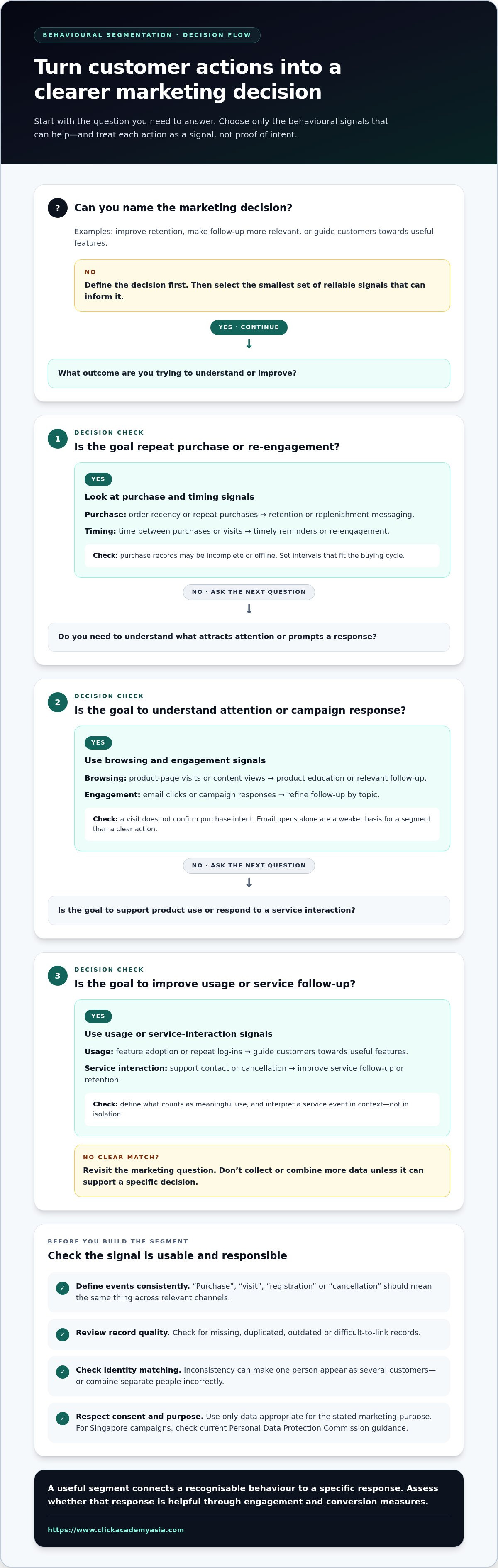
More tracking doesn’t automatically produce better segments. Start with a marketing question, then select the smallest set of reliable signals that can help answer it. This keeps data collection focused and makes it easier to explain why a segment should lead to a particular action.
Match behavioural signals to the marketing question
For a repeat-purchase or re-engagement question, examine how recently and how often customers have bought. To understand what attracts attention, look at product-page visits and content interactions. Campaign clicks can indicate which topics prompt a response, while email opens alone are a weaker basis for a segment because an open doesn’t show what the person did next.
Use the table to connect each signal category to a decision before deciding whether to collect or combine more data.
Check data quality before building segments
Before using a signal, define its event consistently across relevant channels. A “purchase”, “visit”, “registration” or “cancellation” should mean the same thing wherever it is recorded. Check whether records are missing, duplicated, outdated or difficult to link to the same customer. Inconsistent identity matching can make one person appear to be several customers, or combine separate people incorrectly.
Keep collection and activation consent-aware, and use only data that is appropriate for the stated marketing purpose. For Singapore campaigns, check current guidance from the Personal Data Protection Commission before making decisions about personal data. [External Link: PDPC guidance on personal data]
Teams can strengthen the strategy and measurement skills behind this work through practical marketing analytics learning. A clear question, well-defined events and dependable records give customer segmentation using behavioral data a stronger foundation.
Rules-based segments or machine learning: which approach fits your data?
The best method is one your team can explain, maintain and connect to a marketing decision. Rules-based segmentation applies clear conditions to customer records. Clustering, an unsupervised machine-learning approach, analyses multiple signals to identify patterns that may not be obvious in advance.
Neither method is automatically better. In customer segmentation using behavioral data, incomplete tracking or an unclear use case can make a sophisticated model harder to trust and use than a straightforward rule.
When rules-based behavioural segments are enough
Choose rules when the audience definition is clear and the resulting action is understood. For example, define a recent purchaser using a documented purchase window, identify subscribers who have been inactive under a stated criterion, or group customers who have viewed the same product repeatedly. Record each rule, the marketing purpose it serves and how often the team will review it.
Clear rules give colleagues a shared definition and make it easier to investigate why someone entered or left a segment. They’re a strong starting point when the goal is to act on a known behaviour rather than discover a new one.
When unsupervised learning may add value
Clustering can help explore how combinations of actions relate across a customer base, such as purchase patterns alongside browsing and product usage. It can surface groups that a team wouldn’t have defined using a single threshold. But a cluster label isn’t a marketing strategy: teams still need to interpret the pattern, check that it is meaningful and decide what response is appropriate.
Plan for the work after modelling, too. Someone must be able to explain the groups, translate them into campaign or experience decisions, and monitor whether the segments remain useful as behaviour changes.
Rule of thumb: start with rules when you can describe the audience and action in one sentence. Explore clustering when you have consistent behavioural data, a clear discovery question and the capability to validate and use what you find.
How to build, activate, and improve behavioural customer segments
Make customer segmentation using behavioral data a repeatable campaign process, not a one-off analysis. Start with one use case your team can explain, then move from the business question to a measured response.
Set the business question. Decide what you want to improve, such as repeat purchases, product understanding or re-engagement.
Choose the signals. Select the actions that relate directly to that goal, and define how each event is recorded.
Write the segment rule. Describe who qualifies in plain language, including any time period or action threshold. Check that the team can apply the definition consistently.
Plan the activation. Specify the message, channel and next action. Add exclusions to avoid sending irrelevant or conflicting communications.
Measure and review. Compare results with a baseline, document what you learn and update the segment when behaviour or priorities change.
Turn a segment into a campaign action
A segment only becomes useful when it informs a relevant experience. For example, define an audience as customers who bought a particular product but haven’t returned within the usual purchase interval. Send them a timely replenishment reminder by email, with a clear route to view the product. Exclude customers who have already purchased again, and set frequency controls so repeated qualifying events don’t trigger repetitive messages.
For another use case, group subscribers who clicked content about a product category. Follow up with related guidance through the channel they’ve engaged with, and exclude people who have already completed the intended action. Keep the rule, message and desired outcome aligned.
Measure outcomes and refresh segments
Choose a measure that fits the objective: conversion for a purchase campaign, retention for a repeat-use initiative, or engagement for a content follow-up. Record the pre-campaign baseline, then compare the segment’s results with an appropriate reference group, such as a comparable audience that didn’t receive the message, where practical. This helps distinguish campaign performance from general changes in customer activity.
Set the refresh cadence to match the behaviour and decision. A time-sensitive campaign may need more frequent updates than a segment based on a slower purchase cycle. Document the rule, results and learning, then revise the definition if it stops identifying a useful audience.
Build confidence in the measurement behind your segmentation with [Internal Link: ClickAcademy Asia Marketing Analytics and GA4 learning], and apply those skills to improve your team’s campaign decisions.
Build the skills to apply customer segmentation using behavioral data in Singapore
Strong segments depend on more than access to customer records. Teams need the judgement to connect a business objective to meaningful signals, the analytical skills to interpret those signals, and the discipline to measure results and handle customer data responsibly.
In practice, that means building capability across four areas:
Strategy: define the campaign or customer outcome a segment should support.
Analytics: interpret behavioural patterns and assess whether the underlying data is reliable.
Measurement: select relevant metrics, establish a baseline and use findings to optimise activity.
Responsible interpretation: distinguish observed actions from assumptions and use data with care.
Connect segmentation work to marketing strategy and analytics
A clear audience definition helps teams plan campaigns with purpose: who the message is for, what it should address and what response to measure. That definition also gives analysts and marketers a shared reference point when reviewing performance and deciding what to improve. Build the strategy first, then use analytics to test whether the segment and message are working as intended.
For teams developing these capabilities in Singapore, ClickAcademy Asia offers WSQ Digital Marketing Strategy & Planning and WSQ Marketing Analytics & Insights. These courses develop strategic planning and measurement skills that teams can apply to segmentation work. Singapore’s WSQ framework and SSG context provide a local setting for professional skills development. Training support and funding depend on applicable criteria, so avoid assuming eligibility.
Choose a practical next step for your team
Start small. Document one segmentation use case and note the skills needed to carry it through, from defining the audience and interpreting data to activating a campaign and reviewing its outcome. This gives managers and HR decision-makers a practical way to identify capability gaps and prioritise relevant learning.
Then put the learning into practice: agree on the audience rule, assign responsibility for measurement and record what the team learns. This turns customer segmentation using behavioral data from a one-off exercise into a repeatable marketing capability.
Action summary: choose one business objective, map the skills it requires, and strengthen the team’s strategy and analytics capability. Explore [Internal Link: ClickAcademy Asia practical digital marketing training] to help your team apply its learning with confidence.
Turn customer insights into your next marketing advantage
Effective segmentation starts with a decision, not a data dump. Choose behavioural signals that relate to a clear business question, then build an audience rule your team can explain and act on. Measure the outcome and review the segment as customer behaviour changes.
Applying customer segmentation using behavioral data takes strong strategy, analytics and measurement skills. In Singapore, teams can build these capabilities through the WSQ framework. ClickAcademy Asia offers WSQ Digital Marketing Strategy & Planning and WSQ Marketing Analytics & Insights to help teams develop relevant skills.
Identify a use case, map the skills your team needs, and put new learning to work in a campaign. Equip your team with relevant skills through ClickAcademy Asia’s WSQ training tracks, with funding subject to applicable criteria. [Internal Link: Explore practical digital marketing training] Take the next step towards more focused, measurable marketing with confidence.
Frequently Asked Questions
What is customer segmentation using behavioral data?
Customer segmentation using behavioral data groups customers by actions and interaction patterns, such as purchases, page visits or product usage. Marketers use these observed signals to define audiences around behaviours relevant to a business objective. For example, customers who have viewed a product several times could receive educational content about it. The behaviour indicates a possible opportunity, not certainty about what any individual intends to do.
What types of behavioral data are useful for customer segmentation?
Useful behavioural data can include purchase history, browsing activity, campaign engagement, product or feature usage, timing, and service interactions. Choose signals based on the decision you want to support. Purchase recency might inform a retention campaign, while feature adoption could point to a need for product education. Check that events are consistently defined and records are reliable before using them to create segments.
How do you create customer segments from behavioral data?
Start by defining a marketing question, such as how to encourage repeat purchases. Select relevant, consistently recorded signals, then write a segment rule that colleagues can understand and apply. For instance, the rule might identify customers who bought a product but haven’t made another purchase within a defined interval. Choose a suitable message and channel, measure the outcome against a baseline, and review the rule as needs change.
What is the difference between behavioral and demographic segmentation?
Behavioural segmentation groups customers by actions, such as purchases, website visits or campaign clicks. Demographic segmentation groups them by attributes, such as age or location. Each provides a different perspective, and one doesn’t automatically replace the other. Combining them can add context, but keep observed behaviour separate from assumptions. A demographic attribute may describe a customer, while an action shows something they did.
Is behavioral segmentation suitable for small marketing teams?
Yes. A small marketing team can begin with a simple, rules-based segment using data it already records reliably. For example, it could identify recent purchasers for a relevant follow-up, then track a clear outcome such as conversion or repeat purchase. Start with one campaign use case rather than building multiple audiences at once. A plain-language rule helps colleagues manage the segment and review whether it remains useful.
How often should behavioral customer segments be updated?
Update segments at a cadence that fits the behaviour and the marketing decision. A time-sensitive campaign may need more frequent updates than a segment based on a slower purchase cycle. Consider how quickly the underlying actions change and how often the team can act on new information. Review the segment’s performance and definition regularly, then adjust the cadence if the audience becomes outdated or less useful.
Can customer segmentation use behavioral data responsibly?
Yes, if the team handles data carefully and uses it for an appropriate, clearly defined marketing purpose. Limit collection to signals relevant to the business question, apply clear consent-aware practices, and take care when linking records across channels. In Singapore, marketers should follow applicable PDPA requirements and consult current Personal Data Protection Commission guidance. Interpret actions as signals, not definitive judgements about an individual’s needs or intentions.


Comments