
7 Signs Your Marketing Team Has a Skill Gap: The 2026 Checklist

What if your marketing team's inability to hit targets isn't caused by a small budget, but by a hidden technical deficit that's draining your resources? You might find it exhausting to see campaign ROI stall while your dependency on expensive external agencies grows for even the simplest digital tasks. Recognising the signs your marketing team has a skill gap is essential if you want to stop wasting your S$5,000 monthly ad spend on outdated strategies that no longer convert in the Singapore market.
We agree that it's difficult to push for innovation when there's internal resistance to adopting new AI or data tools. You deserve a team that feels empowered to lead rather than follow. In this guide, you'll learn how to identify critical technical deficiencies and discover the exact steps to bridge them with practitioner-led training that delivers immediate results. It's time to move away from theoretical learning and focus on practical mastery that drives growth.
We're providing a clear diagnostic tool to evaluate your staff and a roadmap for upskilling that aligns with national standards such as SSG frameworks. This article outlines seven specific red flags to watch for and explains how to transform your current employees into high-performing digital experts. You'll gain the clarity needed to improve team efficiency and reclaim your strategic autonomy before the 2026 landscape shifts again.
Key Takeaways
Understand the evolving definition of a marketing skill gap and why traditional academic qualifications often fall short of 2026 technical requirements.
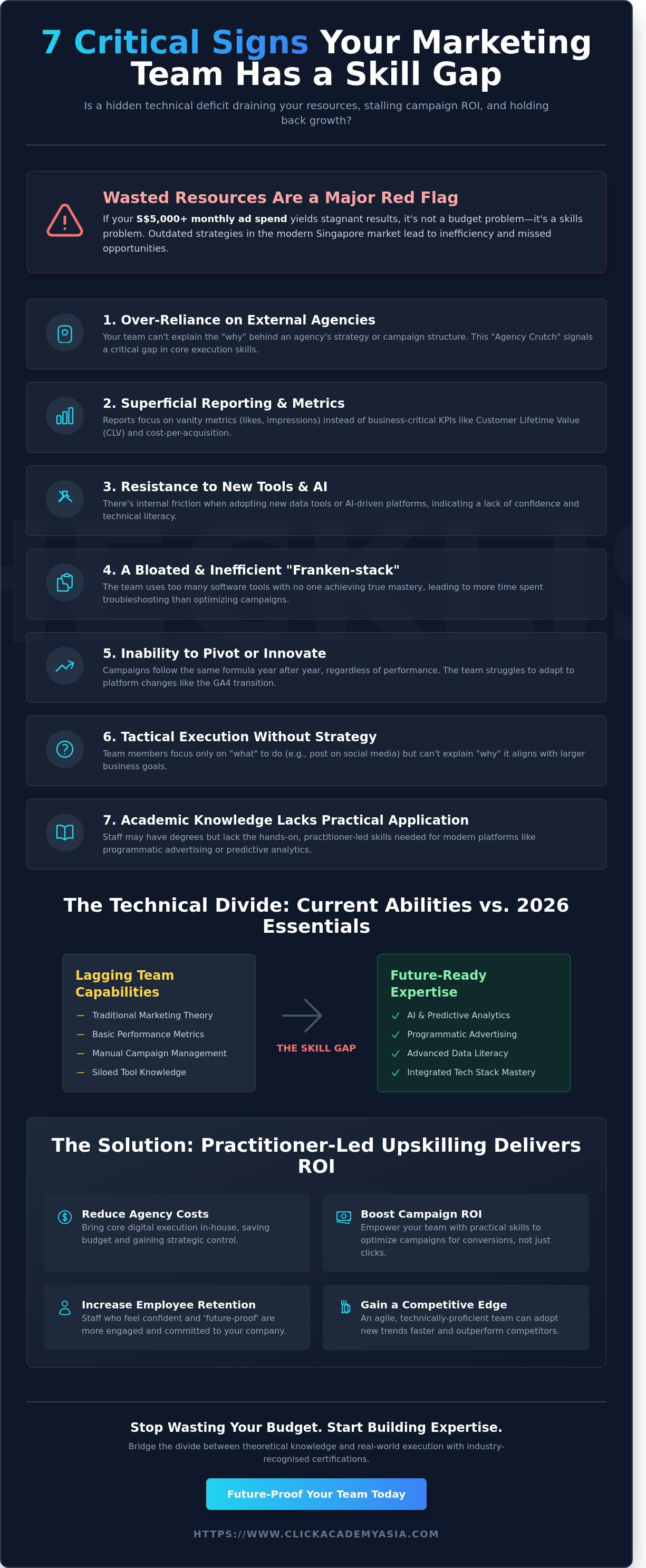
Identify the 7 critical signs your marketing team has a skill gap, including an over-reliance on external agencies and reporting that fails to track customer lifetime value.
Learn how to move beyond basic performance metrics by using a Skills Matrix to audit the actual technical competency of your workforce.
Discover why practitioner-led upskilling is a more cost-effective strategy for your S$ training budget than the high cost of hiring new "digital natives."
Future-proof your department by implementing industry-recognised certifications that bridge the divide between theoretical knowledge and real-world execution.
Table of Contents Defining the Marketing Skill Gap in a Post-AI Landscape The Skill Gap Checklist: 7 Warning Signs to Monitor Conducting a Technical Skills Audit: Beyond Performance Metrics Bridging the Gap: Why Practitioner-Led Training Beats Tactical Hiring Future-Proofing Your Workforce with Accredited Certification
Defining the Marketing Skill Gap in a Post-AI Landscape
A marketing skill gap isn't just a buzzword; it's the measurable distance between the technical demands of 2026 digital platforms and your team's current ability to execute. If your campaigns are underperforming despite a high workload, you're likely seeing one of the major signs your marketing team has a skill gap. This disparity often occurs because traditional marketing degrees haven't kept pace with practitioner-led essentials like programmatic advertising or predictive analytics. While a degree provides a foundation, it rarely prepares a team for the granular requirements of modern data-driven environments.
Understanding the theory behind these disparities is crucial for any leader looking to scale. When we look at Defining the Marketing Skill Gap, we see how knowledge and ability don't distribute evenly across a workforce, often leaving teams behind as technology accelerates. This "hidden" gap is expensive. In Singapore, businesses can lose up to 26% of their digital advertising budget through inefficient account management and missed conversion opportunities. Future-ready teams must bridge this by balancing creative intuition with technical precision.
To better understand how these gaps manifest in real-world scenarios, watch this helpful video:
Why Skill Gaps Appear Suddenly
Algorithms on platforms like Meta and Google Search change faster than most yearly marketing plans can accommodate. The mandatory transition from GA3 to GA4, for instance, required a level of data literacy that caught many teams off guard. Many local firms also suffer from a "Franken-stack," which is a collection of too many software tools with no one on staff who truly masters them. This tech bloat creates a massive barrier, as undertrained staff spend more time troubleshooting software than optimising campaigns. Recognising these signs your marketing team has a skill gap early can prevent long-term stagnation.
The ROI of Closing the Gap
Investing in your team's professional development delivers immediate financial returns for your organisation. You can significantly reduce your reliance on expensive third-party agencies for core digital execution, keeping more of your S$ budget in-house. When you empower your staff through practitioner-led training at ClickAcademy Asia, you also see a boost in employee retention. Staff who feel "future-proof" and confident in their roles are far more likely to stay committed to the company. They become agile enough to adopt emerging trends, such as AI-driven content creation, turning your marketing department into a high-performance engine.
The Skill Gap Checklist: 7 Warning Signs to Monitor
Identifying the signs your marketing team has a skill gap requires looking past the surface of daily tasks. It's about spotting where efficiency stalls and where strategic thinking is replaced by habit. Using a The Skill Gap Checklist can help leaders identify these blind spots before they impact the bottom line. When a team stops asking "why" and focuses solely on "what," the gap is already widening.
Signs 1-4: Strategic and Analytical Deficiencies
The "Agency Crutch" is a primary indicator of internal weakness. If your team cannot explain the logic behind an external agency's campaign structure or bidding strategy, they've become passive observers. They're project managing rather than leading the brand's digital direction. A competent team should be able to challenge an agency with data-driven insights, not just approve their invoices.
Reporting often reveals signs your marketing team has a skill gap when metrics remain surface-level. Are your monthly decks filled with "likes," "shares," and "impressions"? While these look good on a slide, they lack substance if the team cannot translate GA4 insights into conversion attribution. A skilled marketer analyses why a campaign failed to meet its targets and pivots the strategy accordingly, rather than simply moving to the next creative brief.
Tactical overload is another red flag for senior leadership. When managers spend 80% of their time on execution tasks like uploading posts or formatting emails, strategy is ignored. This imbalance usually suggests a lack of delegated expertise or a team that doesn't understand the omnichannel journey. They might be running multichannel silos where content is mirrored across platforms without any native optimisation for the Singapore market's unique user behaviours.
Signs 5-7: Technical and Execution Hurdles
Low tool adoption is a silent budget killer for many Singaporean firms. Your company might invest in expensive marketing automation software, but it's a wasted asset if the team only uses it for basic email blasts. This often stems from a lack of technical confidence. If staff avoid advanced features because they seem "too complex," your ROI on technology will continue to plummet.
AI and Technical Errors: Look for a struggle with AI prompting for SEO research or consistent errors in pixel tracking setup.
Feature Avoidance: Notice if the team ignores new features on LinkedIn or TikTok due to a "lack of time."
Stagnant Creative: Content is repeated across channels without adjusting for platform-specific formats.
Technical SEO and data privacy regulations change rapidly. If your team is still using outdated keyword stuffing methods or hasn't updated tracking protocols for a cookieless future, they are falling behind. These execution hurdles prevent your brand from reaching its full potential in a competitive digital space. If these signs feel familiar, it's time to upskill your team through practitioner-led training that bridges the gap between theory and results.
Conducting a Technical Skills Audit: Beyond Performance Metrics
Basic KPIs like click-through rates or lead volume only tell half the story. While these numbers show if a campaign is working, they don't reveal how efficiently your team is working to get those results. If your ROAS is high but your team takes three days to build a basic landing page, you are seeing one of the clearest signs your marketing team has a skill gap in technical execution.
To get a true picture of your team's health, you need a Skills Matrix. This is a visual tool where you map specific technical competencies against industry standards on a scale of one to five. You might list skills like programmatic bidding, SQL for data analysis, or omnichannel automation. By plotting your team's current abilities against these benchmarks, you can see exactly where your "single points of failure" exist, such as having only one person who knows how to set up server-side tracking.
Don't rely solely on your own observations. Use anonymous team self-assessments to uncover perceived versus actual gaps. Often, a team member might feel confident in "social media," but a technical audit reveals they only know organic posting and lack knowledge of Meta's Advanced Conversions API. To verify these self-reports, implement a Practical Test. Give your team a hypothetical campaign problem, like a sudden 20% drop in conversion rates on a Singapore-based e-commerce site, and ask them to diagnose the issue in real-time. This reveals their true troubleshooting logic and technical depth.
Setting Benchmarks with Global Standards
You cannot measure what you haven't defined. Use global benchmarks from the Digital Marketing Institute or Google to set the bar for what "competent" looks like in 2024. For a more localised and structured approach, align your team's capabilities with the WSQ Digital Marketing Strategy & Planning framework. This ensures your strategists aren't just "doing digital," but are operating at a level that meets Singapore's national standards for professional excellence. Compare your team's output to best-in-class regional examples to see if they are innovating or merely following outdated playbooks.
Interviewing Your Team for Insight
Sit down with your specialists and ask "How" and "Why" questions about their daily workflow. If a specialist can't explain why they chose a specific bidding strategy beyond "it's what we've always done," you've found a knowledge plateau. These conversations also help you distinguish between a lack of software access and a lack of software training. You might find that your team isn't using your S$15,000-a-year CRM to its full potential simply because they don't know how to build automated workflows. A technical audit is a neutral diagnostic tool for growth rather than a performance review.
Bridging the Gap: Why Practitioner-Led Training Beats Tactical Hiring
Many managers think hiring a fresh "digital native" is the quickest fix when they notice the signs your marketing team has a skill gap. It feels easier to hire someone who grew up with social media than to teach a seasoned strategist how to run a programmatic campaign. This is often a tactical error. Hiring is expensive and slow. In Singapore, the cost of replacing a mid-level professional can exceed S$30,000 when you factor in headhunter fees, lost productivity, and onboarding time.
Intensive bootcamps offer a "no fluff" alternative to the endless cycle of recruitment. While free YouTube tutorials provide surface-level tips, they lack the structured learning paths needed for professional mastery. A structured programme ensures your team doesn't just learn "how" to click buttons, but understands the "why" behind omnichannel strategy and conversion optimisation. Practitioner-led training provides direct access to experts who are currently managing million-dollar budgets, giving your team insights that aren't yet in any textbook.
The Cost-Benefit of Upskilling
Investing in your current team's growth is a powerful retention tool. It shows employees you value their career progression, which is vital in a competitive market like Singapore. You can also significantly lower your expenses by using government support. High-quality WSQ digital marketing courses are heavily subsidised through SSG frameworks. This means your business can access elite training for a fraction of the cost of a single new hire's monthly salary.
What to Look for in a Training Partner
Don't settle for purely theoretical lectures. Choose academies that prioritise hands-on workshops where staff build real campaigns. Look for partners that offer official Google or Meta certifications to ensure your team meets global standards. It's also essential to find instructors with regional expertise. The Singapore market has unique nuances in consumer behaviour and regulations that Western-centric courses often overlook. Identifying the signs your marketing team has a skill gap is only the first step; choosing the right mentor is what drives the transformation.
Ready to turn your current team into a powerhouse of digital expertise? You can modernise your marketing strategy with our industry-recognised certifications today.
Future-Proofing Your Workforce with Accredited Certification
By 2026, the marketing environment will demand more than just basic digital literacy. It requires a deep, strategic understanding of AI integration and data privacy. Identifying the signs your marketing team has a skill gap is the first step toward staying competitive. Ignoring these gaps leads to missed revenue and high staff turnover. ClickAcademy Asia serves as your mentor-led partner to bridge these divides through structured corporate transformation.
Investing in WSQ, SEO, and SEM certifications provides a dual benefit. For individual staff, it validates their expertise and builds a clear career path. For the organisation, it ensures a measurable return on investment. Teams trained in modern performance marketing can reduce cost-per-acquisition by up to 20% through better campaign optimisation. Leaders should act now by booking a comprehensive skills assessment to map out their team's future capabilities.
The ClickAcademy Asia Advantage
Our training goes beyond theory. We use a practitioner-led approach, meaning your team learns from experts who manage multi-million dollar budgets daily. This ensures every lesson is grounded in real-world application rather than outdated textbooks. We've designed our courses specifically for PMEBs and global organisations to ensure "future-ready" status in a volatile market.
Multinational teams benefit from our extensive regional coverage across Asia. Whether your staff is based in Singapore or across the region, we provide consistent, high-quality training standards. This regional presence makes us a vital partner for companies looking to synchronise their marketing skills across different borders and cultures.
Next Steps for Your Team
Don't let your marketing strategy stall due to outdated skills. You can review our range of WSQ Content Marketing Strategy and analytics modules to find the right fit for your current needs. These modules are specifically aligned with national standards to ensure your team gains recognised, high-value credentials that carry weight in the Singapore market.
If your requirements are more specific, contact our advisors to design a bespoke corporate training track. We'll help you identify which signs your marketing team has a skill gap are most critical to address first. This tailored approach ensures your training budget is spent on the skills that will move the needle for your business.
Empower your team with ClickAcademy Asia today and turn your marketing department into a powerhouse of digital innovation.
Turn Your Team’s Potential into Market Leadership
Ignoring the signs your marketing team has a skill gap doesn't just stall growth; it leaves your brand vulnerable in a landscape where AI and data privacy regulations change weekly. By 2026, the divide between teams that merely use tools and those that master strategy will define market winners in Singapore. Success requires moving beyond performance metrics to a culture of continuous, practical learning.
Auditing your technical capabilities is the first step, but the real transformation happens through practitioner-led training. Instead of tactical hiring that only solves today's problems, focus on building a resilient workforce equipped with global standards. This approach ensures your team doesn't just survive the next technological shift but actively leads the charge in the regional market.
As an official Google and Meta training partner, ClickAcademy Asia offers hands-on workshops designed for immediate real-world application. Our WSQ-certified courses are eligible for SSG subsidies, making it easier to upskill your talent while managing costs effectively. It's time to bridge the gap and empower your professionals to lead with confidence.
Identify and close your team’s skill gaps with ClickAcademy Asia and start building your future-proof marketing engine today.
Frequently Asked Questions
Is a marketing skill gap the same as a performance issue?
No, a marketing skill gap isn't the same as a performance issue. A skill gap occurs when a staff member lacks the specific technical knowledge required to execute a task, such as not knowing how to configure a server-side tracking pixel. Recognising the signs your marketing team has a skill gap is the first step toward building a more resilient department. A performance issue happens when someone has the necessary skills but fails to meet targets due to low motivation or poor internal processes.
How often should I conduct a skills audit for my marketing team?
You should conduct a formal skills audit every 12 months to ensure your team stays aligned with industry shifts. In a competitive market like Singapore, a bi-annual check is often more effective for catching emerging needs in areas like generative AI or data privacy. Regular audits help you identify the signs your marketing team has a skill gap before those deficiencies impact your quarterly revenue. This proactive habit keeps your strategy sharp and your talent ahead of the curve.
What are the most common digital marketing skill gaps in 2026?
In 2026, the most common gaps involve advanced AI prompt engineering and first-party data strategy. As traditional tracking methods disappear, many teams struggle to maintain accurate attribution without sophisticated analytical skills. Ethical automation and omnichannel orchestration are also high-demand areas where proficiency is currently low. Training your team in these specific disciplines will prevent the common bottlenecks that stall digital transformation projects.
Can online tutorials replace professional certification programs?
Online tutorials don't replace professional certification programmes because they usually lack structured assessment and global industry recognition. While a free video might show you how to use a specific software feature, a certification from a body like the Digital Marketing Institute provides a comprehensive strategic framework. These practitioner-led programmes ensure you master global standards rather than just learning isolated tactics. This formal recognition carries significantly more weight with regional employers and clients.
How do I convince my team that upskilling is a benefit, not a burden?
You can convince your team by framing upskilling as a way to increase their professional market value and reduce daily work stress. Explain that mastering new tools like AI automation will handle repetitive tasks, giving them more time for high-level creative strategy. When employees see training as an investment in their long-term career growth, they're more likely to engage. Highlight how these new skills lead to measurable project successes and greater professional confidence.
What is the role of AI in bridging current marketing skill gaps?
AI bridges skill gaps by acting as a sophisticated co-pilot that augments human creativity and analytical speed. It helps teams process large datasets or generate initial content drafts quickly, which compensates for technical shortcomings in those specific areas. However, AI requires human oversight to ensure brand consistency and ethical standards are maintained. Using AI effectively allows your team to focus on high-level strategic thinking rather than getting bogged down in manual execution.
Are there government subsidies available for professional marketing training?
Yes, you can access substantial funding through SkillsFuture Singapore (SSG) for many accredited professional programmes. Eligible Singapore Citizens and Permanent Residents often receive subsidies covering 70 percent or up to 90 percent of course fees for WSQ-aligned training. These grants make high-level professional development highly accessible for local businesses looking to transform their workforce. Always check the specific eligibility criteria on the official SSG portal to maximise your annual training budget.
What is the difference between academic degrees and practitioner-led certifications?
Academic degrees focus on foundational theory and critical thinking, while practitioner-led certifications prioritise immediate, real-world application. A degree might explain the psychological history of consumer behaviour, but a certification teaches you how to optimise a live conversion funnel using current tools. For professionals in Singapore, certifications offer a faster way to update skills as platform algorithms change. This practical focus ensures you can apply what you learn to your current campaigns immediately.


Comments