
Mastering Sales Performance Management: A Practitioner-Led Guide for 2026

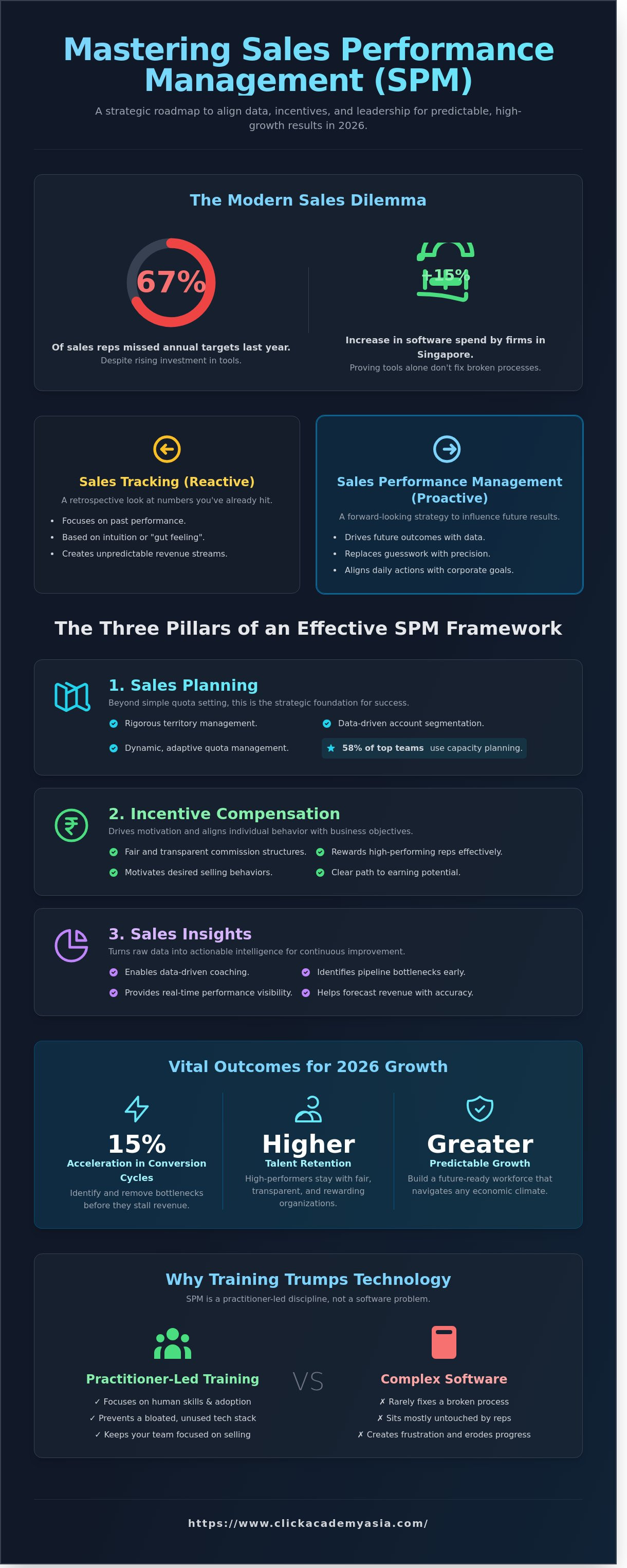
Did you know that 67% of sales representatives missed their annual targets last year, even as firms in Singapore increased their software spend by 15%? It is a sobering reality that throwing more tools at a team rarely fixes a broken process. You probably agree that managing a sales force often feels like a balancing act between demanding board-level results and keeping your best people from jumping ship. It is frustrating to watch high turnover rates erode your progress while your expensive tech stack sits mostly untouched by the reps who need it most.
This guide will show you how to master Sales Performance Management by aligning data-driven planning with supportive leadership to accelerate sales velocity and exceed your 2026 revenue targets. We promise to provide a clear roadmap for setting realistic quotas, improving team morale through transparent incentives, and finally getting a real return on your technology investments. You will discover how to transform inconsistent individual performances into a predictable, high-growth engine for your business.
Key Takeaways
Shift from reactive tracking to a forward-looking strategy that aligns your data with real-world sales outcomes.
Discover how to integrate sales planning, incentives, and insights into a unified ecosystem that drives consistent revenue growth.
Learn why prioritising practitioner-led training over complex software prevents a bloated tech stack and keeps your team focused on selling.
Master a practical, step-by-step roadmap to implement Sales Performance Management that accelerates sales velocity for the 2026 Singapore market.
Identify the specific leadership skills needed to bridge the gap between technical frameworks and high-performing sales teams.
Table of Contents What is Sales Performance Management (SPM)? The Three Pillars of an Effective SPM Framework Why Training Trumps Technology in Sales Performance Implementing SPM: A Step-by-Step Strategic Roadmap Elevate Your Sales Leadership with ClickAcademy Asia
What is Sales Performance Management (SPM)?
Think of Sales Performance Management as the operational engine that transforms your business goals into reality. It is a systematic approach to optimising sales results through data-driven planning, territory management, and continuous coaching. While many managers confuse this with simple sales tracking, the two are worlds apart. Tracking is a retrospective look at the numbers you have already hit, but SPM is a forward-looking strategy designed to influence the numbers you haven't reached yet. You can gain a deeper understanding of these foundational principles by exploring What is Sales Performance Management (SPM)? and its role in modern corporate structures.
The shift from intuition-based selling to analytical rigor is no longer optional for leaders looking toward 2026. Relying on a "gut feeling" about which leads will close or which reps are performing creates unpredictable revenue streams. By applying a structured Sales Performance Management framework, you replace guesswork with precision. The primary goal here is simple but powerful; you are aligning every individual rep's daily behaviour with your overarching corporate objectives to ensure total synchronisation across the board.
To better understand this concept, watch this helpful video:
The evolution of SPM in the Asian market
In Singapore and across Southeast Asia, the competitive landscape has intensified dramatically since 2023. Local firms are no longer just competing with the shop next door; they are up against global players with sophisticated tech stacks. Traditional sales management often fails in our digital-first economy because it lacks the agility to respond to real-time market shifts. Forward-thinking leaders in the region are now adopting global standards in sales leadership to maintain their edge. This shift ensures that local teams are not just working harder, but are working smarter by using practitioner-led insights that reflect the unique cultural and economic nuances of the Asian market.
Why SPM is vital for your 2026 growth
As we approach 2026, the cost of customer acquisition in Singapore continues to rise. Implementing a robust Sales Performance Management strategy helps reduce "sales friction" by identifying bottlenecks in your pipeline before they stall your revenue. A 2024 industry study showed that companies using advanced SPM tools saw a 15% acceleration in their conversion cycles. Beyond the numbers, SPM is a critical driver for talent retention. In a tight labour market, high-performing reps are more likely to stay with an organisation that provides clear quotas, fair compensation structures, and a transparent path to mastery. Sales Performance Management is the bridge between high-level strategy and daily sales activity.
By focusing on these analytical foundations, you empower your team to move beyond survival and into a state of consistent, predictable growth. This isn't just about hitting a target for the next quarter; it's about building a future-ready workforce that can navigate any economic climate with confidence and skill.
The Three Pillars of an Effective SPM Framework
Think of an effective Sales Performance Management framework as a three-legged stool. If one leg is shorter than the others, the entire structure wobbles. These pillars, Sales Planning, Incentive Compensation, and Sales Insights, must function as a unified ecosystem to drive consistent revenue. This isn't a "set and forget" software solution. It is a practitioner-led discipline that requires human expertise to calibrate and execute. When a single pillar fails, the sales organisation loses its momentum, leading to missed targets and high rep turnover.
Sales Planning: Beyond simple quota setting
Effective planning starts with rigorous territory management and account segmentation. You cannot simply assign leads alphabetically and expect results. In Singapore's competitive B2B market, 58% of high-performing teams use data-driven capacity planning to ensure they have the right number of reps covering the right market segments. Quota management must be a dynamic process. Instead of a static annual figure, it should adapt to market shifts and individual rep historical performance. This ensures targets remain challenging yet achievable, preventing the "sandbagging" culture that often plagues unoptimised teams.
Incentive Compensation: Motivating the right behaviours
Trust is the primary currency of a sales floor. Transparent commission structures are essential for maintaining this trust, as reps need to see a direct link between their effort and their bank balance. Modern Sales Performance Management has shifted away from rewarding raw volume alone. Instead, 64% of leading organisations now reward the "quality of sale" by aligning bonuses with long-term customer lifetime value (CLV). Implementing SPM: A Step-by-Step Strategic Roadmap involves ensuring these incentives align with both sales and HR goals to reduce churn. If your bonuses only trigger on the initial sign-up, you risk incentivising "bad fit" clients who drain resources and churn within six months.
Sales Insights: Using data to drive coaching
Data is useless if it doesn't lead to action. You must track key metrics like sales velocity, pipeline health, and win rates to identify where deals are stalling. A 2023 industry report found that teams using real-time insights see a 15% increase in quota attainment. These numbers help you identify individual training gaps quickly. For instance, if a rep has a high meeting rate but a low closing rate, the issue is likely negotiation skills rather than prospecting. While data provides the "what" regarding performance, leadership provides the "why" through targeted coaching. To truly master these nuances, consider upskilling your leadership team through practitioner-led training that bridges the gap between theory and execution.
Key Takeaways:
Sales Planning requires dynamic quota management and precise capacity planning to avoid market fatigue.
Incentive Compensation must prioritise "quality of sale" and CLV over simple volume to ensure long-term profitability.
Sales Insights serve as a diagnostic tool, allowing leaders to provide specific, data-backed coaching to individual reps.
Why Training Trumps Technology in Sales Performance
Many sales directors in Singapore fall into the "software trap." They invest upwards of S$15,000 per year on high-end Sales Performance Management platforms, expecting the dashboard to magically fix declining margins. Technology is a multiplier, not a foundation. If your underlying sales process is flawed, a new tool only helps you fail faster and at a higher cost. Success requires a shift in focus from the interface to the individual.
The "bloated tech stack" has become a genuine productivity killer in modern sales offices. Research indicates that the average sales representative spends less than 36% of their week actually selling to prospects. The remaining 64% is often swallowed by manual data entry and navigating complex software that was ironically designed to save time. When your team spends four hours a day updating CRM fields instead of closing deals, your technology has become a barrier to revenue.
A tool is only as effective as the practitioner who operates it. Think of it like a professional chef versus a novice. Giving a beginner a S$500 Japanese steel knife won't result in a Michelin-star meal; it requires years of technique and skill. Similarly, your Sales Performance Management strategy must prioritise the "how" over the "what." Leaders need specific training to interpret data correctly. They must learn to look past the raw numbers to identify the behavioural patterns that drive or derail a deal.
Effective Performance Management Principles suggest that monitoring is only one part of the cycle. You also need to plan, develop, and reward. Singaporean sales leaders must be trained to act as strategic coaches. They need to know how to use data to have difficult conversations and how to turn a red KPI into a development opportunity. Without this human intervention, the data is just noise on a screen.
The human element of SPM
High-performance teams aren't built on algorithms; they are built on emotional intelligence and trust. An automated notification telling a rep they're 15% below quota isn't coaching. It's just a reminder of failure. True growth happens when a mentor-led session addresses the specific psychological or tactical roadblocks a rep faces. Practitioner-led training is the missing link that transforms a cold data point into a breakthrough moment for a salesperson.
Upskilling for the 2026 sales landscape
By 2026, AI will likely handle most routine lead qualification and administrative logging. This shift makes human soft skills like complex negotiation and empathy more valuable than ever before. Establishing a continuous learning culture ensures your team stays ahead of regional competitors in a volatile market. Investing in professional training is the highest ROI move a company can make. It often yields a 400% return on every S$1 spent through increased win rates and significantly reduced staff turnover.
Key Takeaway:
Technology provides the map, but training provides the engine. Ensure your investment in people matches or exceeds your investment in software to see a real impact on your bottom line.
Implementing SPM: A Step-by-Step Strategic Roadmap
Setting up a Sales Performance Management framework isn't about buying a shiny piece of software and hoping for the best. It's about building a bridge between your financial targets and the daily actions of your sales team. In the first 90 days, you can realistically aim to reduce commission disputes by 30% and improve forecast accuracy by 15% through better data visibility. This roadmap focuses on practical execution rather than high-level theory.
Phase 1: Audit and Alignment
Step 1: Analyse your current sales data and identify performance bottlenecks. Don't guess where the leaks are; use your CRM to find them. If your average deal cycle in Singapore has stretched from 45 to 60 days over the last year, you need to know why. Look for "dead zones" where leads stall for more than 10 days without contact. This audit provides the baseline you need to measure future success.
Step 2: Align sales territories and quotas with realistic 2026 market forecasts. Many Singaporean firms still use 2022 data to set 2025 targets, which is a recipe for demotivation. Research from the Ministry of Trade and Industry (MTI) suggests specific growth sectors; align your territories to these high-potential areas. Ensure your Finance department signs off on these numbers to prevent mid-year budget friction.
Step 3: Review your incentive plans to ensure they drive strategic outcomes. If your goal is recurring revenue but your bonus structure only rewards the initial "land," your team will ignore "expand" opportunities. A well-structured plan should balance short-term wins with long-term account health. Aim for a "no-surprises" model where a rep can calculate their commission in under 60 seconds.
Phase 2: Execution and Upskilling
Step 4: Roll out Sales Performance Management tools but prioritise user adoption. Technology only works if the people on the ground actually use it. Instead of a mandatory four-hour lecture, run short, practitioner-led "lunch and learn" sessions. Focus on how the tool saves them time, such as automating the S$2,000 monthly expense claim process or providing real-time leaderboard updates.
Step 5: Implement a regular cadence for sales coaching based on SPM insights. Move away from generic "how's the pipeline?" meetings. Use the data to have surgical conversations. If the Sales Performance Management dashboard shows a rep is great at prospecting but fails at the closing stage, your coaching should focus specifically on negotiation tactics and final-stage objection handling.
Step 6: Continuously optimise the process based on practitioner feedback. Your sales reps are your eyes and ears in the Singapore market. Every quarter, hold a feedback loop session where reps can flag processes that feel like "red tape." If a specific reporting requirement takes three hours but adds zero value to the closing process, scrap it immediately to keep the team agile.
Quick Wins for the First 90 Days:
Standardise the sales stage definitions across Marketing and Sales to reduce lead rejection by 20%.
Automate commission tracking to save each manager approximately 5 hours of admin work per month.
Identify the top 10% of performers and document their "secret sauce" to create a training baseline for new hires.
Ready to lead your team toward measurable growth and master the latest digital sales strategies? Explore our practitioner-led certification courses to future-proof your career and drive real-world results in the Singapore market.
Elevate Your Sales Leadership with ClickAcademy Asia
Mastering Sales Performance Management requires more than just a dashboard; it demands a leadership mindset that can turn metrics into motivation. While many companies invest in expensive software, a 2023 industry report showed that 58% of sales leaders feel they lack the formal training to coach their teams effectively. ClickAcademy Asia addresses this gap by providing high-level educational programmes that transform managers into strategic mentors. Our curriculum doesn't just skim the surface of sales tactics. We provide a structured roadmap to help you optimise every stage of your sales cycle and drive sustainable revenue growth.
Our Sales Leadership and Sales Training modules are specifically tailored for Singapore-based PMEBs who need to stay competitive in a digital-first economy. By integrating WSQ-certified frameworks, we ensure that your learning is recognised by industry standards across the region. These courses empower you to build a resilient sales culture where performance is measured by more than just the final invoice. You'll learn how to align individual incentives with overarching corporate goals, ensuring your Sales Performance Management strategy is both fair and highly effective.
Why choose a practitioner-led approach?
There's a vast difference between academic theory and the battle-tested insights of ClickAcademy Asia mentors. Our trainers aren't career academics; they're seasoned professionals who've led regional teams for global tech giants and local unicorns alike. This means you won't spend your time on outdated case studies. Instead, you'll engage with real-world scenarios that reflect the current challenges of the Singaporean and wider Asian markets.
Learning alongside a cohort of regional professionals adds another layer of value to your experience. You'll share insights with peers from diverse industries, from fintech to manufacturing, fostering a network that extends far beyond the classroom. Since 2011, ClickAcademy Asia has empowered over 10,000 professionals to become future-ready. This track record of excellence ensures that when you train with us, you're gaining skills that are immediately applicable to your daily operations.
Take the next step in your sales career
The path to sales excellence is a continuous journey of refinement and education. We invite you to explore our specific certification pathways, designed to take you from foundational knowledge to expert-level mastery. Whether you're looking to refine your negotiation skills or overhaul your entire sales operations framework, we have a module that fits your professional goals.
For Singaporeans and Permanent Residents, the financial barrier to world-class education is significantly lowered through SSG support. Many of our WSQ-certified modules qualify for up to 70% funding, making it a cost-effective investment in your future. For instance, a course valued at S$1,000 could cost as little as S$300 before GST for eligible participants. This support reflects Singapore's commitment to upskilling its workforce, and we're proud to be a partner in that mission.
Don't let your team's potential go untapped because of a lack of structured guidance. Transformation begins with the decision to lead with clarity and expertise. Take control of your professional trajectory and start building a high-performance culture that delivers results year after year.
Transform your sales team with ClickAcademy Asia’s expert training
Future-Proof Your Sales Strategy for 2026
Mastering Sales Performance Management requires more than just a shiny new CRM. It's about balancing your strategic pillars with a team that's actually trained to use them. By 2026, the gap between high-performing teams and the rest will be defined by those who prioritise practitioner-led insights over automated shortcuts. You've seen the roadmap; now it's time to execute with precision.
Don't let your growth stall because of outdated frameworks. Whether you're looking to optimise your incentive structures or refine your data analytics, practical expertise is your greatest asset. At ClickAcademy Asia, we've empowered professionals across 30+ countries to lead with confidence. Our WSQ-certified courses are designed by industry veterans and offer SSG funding support for eligible learners in Singapore, making world-class education accessible and affordable.
Ready to transform your sales trajectory? Master Sales Leadership with ClickAcademy Asia and start building a high-impact team that delivers consistent results. We're here to help you turn these strategies into tangible success.
Frequently Asked Questions
What is the difference between Sales Performance Management and Sales Management?
Sales Management focuses on the daily tactical oversight of people and activities, while Sales Performance Management is a strategic, data-led approach to optimising the entire sales ecosystem. While a manager might focus on individual coaching and hiring, SPM handles the heavy lifting of incentive compensation, territory design, and quota planning. It is the difference between managing a team and building a scalable, automated engine for revenue growth.
How much does it cost to implement a Sales Performance Management framework?
A standard implementation for a mid-market Singaporean company usually ranges from S$20,000 to S$65,000. This figure covers the initial software configuration, data migration from legacy systems, and practitioner-led team training sessions. You should also budget for monthly subscription fees, which typically start around S$130 per user for professional-grade platforms. Investing in Sales Performance Management early prevents the 3% to 5% revenue leakage often caused by manual calculation errors.
Can small businesses benefit from SPM, or is it only for global companies?
Small businesses gain a massive advantage from SPM by automating commission tracking, which is prone to human error in 15% of manual spreadsheets. You do not need a global footprint to see the value in accurate payouts and clear performance visibility. Starting early with these frameworks allows a 10-person startup to scale to 50 people without the typical growing pains of misaligned sales targets or disputed incentives.
How does SPM software integrate with existing CRM systems like Salesforce?
Most modern SPM tools use pre-built connectors to sync with Salesforce in under 60 minutes via secure API links. This connection allows the system to pull closed-won opportunities directly into your commission engine without any manual intervention. It creates a single source of truth that gives your reps 100% visibility into their earnings directly within their CRM dashboard, which significantly boosts daily productivity.
What are the most important KPIs to track in Sales Performance Management?
The three pillars you must track are Quota Attainment, Commission Expense as a Percentage of Revenue, and Sales Cycle Length. High-performing organisations also monitor the Ramp-up Time for new hires, aiming to reduce this by 25% through better Sales Performance Management. Tracking these specific data points ensures your team's efforts align with your company's financial objectives and identifies coaching gaps before they impact the bottom line.
How often should sales quotas be reviewed and adjusted?
You should conduct a formal review of sales quotas every quarter to stay aligned with the fast-moving Singaporean economy. Waiting until the end of the year is a mistake, as 62% of market leaders now adjust targets mid-cycle to reflect real-world volatility and shifting consumer demand. Regular adjustments ensure that your targets remain challenging yet achievable, preventing your top talent from feeling discouraged by outdated or impossible goals.
Is there government funding available for sales training in Singapore?
Singapore provides robust support through SSG and WSG, offering subsidies that often cover 50% to 70% of course fees for eligible companies and individuals. Local businesses can also apply for the Productivity Solutions Grant (PSG) or the Enterprise Development Grant (EDG) to offset the costs of adopting Sales Performance Management technology. These initiatives are designed to help you transform your workforce and maintain a competitive edge in the regional market.
What is the role of AI in Sales Performance Management for 2026?
By 2026, AI will move from simple data analysis to predictive territory modelling that anticipates market shifts six months in advance. You will see AI assistants providing real-time coaching nudges to reps, suggesting the exact actions needed to hit monthly targets based on historical success patterns. This technology will automate 40% of current administrative tasks, leaving your sales leaders free to focus on high-value relationship building and strategic growth.



Comments