
Mastering Sales Channels Fundamentals: A Professional Guide for 2026
- ClickAcademy Asia

- Apr 22
- 13 min read
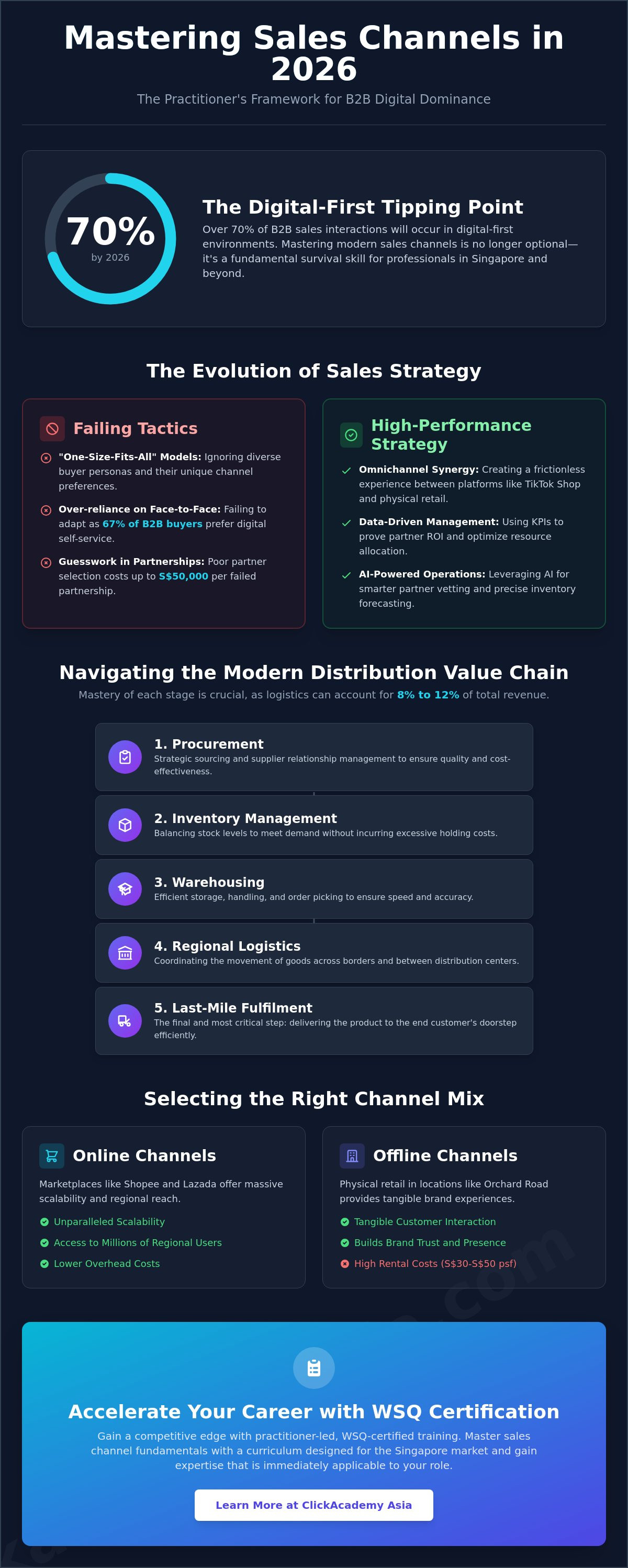
By 2026, over 70% of B2B sales interactions will occur in digital-first environments, making Mastering Sales Channels Fundamentals a survival skill rather than an optional extra. You likely feel the weight of inefficient partners who consume more time than they generate in revenue. It’s frustrating when product launches stall because platforms aren't synced or when you can't clearly prove partner ROI with hard data. You aren't alone in feeling behind on AI-driven sales tools that seem to change every week.
This guide will show you that high-performance channel management isn't about working harder; it's about applying a practitioner-led framework to select the right partners and leverage modern automation. You'll gain the clarity needed to manage complex networks without the constant guesswork. We’ll explore how to build data-driven performance reports and align your strategy with WSQ standards to ensure your professional expertise is recognised in the Singapore market. From selecting the right platforms to measuring every S$ of spend, we’ve mapped out the path to channel excellence.
Key Takeaways
Understand why omnichannel distribution is the non-negotiable standard for 2026 and how to align your partner synergy for maximum impact.
Navigate the modern distribution value chain by applying a rigorous criteria list to select the most effective online and offline partners.
Pinpoint the KPIs that actually drive growth and learn to interpret data to uncover hidden trends within your partner relationships.
Future-proof your operations by integrating AI tools for smarter partner vetting and precise inventory forecasting.
Gain a competitive edge by Mastering Sales Channels Fundamentals through practitioner-led, WSQ-certified training designed for the Singapore market.
Table of Contents The Strategic Importance of Mastering Sales Channels Fundamentals in 2026 The Distribution Value Chain: Selecting the Right Modes and Partners Performance Metrics: How to Analyse and Optimise Partner Relationships Future-Proofing Sales: Integrating AI and Omnichannel Strategies Accelerate Your Career with WSQ-Certified Sales Training
The Strategic Importance of Mastering Sales Channels Fundamentals in 2026
Sales is no longer just about closing a single deal; it's about building a robust, resilient architecture for your product. Mastering Sales Channels Fundamentals involves understanding how your offerings move through the distribution value chain while maintaining perfect synergy with every partner. In 2026, Singaporean businesses cannot afford to treat distribution as an afterthought or a series of isolated transactions.
Omnichannel has evolved from a trendy buzzword into the mandatory standard for survival. Customers now expect a frictionless transition between a physical retail presence in Funan and a digital storefront on TikTok Shop or Lazada. Professionals must pivot from transactional selling to managing complex, relationship-driven networks. This shift ensures that every touchpoint adds value rather than just acting as a middleman.
To better understand how these channels fit into the broader sales journey, watch this helpful video:
Adopting professional frameworks is the most effective way to reduce channel conflict and boost your ROI. When you have a clear strategy, you can identify friction points between direct and indirect sales teams before they damage your bottom line. This analytical approach allows you to allocate resources to the most profitable partners while maintaining a consistent brand voice across the entire network.
Why Traditional Sales Tactics are Failing
The "one-size-fits-all" distribution model has collapsed under the weight of the digital age. Recent data suggests that 67% of B2B buyers now prefer digital self-service or remote interactions over traditional face-to-face meetings. Relying on outdated methods leads to poor partner selection, which can cost a company up to S$50,000 in lost productivity and brand damage per failed partnership. Professionals need a data-driven approach to survive the market volatility that defines the current Singaporean landscape.
The Role of WSQ Certification in Professional Growth
For PMEBs in Singapore, individual growth is tied to industry-recognised standards like the WSQ framework. Mastering Sales Channels Fundamentals through a certified programme prepares you for high-level leadership roles by validating your expertise. It's vital to choose practitioner-led training at ClickAcademy Asia rather than purely theoretical study. Learning from experts who have managed real-world distribution networks ensures you gain practical insights that you can apply to your role immediately. This focus on practical mastery helps you navigate the complexities of the regional market with confidence.
The Distribution Value Chain: Selecting the Right Modes and Partners
Singapore's digital economy contributed approximately 17.3% to the nation's GDP in 2022, a figure that continues to climb as businesses move towards sophisticated omnichannel models. To navigate this, you must dissect your distribution value chain into five critical components: procurement, inventory management, warehousing, regional logistics, and last-mile fulfilment. Mastering Sales Channels Fundamentals involves identifying where value is added and where friction occurs in this journey, especially when logistics costs in the region can account for 8% to 12% of total revenue.
Aligning your channel selection with specific buyer personas is non-negotiable. For instance, a tech-savvy Gen Z consumer in Singapore expects the speed of a 2-hour delivery window, whereas a B2B procurement officer prioritises bulk discount structures and reliability. Your choice of partners must reflect these specific demands to ensure your brand promise remains intact from the warehouse to the doorstep.
Evaluating Online vs. Offline Channels
Digital marketplaces like Shopee and Lazada offer unparalleled scalability, allowing you to reach millions of regional users without the S$30 to S$50 per square foot rental costs associated with prime Orchard Road retail space. However, physical retail provides the tactile brand experiences that often lead to a 20% higher customer lifetime value. Balancing a hybrid model allows you to capture the high-intent browser online while satisfying the "see-it-now, buy-it-now" impulse of the physical shopper. Use this checklist to assess the technical readiness of any online partner:
API Integration: Does the platform support real-time inventory synchronisation?
Data Transparency: Will you have direct access to customer purchase behaviour and analytics?
Payment Versatility: Can they process local favourites like PayNow, GrabPay, and ShopBack PayLater?
Fulfilment Speed: Do they offer integrated 3PL services that meet a 24-48 hour delivery standard?
Creating High-Impact Partner Engagement Plans
A successful partner engagement plan moves beyond a simple contract; it establishes a framework for shared growth. You must define essential elements such as clear communication protocols, joint marketing funds, and performance standards. Setting realistic expectations, such as a 98% on-time delivery rate or a 5% maximum return rate, fosters long-term loyalty by removing ambiguity. By adopting a Mastering Sales Channels Fundamentals mindset, you can transform a standard vendor relationship into a high-performance partnership.
Partner synergy is the intentional alignment of strategic goals and operational resources to ensure both parties achieve greater results together than they could alone. To accelerate your team's ability to manage these complex relationships, consider how practitioner-led training can provide the tactical skills needed for modern channel management. High-impact plans should always culminate in regular quarterly business reviews to pivot strategies based on real-time market data and partner feedback.
Performance Metrics: How to Analyse and Optimise Partner Relationships
Numbers don't lie, but they often hide the truth if you aren't looking at the right ones. In 2026, simply tracking top-line sales is a recipe for stagnation. To stay ahead in Singapore's competitive trade environment, Mastering Sales Channels Fundamentals requires a shift from reactive monitoring to proactive optimisation. You need to identify which partners are truly driving growth and which are merely taking up space in your CRM.
The KPI Dashboard for Channel Managers
Your dashboard should focus on three pillars: Partner-Led Revenue (PLR), Customer Acquisition Cost (CAC), and partner churn rate. In Singapore, where operational costs remain high, keeping your CAC low through efficient partnerships is vital. Aim for a CAC that is at least 30% lower than your direct sales cost to justify the channel investment. Use real-time analytical tools to track the distribution value chain, ensuring you see exactly where stock is moving or where digital conversions are stalling.
Partner-Led Revenue: Track the percentage of total sales initiated by partners versus those closed by your internal team.
Churn Rate: Monitor how many partners stop engaging or producing within a six-month window.
Qualitative Feedback: Don't ignore the "why" behind the "what." Regular catch-ups with your top 10% of partners can reveal market shifts that data might miss.
When you spot an underperformer, avoid the impulse to cut ties immediately. Instead, use a structured "rehabilitation" period. Offer targeted training or temporary incentive boosts to see if the issue is a lack of skill or a lack of motivation. If performance doesn't improve within 90 days, it's time to part ways professionally to protect your broader network's health.
Reporting Insights for Executive Leadership
The C-suite doesn't want a data dump; they want a narrative that leads to a decision. When you present your monthly channel performance report, lead with the impact on the bottom line. Translate raw numbers into actionable insights. For example, instead of saying "web traffic is up," explain how a specific partner's SEO efforts led to a S$50,000 increase in qualified leads this month.
Structure your report with a clear executive summary followed by a breakdown of channel health and future projections. Transparency is your greatest asset here. If a particular strategy failed, explain why and what the pivot looks like. This level of honesty builds the trust necessary to secure larger budgets for your next phase of Mastering Sales Channels Fundamentals. Focus on long-term value and regional leadership to align with the strategic goals of most Singapore-based firms.
Pro Tip: Use standardised reporting templates to ensure consistency. This allows leadership to compare month-on-month performance without needing to relearn your data visualisations every time.
Future-Proofing Sales: Integrating AI and Omnichannel Strategies
The 2026 sales landscape demands more than just a list of distributors; it requires a tech-driven approach to scale effectively without losing the personal touch. AI isn't here to replace your sales team, but to act as a force multiplier. By Mastering Sales Channels Fundamentals, you can leverage machine learning to identify which partners are actually delivering value and which are simply taking up inventory space.
We define AI-Augmented Sales as the use of data to enhance human intuition. This means using algorithms to handle the heavy lifting of data crunching while your team focuses on high-level strategy. For example, AI tools can now perform automated due diligence on potential partners in Singapore by scanning financial records and market sentiment in seconds. This ensures you only partner with entities that align with your brand's growth trajectory.
Dynamic Channel Optimisation takes this a step further. It uses machine learning to reallocate resources between channels in real-time. If your e-commerce platform sees a 20% spike in demand while a physical distributor in Orchard Road lags, the system suggests immediate stock transfers. It's about being agile enough to follow the money as it moves across the omnichannel ecosystem.
Streamlining Workflows with AI Tools
Automation is the key to maintaining sanity while managing multiple channels. You don't need to manually email every partner for monthly reports anymore. Modern CRM integrations can automate these routine communications, ensuring your data is always current. Predictive analytics also play a massive role in inventory forecasting; tools can now predict stockouts 14 days in advance with 90% accuracy based on historical trends and local events like the Great Singapore Sale.
Partner Vetting: Use AI to score potential distributors based on past performance and creditworthiness.
Inventory Forecasting: Implement predictive models to prevent overstocking and reduce warehouse costs.
Automated Reporting: Set up triggers that alert you when a channel's performance dips below a specific KPI.
Coordinating Modern Product and Service Launches
A successful launch in 2026 requires perfect synchronisation across every touchpoint. When you're Mastering Sales Channels Fundamentals, your launch plan must be airtight to prevent channel conflict. Consistency is your greatest asset here; if your pricing or messaging varies wildly between your website and a third-party retailer, you'll lose consumer trust instantly. You can learn how SEO supports your digital strategy to ensure your brand remains visible during these critical periods.
Follow this step-by-step guide for a multi-channel launch:
Centralise Assets: Use a digital asset management tool so all partners access the same approved imagery and copy.
Set Tiered Pricing: Establish clear Minimum Advertised Price (MAP) guidelines to prevent a race to the bottom.
Sync Launch Times: Use automated scheduling to ensure all digital storefronts go live simultaneously.
Monitor Feedback: Use social listening AI to track customer sentiment across all channels during the first 48 hours.
Don't fall for the myth that AI makes human relationships redundant. In fact, the more automated the world becomes, the more valuable a trusted partnership becomes. AI gives you the data, but your ability to negotiate and build rapport is what closes the deal. It's about using the machine to find the opportunity and the human to seal it.
Ready to elevate your distribution strategy for the digital age? Master the latest sales technologies with ClickAcademy Asia today.
Accelerate Your Career with WSQ-Certified Sales Training
The 2026 commercial landscape demands a sophisticated approach to distribution that most traditional models simply cannot support. Success now hinges on your ability to integrate digital touchpoints with physical logistics seamlessly. Mastering Sales Channels Fundamentals is no longer an optional skill for marketing managers or business owners; it's the baseline for professional relevance in Singapore's competitive economy. At ClickAcademy Asia, we bridge the gap between academic theory and the high-stakes reality of modern commerce.
Our practitioner-led approach ensures that every lesson is grounded in current market conditions. We focus on delivering actionable insights that you can implement the very next day at the office. By focusing on practical application, we help you avoid the common pitfalls of channel conflict and inventory mismanagement that plague many growing businesses.
Why Choose ClickAcademy Asia?
We bring a 15-year history of empowering over 30,000 professionals across Asia to the classroom. Our curriculum is built on a "no fluff" philosophy, meaning we cut out the corporate jargon to focus on strategies that drive conversion and efficiency. Every trainer is an active industry expert who understands how to navigate the specific regulatory and consumer nuances of the Singapore market.
Practical Frameworks: Move beyond definitions to build robust channel strategies using our proprietary templates.
Industry Recognition: Earn WSQ certifications that are highly valued by employers and government bodies alike.
Regional Expertise: Benefit from a curriculum designed for the unique digital ecosystem of Southeast Asia.
If you're looking to broaden your expertise beyond sales, explore our full range of WSQ training programmes to find the perfect match for your career trajectory.
Maximising Your Training Grant Opportunities
Professional development in Singapore is supported by significant financial incentives that make high-level training accessible. Singapore Citizens and Permanent Residents can access SSG funding to offset a substantial portion of their course fees. For those aged 40 and above, the Mid-Career Enhanced Subsidy (MCES) provides even deeper support, often covering up to 90% of the costs for eligible programmes.
Companies also benefit from these initiatives. SME-sponsored employees qualify for enhanced funding levels, while non-SME firms can still tap into standard baseline subsidies. Additionally, you can utilise your personal SkillsFuture Credit to cover any remaining out-of-pocket expenses, potentially reducing your upfront cash outlay to zero. It's a strategic investment in your human capital that pays immediate dividends.
Take the next step in your professional journey today. Visit the MySkillsFuture portal to check your remaining credit balance and prepare for our upcoming intake. Secure your spot in our next cohort and start Mastering Sales Channels Fundamentals to future-proof your career. Don't just manage your channels; master them.
Future-Proof Your Distribution Strategy Today
Success in the 2026 landscape requires more than just a list of distributors. It demands a sophisticated blend of AI-driven insights and a seamless omnichannel approach. By focusing on high-performing partner relationships and precise performance metrics, you'll transform your sales strategy from a cost centre into a growth engine. This shift isn't just about survival; it's about leading the market through superior efficiency and smarter partnerships.
Mastering Sales Channels Fundamentals is the key to navigating these complexities with confidence. You'll move beyond theory to apply practical, real-world frameworks that work in the local Singapore context. Whether you're refining your value chain or integrating new digital touchpoints, the right training bridges the gap between current operations and future market demands.
Our practitioner-led training offers an official WSQ-certified curriculum designed for immediate impact. Eligible professionals can also benefit from up to 70% SSG funding, making this professional upgrade both accessible and essential for your career trajectory. Secure your seat for the next Mastering Sales Channels Fundamentals intake here and start leading your team toward measurable success. We're ready to help you reach that next milestone in your career.
Frequently Asked Questions
What are the core fundamentals of sales channel management?
The core fundamentals of sales channel management involve three pillars: channel design, partner selection, and ongoing conflict management. You've got to map your customer journey to ensure your product reaches the end-user efficiently. Effective management requires clear communication protocols and incentive structures that align your partners' goals with your own business objectives. Focusing on these areas ensures your distribution network remains robust and profitable over the long term.
How do I choose between direct and indirect sales channels in 2026?
Choosing between direct and indirect sales channels in 2026 requires a data-driven hybrid approach. Direct channels offer 100% control over the customer experience and higher margins, while indirect channels provide rapid scalability across new markets. You should evaluate your product complexity; if it requires heavy technical support, direct is often better. For mass-market reach, third-party distributors remain essential for achieving rapid growth in the Singapore market.
Is the Mastering Sales Channels Fundamentals course eligible for SSG funding?
Yes, the Mastering Sales Channels Fundamentals course is eligible for SSG funding for Singapore Citizens and Permanent Residents. Eligible individuals can receive up to 70% in course fee subsidies under the current SkillsFuture Singapore framework. This financial support makes professional development more accessible for SMEs and individual professionals. It's an excellent way to upskill without a heavy financial burden on your personal savings.
What are the prerequisites for attending WSQ sales training at ClickAcademy Asia?
There aren't any strict academic prerequisites for our WSQ sales training, though we recommend a basic command of English and some professional experience. Most learners come from sales, marketing, or business development backgrounds with at least 1 to 2 years of industry exposure. This ensures you can apply the practitioner-led insights directly to your current workplace challenges. It's all about practical application rather than just theory.
How does AI impact modern sales channel strategy?
AI transforms modern sales channel strategy by automating partner performance tracking and predicting inventory needs with high accuracy. It allows managers to identify underperforming channels before revenue drops significantly. By using AI-driven CRM tools, you can personalise partner support at scale. This ensures every distributor has the right marketing collateral at the right time, which can boost channel productivity by 25% or more.
Can I use my SkillsFuture Credit for this sales course?
You can definitely use your SkillsFuture Credit to offset the remaining out-of-pocket fees for this sales course. This applies to both the initial S$500 credit and the additional top-ups provided to Singaporeans aged 40 and above. It's a practical way to invest in your career growth while minimising your personal cash expenditure. Just log in to the SkillsFuture portal to submit your claim before the course starts.
What career roles benefit most from mastering sales channels?
Career roles such as Channel Managers, Business Development Leads, and Key Account Managers benefit most from Mastering Sales Channels Fundamentals. Professionals in these positions often see a 20% increase in channel efficiency after implementing structured management frameworks. Marketing managers also find value here as they learn to align promotional campaigns with diverse distribution networks. It's a vital skill for anyone driving regional growth in Asia.
How do you measure the success of a channel partner relationship?
Measuring the success of a channel partner relationship requires tracking specific KPIs like partner-led revenue growth and lead conversion rates. You should also monitor the partner churn rate and the average time it takes to onboard a new distributor. A healthy relationship typically shows a steady 10% to 15% year-on-year growth in sales volume. Consistent communication and shared data are the hallmarks of these successful partnerships.



Comments