
Corporate Sales Training for Technology Companies: The 2026 Buyer’s Guide

What if your sales team's deep technical knowledge is actually the very thing stalling your most promising deals? It's a common paradox in Singapore's tech sector where brilliant engineers-turned-sellers often lead with specifications rather than business outcomes. This approach frequently results in enterprise sales cycles that stretch well beyond 12 months. You likely agree that while your solution is cutting-edge, your team often finds it difficult to articulate that value to the diverse group of non-technical stakeholders who now control the budget.
This guide provides a clear framework for evaluating corporate sales training for technology companies that prepares your staff for the AI-driven demands of 2026. You'll learn how to transform your team into consultative partners who can shorten deal cycles and increase win rates by focusing on strategic impact rather than just features. We'll also examine how to leverage practitioner-led insights and maximise your use of SSG grants to ensure your professional development investment delivers a measurable return for your organisation.
Key Takeaways
Pivot from product-led pitches to solution-oriented selling to cut through stakeholder fatigue and information overload in the 2026 tech market.
Identify the non-negotiable criteria for a training provider, prioritising industry-specific practitioners over general sales coaches to ensure technical relevance.
Secure a competitive edge by implementing corporate sales training for technology companies that leverages SkillsFuture funding and aligns with your unique sales cycle.
Master the essential consultative competencies required to move beyond "feature-dumping" and become a trusted advisor in the enterprise space.
Discover how a practitioner-led approach ensures your team applies real-world expertise to navigate the specific complexities of the Singapore technology ecosystem.
Table of Contents The Evolution of B2B Tech Sales in 2026 Key Competencies for Modern Technology Sales Teams Choosing the Right Training Partner: A Decision Framework Strategic Implementation and SkillsFuture Funding ClickAcademy Asia: Practitioner-Led Tech Sales Mastery
The Evolution of B2B Tech Sales in 2026
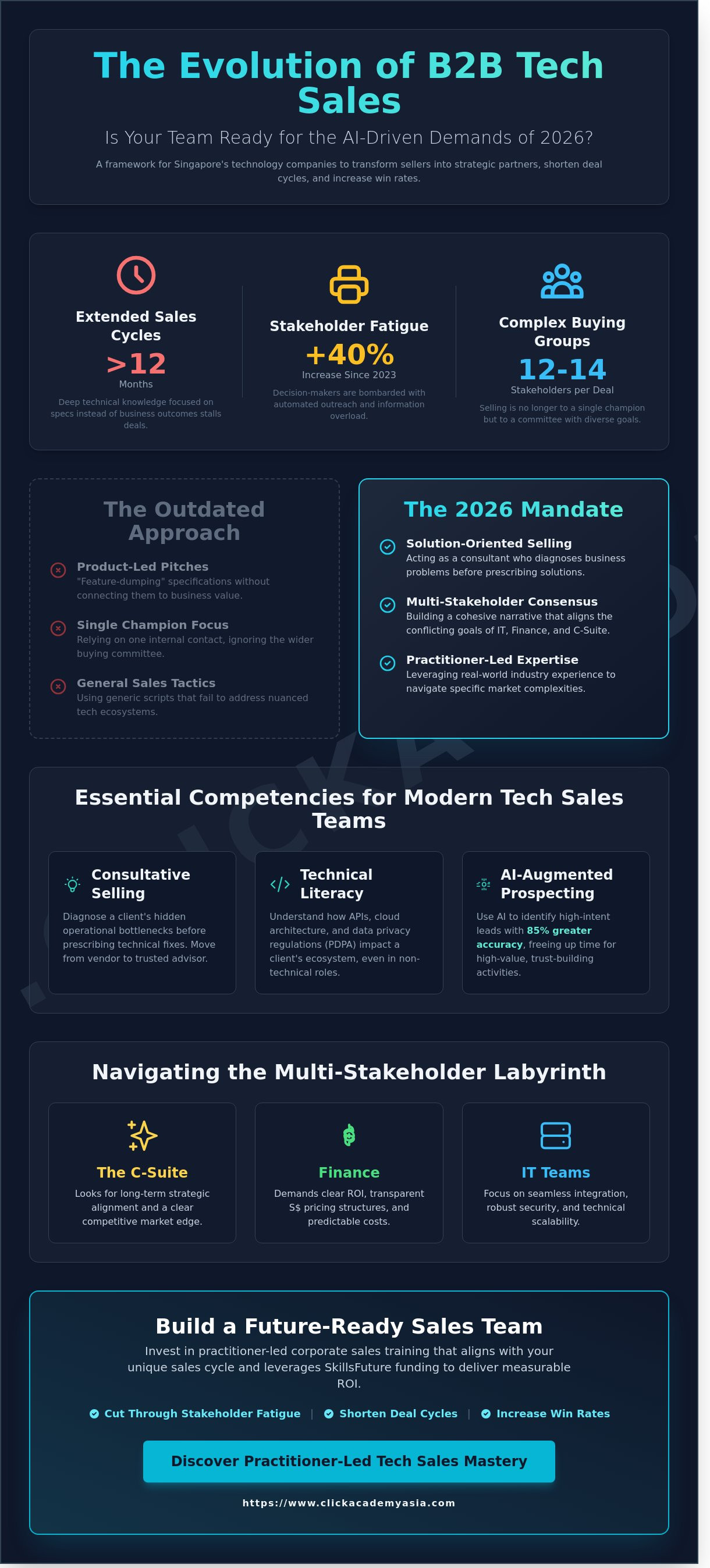
Selling technology in 2026 requires a radical departure from the "feature-dump" methods of the past. Your clients aren't just buying software; they're investing in specific business outcomes and long-term stability. This shift toward solution-led selling means your team must act as strategic consultants who understand a client's vertical as deeply as their own product. Investing in corporate sales training for technology companies is no longer a luxury but a survival tactic in a market where 75% of buyers now prefer a rep-free experience unless the salesperson adds genuine strategic value.
To better understand how these dynamics are shifting, watch this helpful video on modern tech sales strategies:
The tech sector in Singapore faces unique hurdles in 2026, primarily driven by extreme information overload. Decision-makers are bombarded with automated outreach, leading to a 40% increase in stakeholder fatigue compared to 2023. Traditional sales scripts fail because they can't adapt to the nuanced requirements of complex cloud or hardware ecosystems. To stay relevant, companies are adopting Sales process engineering to build more systematic, data-backed workflows that respect the buyer's journey.
AI-Augmented Prospecting and Digital Empathy
AI isn't here to replace your top performers; it's here to give them "superpowers." In 2026, the most successful teams use AI to handle the heavy lifting of data analysis while humans focus on building trust. We call this digital empathy. It's the ability to use data signals to anticipate a client’s specific pain points before they even articulate them. AI-driven insights shorten the initial prospecting phase by identifying high-intent leads with 85% greater accuracy than manual methods.
By leveraging these tools, your team can spend more time on high-value activities. This approach ensures that every interaction feels personalised and timely rather than robotic. If you're looking to upskill your team in these modern methodologies, ClickAcademy Asia provides practitioner-led programmes designed for the Singapore market.
Managing Multi-Stakeholder Enterprise Procurement
The days of winning a deal through a single champion are over. By 2026, the average enterprise tech deal involves 12 to 14 different stakeholders. You're not just selling to the CTO; you're selling to Finance, Legal, and end-users across various departments. Each group has conflicting goals that you must reconcile to reach a consensus. Without a future-ready workforce that can bridge these gaps, even the most innovative products will stall in the procurement pipeline.
IT Teams: Focus on integration, security, and technical scalability.
Finance: Demand clear ROI and transparent S$ pricing structures.
C-Suite: Look for long-term strategic alignment and market edge.
Effective corporate sales training for technology companies focuses on consensus-building techniques. It teaches reps how to align these diverse objectives into a single, cohesive narrative. Maintaining a competitive edge in Singapore's fast-moving market requires a team that can navigate these complex internal politics with confidence and clarity.
Key Competencies for Modern Technology Sales Teams
Tech sales in Singapore is evolving at a breakneck pace. By 2026, the distinction between a simple vendor and a strategic partner will be defined by a team's ability to move beyond "feature-dumping." Successful corporate sales training for technology companies now prioritises consultative selling. This approach requires reps to act as business consultants who diagnose problems before prescribing technical fixes. Instead of reciting a list of specifications, your team must ask probing questions that reveal a client's hidden operational bottlenecks.
Technical literacy is no longer optional for non-technical roles. Business Development Managers must understand how APIs, cloud architecture, and data privacy regulations like the PDPA impact a client's ecosystem. A 2023 LinkedIn Global Talent Trends report indicated that sales professionals with high technical aptitude close deals 15% faster than their peers. This knowledge builds immediate rapport with CTOs and IT managers who have little patience for vague marketing promises.
Data-driven storytelling is the final piece of the 2026 skill set. You cannot simply claim that a software suite improves productivity. You must prove it. Effective storytelling uses concrete numbers to demonstrate business impact. For example, show how a specific automation tool reduced manual data entry by 30% for a local SME, saving them S$4,500 in monthly labour costs. This level of precision transforms a sales pitch into a compelling business case.
Mastering Complex Software and Hardware Solutions
Modern sales teams must assess how new solutions integrate with a client's legacy infrastructure. This involves designing modular offerings that allow companies to scale at their own pace. When presenting these solutions, always link a technical feature to a specific efficiency gain. If you are selling a cybersecurity upgrade, don't just talk about encryption; explain how it prevents a data breach that could cost a Singaporean firm upwards of S$1 million in fines and lost trust. To stay ahead, consider enrolling your team in practitioner-led sales programmes that focus on these real-world applications.
Advanced Negotiation for Premium Tech Offerings
Selling premium technology requires a shift in how you handle price objections. Instead of offering discounts, focus on demonstrating long-term ROI. If a software contract costs S$120,000, your negotiation should highlight how the system generates S$600,000 in value over three years through cost savings and revenue growth. Mastering procurement-specific tactics is also vital. Dealing with procurement departments in large MNCs or Singapore government agencies requires a deep understanding of contract lifecycle management and compliance. Use customised use cases to show that your premium pricing reflects a lower total cost of ownership over time. Effective corporate sales training for technology companies ensures your team can defend margins by proving that the cheapest option is rarely the most cost-effective one.
Choosing the Right Training Partner: A Decision Framework
Selecting a partner for corporate sales training for technology companies isn't just a box-ticking exercise for HR. It's a strategic investment that should yield measurable returns, such as a 15% increase in average deal size or a 20% reduction in sales cycle length. You need a provider that understands the friction points of a technical sale, from navigating procurement hurdles to convincing a sceptical CTO. A top-tier partner must offer more than just a workshop; they should provide a framework for post-training evaluation and long-term support to ensure new habits actually stick.
The gold standard in this industry is practitioner-led instruction. This means your sales team learns from someone who has actually closed high-value tech contracts, not a career academic who relies on outdated textbooks. When you evaluate providers, look for those who can demonstrate a track record of success within the last 24 months. This ensures their tactics are relevant to the current B2B landscape, where buyers are more informed and less patient than ever before.
Assessing Practitioner Experience vs. Theoretical Coaching
Your trainers must have real-world experience in the technology sector to be credible. Tech sales are unique because they often involve selling a "future state" or a complex solution rather than a physical product. Ask providers specific questions: "What was the last S$200,000 SaaS deal your trainer closed?" or "How do they handle technical objections during a proof-of-concept phase?" If they can't answer with specifics, they're likely teaching theory.
The value of role-plays depends entirely on their realism. Instead of generic scenarios, insist on role-plays based on actual B2B tech situations, such as pitching a cloud migration strategy to a risk-averse financial director in Singapore. This practical application allows your team to fail in a safe environment before they step into a high-stakes meeting.
Regional Adaptability Across Asian Markets
Singapore serves as a primary hub for tech giants, but your sales team likely handles accounts across Malaysia, Indonesia, and beyond. Understanding cultural nuances is vital for regional business development. A strategy that works in a direct Singaporean boardroom might need significant adjustment to build trust in a more relationship-driven Malaysian context. You cannot rely on a "one-size-fits-all" Western curriculum for these diverse markets.
Partnering with a provider like ClickAcademy Asia gives your team a distinct advantage. Their regional reach across 30 countries ensures that the corporate sales training for technology companies they provide is grounded in local market realities. They help your sales professionals master the art of regional negotiation, ensuring your tech solutions resonate whether you're selling in downtown Kuala Lumpur or the suburbs of Manila.
Strategic Implementation and SkillsFuture Funding
Executing corporate sales training for technology companies shouldn't mean pausing your revenue engine. A staggered rollout ensures your team stays active while upskilling. You can schedule sessions during traditionally slower periods, such as the start of Q1, to avoid clashing with end-of-quarter surges. This phased approach allows sales reps to apply new techniques to live deals immediately, turning the classroom into a real-world laboratory.
Effective training must mirror your specific sales cycle. If your average deal takes nine months to close, a one-day workshop won't suffice. We align modules with critical milestones like technical discovery or stakeholder consensus building. Leadership plays the most vital role here. When managers reinforce these new behaviours during weekly pipeline reviews, the adoption rate of new skills can increase by up to 70% compared to teams without active management involvement.
Navigating SSG and WSQ Subsidy Frameworks
Understanding the difference between SkillsFuture Singapore (SSG) and the Workforce Skills Qualifications (WSQ) is essential for budget optimisation. SSG is the statutory board that oversees the funding, while WSQ is the national credential system that ensures training meets industry standards. Companies can often access subsidies covering a significant portion of course fees for eligible employees. The co-payment mechanism is straightforward; your firm pays the net fee after the grant is applied, which significantly reduces the upfront financial burden for corporate sales training for technology companies.
Measuring Long-Term Sales Performance Gains
Success isn't measured by a completion certificate. You need to track KPIs like lead-to-opportunity conversion rates and average contract value. A 2023 industry benchmark suggests that high-performing tech sales teams see a 15% increase in win rates within six months of targeted training. Additionally, measure technology implementation satisfaction. If your team is better at explaining complex SaaS features, your customer churn rates should logically decrease as clients better understand the product's value. Using a CRM to tag deals influenced by new training methods allows for clear ROI reporting.
Ready to transform your team's performance with practitioner-led insights? Explore our corporate sales training solutions to get started today.
ClickAcademy Asia: Practitioner-Led Tech Sales Mastery
The "Tech Sales Domination" programme isn't just another workshop; it's the definitive 2026 solution for high-growth firms. We've built this curriculum to address the specific challenges of the Singapore market, where the sales cycle for complex software often exceeds six months. Most corporate sales training for technology companies relies on outdated playbooks that don't account for the modern buyer's journey. We change that by blending high-level sales strategy with deep digital marketing expertise.
Our approach focuses on empowering your team to act as consultants rather than just vendors. This shift in mindset is essential for teams looking to secure long-term contracts in an increasingly competitive regional environment. By training with us, your staff won't just learn how to pitch; they'll learn how to lead the conversation from the first touchpoint to the final signature.
The Tech Sales Domination Curriculum
We've designed our modules to cover the entire lifecycle of an enterprise deal. Your team will master everything from navigating complex IT procurement processes to executing premium negotiation tactics that protect your margins. We place a heavy emphasis on ROI measurement, ensuring every sales activity translates into a measurable business outcome for your clients. Key focus areas include:
Enterprise IT Sales: Mapping stakeholders and identifying the real decision-makers in multi-layered organisations.
Account Load Management: Strategies to maintain high-touch service without burning out your top performers.
Premium Negotiation: Moving away from price-based competition to value-based closing.
To ensure your team has a holistic view of the funnel, we recommend pairing this training with our WSQ Digital Marketing Strategy & Planning pillar. This creates a unified front where sales and marketing speak the same language, drastically reducing friction in your lead hand-off process.
Why Global Tech Leaders Choose ClickAcademy Asia
Global giants like Google and Meta partner with us because we don't do "fluff." Every session is practitioner-led, meaning your instructors are experts who currently manage multi-million dollar pipelines across Asia. We focus on practical application, giving your team tools they can use the very next day to improve their conversion rates. This isn't academic theory; it's a results-driven framework designed for the fast-moving tech sector.
By choosing ClickAcademy Asia, you're investing in industry-recognised certifications that future-proof your workforce. Our training is aligned with the latest SSG and WSQ standards, ensuring your team meets the highest professional benchmarks in Singapore. If you're ready to scale your revenue and build a world-class sales engine, contact us to customise your corporate sales training today. Let's work together to transform your sales team into a powerhouse of digital-age expertise.
Master the Future of Tech Sales Excellence
Navigating the 2026 sales landscape requires more than just traditional tactics; it demands a shift toward deep technical empathy and data-driven decision making. By prioritising practitioner-led corporate sales training for technology companies, your team can bridge the gap between product features and strategic business value. Don't forget that Singapore-based firms can significantly reduce investment hurdles by leveraging available SSG and SkillsFuture funding to subsidise high-impact learning programmes.
Choosing a partner with a regional presence in over 30 countries ensures your sales strategy remains consistent across global markets. As an official Google and Meta training partner, ClickAcademy Asia delivers expertise grounded in real-world application rather than abstract theory. Our industry veterans provide the practical frameworks needed to accelerate your revenue growth and outpace the competition in an increasingly complex digital economy.
Empower your team with practitioner-led sales training at ClickAcademy Asia
The road to 2026 is paved with opportunity for those ready to adapt. We're here to help you lead that charge with confidence.
Frequently Asked Questions
How does corporate sales training for technology companies differ from general sales training?
Tech-specific training focuses on navigating complex, multi-stakeholder decision cycles that often last 6 to 12 months. Unlike general retail or commodity sales, technology sales require reps to translate dense technical specifications into clear business value for C-suite executives. Our curriculum emphasises solution selling and account management strategies tailored for high-value contracts and intricate software ecosystems.
Can our company use SkillsFuture credits or SSG subsidies for sales training in 2026?
Yes, Singaporean companies can leverage various SSG subsidies and the SkillsFuture Enterprise Credit (SFEC) for eligible programmes. Many of our practitioner-led courses qualify for SSG funding, which can cover a significant portion of the course fees for Singapore Citizens and Permanent Residents. You should check the latest 2026 grant levels on the Enterprise Singapore portal to maximise your S$10,000 credit limit.
What is the ideal duration for a corporate tech sales bootcamp?
The most effective format is a 2 to 3 day intensive workshop followed by structured reinforcement sessions over 4 weeks. Research suggests that sales reps forget 70% of new information within 24 hours if it isn't applied immediately. We structure our bootcamps to include "micro-learning" touchpoints that ensure your team masters the material without spending too much time away from their active pipelines.
How do we ensure sales reps actually apply what they learn in the training?
We use live role-playing based on your actual client scenarios and provide post-training coaching frameworks for managers. Application happens when the training is grounded in real-world challenges rather than abstract theory. By using our practitioner-led approach, your team practices handling the exact objections they face in the Singapore market, making the transition from classroom to field seamless and immediate.
Is the training suitable for both software (SaaS) and hardware sales teams?
Our modules are designed to address the unique commercial logic of both SaaS recurring revenue models and hardware capital expenditure cycles. While SaaS teams focus on Monthly Recurring Revenue (MRR) and churn prevention, hardware teams often deal with longer supply chain lead times and lifecycle management. We bridge these gaps by focusing on the consultative relationship that sits at the heart of all technology transactions.
What qualifications should we look for in a professional sales trainer?
Prioritise trainers who have at least 10 years of documented success in the technology sector and hold industry-recognised certifications. A great trainer must be a practitioner who has personally closed multi-million dollar deals, not just a career academic. Look for mentors who understand the local Singapore business culture and have experience with global tech giants like Google or Meta to ensure your team learns global standards.
How does ClickAcademy Asia customise training for specific technology sectors?
We conduct a pre-training audit of your current sales process to ensure our corporate sales training for technology companies aligns with your specific niche. Whether you operate in Cybersecurity, Fintech, or Cloud Infrastructure, we adapt our case studies to reflect your actual products. This bespoke approach ensures that every framework we teach can be used by your reps the very next morning to accelerate their deal flow.
What is the ROI of professional sales training for B2B tech firms?
Industry benchmarks show that companies investing in structured sales training see a 10% to 20% increase in win rates within the first year. For B2B tech firms in Singapore, this often translates to a return of over S$4 for every dollar spent on development. Beyond direct revenue, you'll likely see a 15% reduction in sales staff turnover as reps feel more empowered and competent in their roles.


Comments